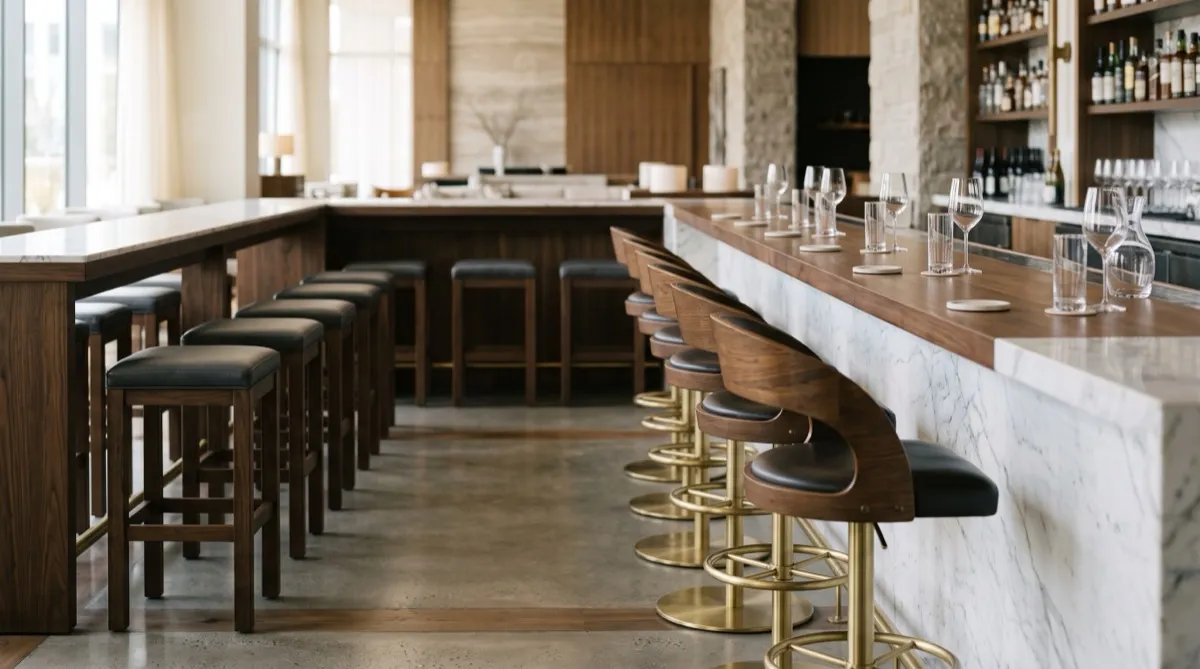
Swivel counter stools solve a real problem: guests turn to talk, to face a bartender, to get up without shoving the stool back into the walkway. That rotation is convenient right up until the mechanism that enables it starts to fail, and a swivel base failing at a busy counter is a maintenance call nobody wants to make mid-service.
The swivel itself is a moving part under constant load, and that is exactly what separates a counter stool built for commercial cycling from one built for occasional home use. Here is how to spec swivel counter stools that hold up.
What "commercial grade" means in a swivel mechanism
A swivel counter stool base has a bearing plate between the seat and the post that lets the seat rotate. In a residential stool, that bearing is often a light-duty ring rated for a few hundred rotations a year. In a busy restaurant or bar counter, a single stool can see thousands of rotation cycles a month, and the bearing has to be rated to match.
Look for a sealed ball-bearing swivel mechanism, not an exposed friction ring. Sealed bearings resist the grit, spilled liquid, and general debris that collects at floor level around a counter, all of which grinds into an exposed mechanism and wears it out early. Ask your supplier for the cycle rating on the swivel itself, not just the frame weight capacity, since those are two different specs and a stool can pass one while failing the other.
Memory-return swivels are worth the small added cost in most commercial settings. They return the seat to a forward-facing position after use, which keeps a counter looking orderly between guests and prevents stools from drifting into the walkway or blocking a neighboring seat. Non-memory swivels are fine for lounge or bar-back seating where orientation does not matter as much.

Fixed still wins in some layouts
Swivel is not the right answer everywhere. Fixed counter stools cost less, have fewer failure points, and are the better choice anywhere floor space is tight and rotation would put a stool into a walkway or another guest's space. Counter seating along a narrow bar rail, a coffee counter with tight stool spacing, or a quick-service counter where turnover speed matters more than comfort are all cases where a fixed stool is the more durable, lower-maintenance choice.
The general rule: swivel where guests linger and where the seat needs to face more than one direction over the course of a visit (a bar with a TV wall, a communal high-top, a lounge-adjacent counter). Fixed where the seating is transactional, tightly spaced, or outdoors, where a swivel mechanism adds a failure point with limited functional payoff.
Seat height and the counter it sits at
Counter-height seating generally runs 24 to 27 inches from floor to seat, paired with a counter around 34 to 36 inches high. Get this wrong and even the best swivel mechanism will not save the stool from feeling wrong to sit in. Measure your actual counter height before ordering rather than assuming a standard, since custom millwork counters vary more than manufactured ones.
Leave 10 to 12 inches of clearance between the seat and the underside of the counter for knee room, and space stools on 24 to 26 inch centers so guests are not shoulder to shoulder. A swivel stool needs a little extra clearance behind it compared to a fixed stool, since guests will rotate outward before standing.
Materials that pair with a swivel base
The base carries the mechanism, so it should be heavy-gauge steel, not aluminum or a lightweight tube frame. Weight in the base also improves stability, since a swivel seat under lateral pressure needs a base that will not tip or rock. Powder-coated steel resists the corrosion that comes from spilled drinks and regular wipe-downs at floor level.
Seat materials follow the same rules as any commercial counter seating: vinyl or performance fabric with a high Wyzenbeek rating for anywhere near a bar or kitchen pass, and a wipe-clean surface anywhere spills are routine. Padded seats improve comfort for longer-dwell counters like a hotel bar or lounge; a hard molded seat is fine and lower-maintenance for quick-turn counters like a coffee shop or fast-casual concept.
Ordering and lead time
Swivel counter stools are one of the categories where in-stock inventory moves fastest, since the mechanism and frame combinations are more standardized than fully custom lounge furniture. Custom fabric or finish orders still carry the typical factory-direct lead time, so confirm your timeline against stock availability before you commit to a custom spec on a tight opening date.
Multi-unit operators replacing stools across several locations should standardize the swivel spec across the whole portfolio rather than sourcing store by store. A single approved frame, bearing rating, and seat material means faster reorders when a stool fails at one location, and it means facilities teams can swap parts between sites without hunting down a discontinued mechanism. Keep a small stock of spare swivel plates on hand if you operate a high-traffic counter, since the bearing is the part most likely to need replacement first, long before the frame or upholstery show real wear.
Run your seating count and spacing through our furniture cost calculator to model the full order before you request pricing. For the full counter-stool category, our commercial barstool buying guide covers heights, frame grades, and sourcing across the whole line. Browse counter stools directly, or request a quote for a matched order across your full counter run.