The decision between backed and backless counter stools looks like a comfort question on the surface. It is really a floor plan and revenue question, and the answer changes depending on what kind of counter you're seating and how long you want guests sitting at it.
Here is how to think through the tradeoff properly, rather than defaulting to whichever style looks best in a showroom photo.
What a back actually buys you
A backed counter stool supports longer dwell times. Guests seated at a coffee bar, a wine counter, or a casual dining counter with no back tend to shift position and stand up sooner than guests with lumbar support behind them. If your concept wants people to linger, order another round, or work from a laptop at the counter, a back is doing real work toward that goal, not just adding to the bill of materials.
Backed stools also read as more finished and considered in a space where the counter is a visible design element rather than purely functional seating. A row of backless stools at a kitchen island or prep counter reads as utilitarian; the same row with backs reads as a designed seating area.
What backless buys you instead
Backless stools take up less floor footprint, both in their own width and in the clearance a guest needs to get in and out of the seat. That difference sounds small per stool, but across a long counter it compounds into meaningfully more seats in the same linear footage, or more circulation space around the same seat count.
Backless stools are also easier to tuck fully under a counter overhang when not in use, keeping walkways clear during off-peak hours or cleaning. And they carry one less component that can loosen, crack, or need repair over years of commercial cycling, since a stool back and its connection points are additional structure that eventually needs maintenance.
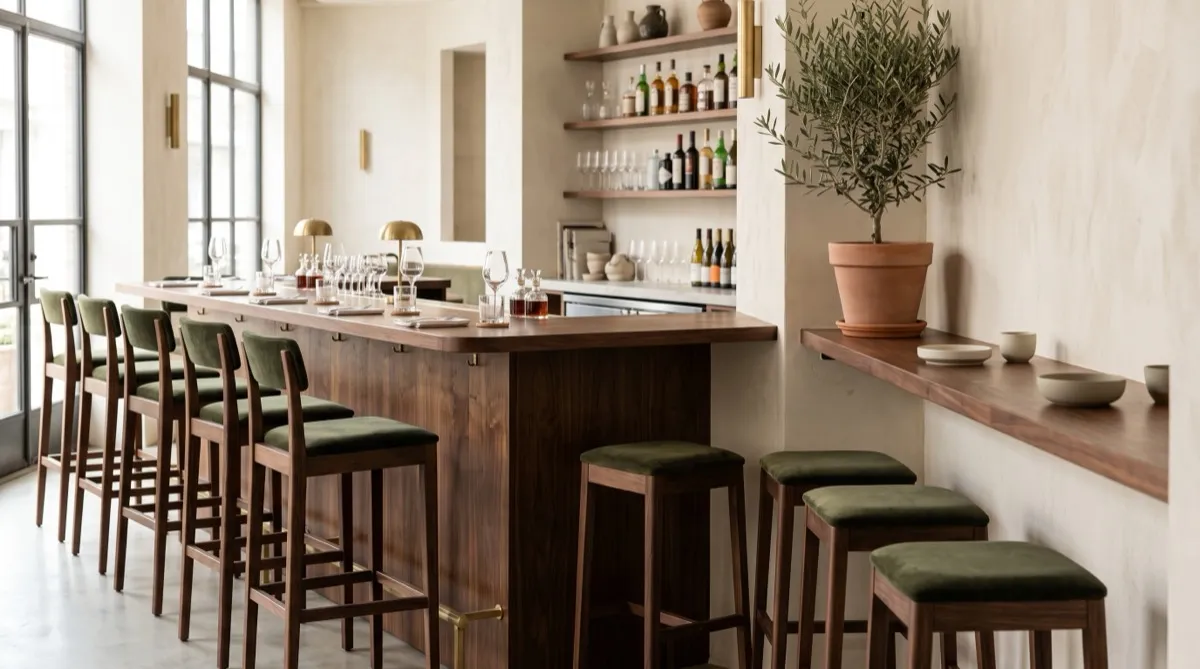
Matching the choice to your concept
Quick-service and grab-and-go counters favor backless. Turnover speed matters more than dwell comfort, and the extra seat density backless stools allow directly supports higher covers per hour during a rush.
Casual dining and bar counters where guests linger favor backed. If the average guest is at the counter for thirty minutes or more, comfort becomes a real factor in table turn and guest satisfaction, and a back earns its floor space back in repeat visits and check averages.
Hotel lobby bars and coffee counters often split the difference, using backed stools at the primary seating zone and backless at overflow or secondary counters where speed matters more.
Home-adjacent kitchen and prep island applications in a multifamily amenity space or model unit usually favor backed for the residential-adjacent comfort expectation, even though the space is still spec'd to commercial durability standards.
Sizing the tradeoff in real numbers
If you are working with a fixed counter length, run both configurations before deciding. A typical backless stool needs roughly 24 inches of width per seat on-center; a backed stool with arms or a wider back profile can need 26 to 28 inches depending on the design. On a twenty-foot counter, that difference can mean two to three additional seats with backless stools, which is a meaningful swing in a space where every seat counts toward revenue.
The right answer often isn't all one or the other. Many successful counter programs mix backed stools at the primary bar or dining counter with backless at a secondary or overflow area, matching the seating style to how each zone actually gets used rather than applying one spec to the whole floor.
Construction specs are the same either way
Whichever style you choose, the underlying construction standard should not change. Heavy-gauge welded steel frames, a reinforced footrest welded separately from the frame, and commercial-grade vinyl or performance fabric upholstery all apply equally to backed and backless stools. The back itself should be structurally integrated into the frame, not bolted on as a separate assembly, since a bolted-on back is the first thing to loosen and rattle under daily commercial cycling.
Run your seat count and spacing through our furniture cost calculator before finalizing either configuration, since the seat-count difference between backed and backless directly changes your total order size and delivered cost. For the full counter-stool category, our commercial barstool buying guide covers frame grades, heights, and materials across the line. Browse counter stools directly, or request a quote once you've settled on a configuration.
Style consistency across a mixed order
Operators who run both backed and backless stools in the same space should stay within one design family rather than mixing unrelated frame styles. Matching finish, leg profile, and upholstery color across both types keeps the counter reading as one cohesive design decision instead of two separate purchases stitched together. This matters most in open-concept spaces where the primary and overflow counters are visible from the same sightline, which is the common layout in a hotel lobby bar or a large casual dining floor.
Ask your supplier whether backed and backless versions of the same stool line share a frame family before you commit to a mixed order. Many manufacturers offer a matched pair, the same base and leg design with and without a back option, which solves the consistency problem without forcing you into two unrelated product lines. That also simplifies reordering down the line, since a broken or worn stool from either category can be replaced from the same supplier relationship rather than starting a new sourcing search for a discontinued style.
Confirm cushion depth and back height are proportional between the two versions as well. A backed stool with a noticeably shallower seat than its backless counterpart from the same line will feel inconsistent to guests moving between zones, even if neither stool is individually uncomfortable.