Counter stools sit in a strange spot in commercial furniture sourcing. They are not quite bar seating, since the height and use case are different, and they are not quite dining seating either, since the transaction at a counter is faster and more physical than at a table. Buyers who treat counter stools as a scaled-down barstool or an upsized dining chair usually end up specifying the wrong thing.
Check the selected counter-stool model's fit, footrest, joints, surface care and supply documents. A commercial label does not establish survival or a first-season failure forecast for an alternative.
The height window that matters most
Use the 34 to 36-inch counter and 24 to 27-inch seat ranges as starting fit examples, not proof that every pairing is correct. Across those endpoints, top-to-seat differences range from 7 to 12 inches. Measure the actual underside or lowest apron and the actual seat, then test thigh clearance and footrest reach for the intended users.
For the 40 to 42-inch bar and 28 to 30-inch seat examples, top-to-seat differences range from 10 to 14 inches before any top/apron deduction. Counter and bar labels do not replace exact measurements. Verify the chosen pair and the stool's seat/footrest dimensions together.
Measure the finished floor, top underside/apron and actual seat/footrest at each counter position. Half an inch versus two or three inches is a dimensional comparison example, not a universal user-sensitivity threshold. Test the paired sample with intended users rather than assuming every guest notices the same difference.
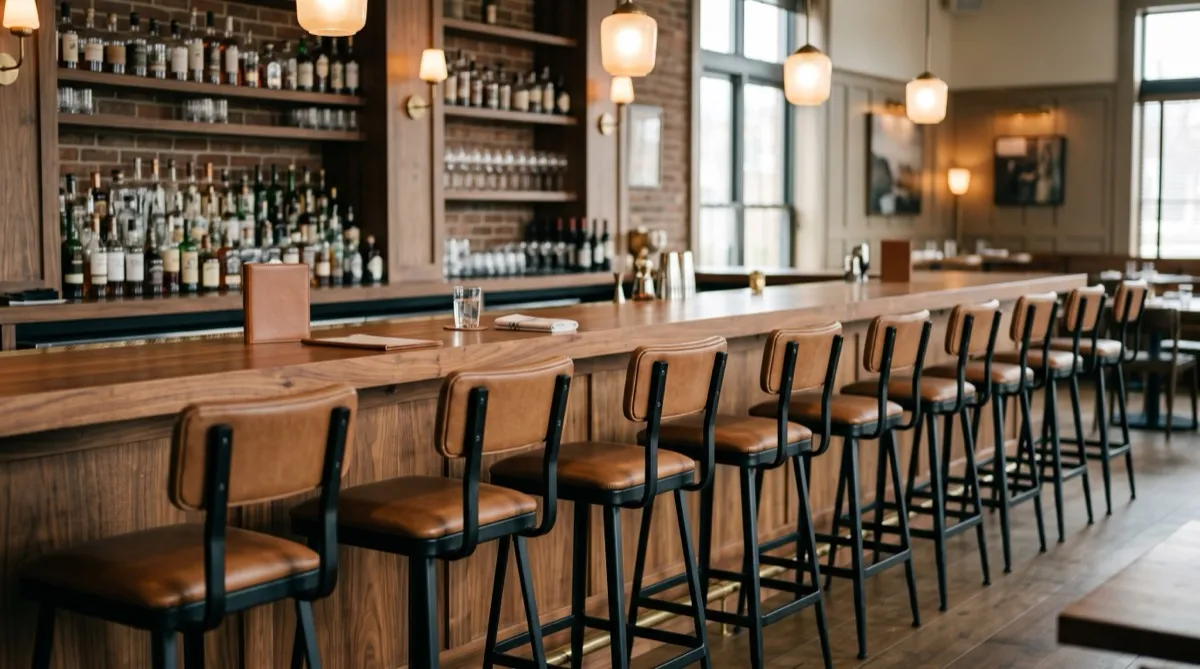
Frame construction: where cheap stools fail first
Inspect the footrest connection and obtain the maker's permitted footrest load, repeated-use tests and inspection instructions for the whole stool. The footrest may experience different loads from the seat; a separate weld or bent-tube construction alone does not establish which model outlasts another.
Ask for tube dimensions/material, joint construction and actual assembly testing. Welded, bolted and cam-lock connections must be assessed as selected models; their labels alone do not establish a months-to-loosening forecast or distinguish every commercial and residential stool.
Seat material for a service environment
Vinyl and high-Wyzenbeek performance fabric are the standard choices for counter seating near any kitchen, bar, or food service area. Both wipe clean quickly between guests, which matters for turnover speed, and both resist the spills and grease that are routine in a service environment. Save natural fabric and softer materials for lounge-adjacent counter seating that sees less direct food and beverage contact.
Padded seats improve comfort for counters where guests linger, like a hotel lobby bar or a wine counter. Molded or lightly padded hard seats are the better choice for quick-turn environments like a coffee counter or fast-casual concept, where lower maintenance and faster cleaning matter more than extended dwell comfort.
Base style: fixed, swivel, or backless
Compare the exact fixed/swivel mechanism's load, repeated-use, replacement-part and care documents with its full occupied/rotated envelope. A fixed base does not automatically mean lower cost or fewer failures. Test both approved options in the actual counter layout.
Backs improve dwell comfort but take more linear footage per seat than backless stools, which changes your total seat count on a fixed counter length. None of these are universally right; the correct combination depends on your concept, your counter length, and how long you expect guests to actually sit.
Outdoor and material considerations
For an outdoor counter, obtain the exact stool's exposure, coating, hardware, care and stability documents. Aluminum does not develop iron rust, but neither an aluminum frame nor powder coat alone establishes corrosion or UV immunity. Verify the whole approved outdoor assembly rather than inferring suitability from the photo.
Sourcing and minimums
Treat twenty units and ten to fourteen weeks as provisional minimum-quantity and custom-schedule inputs. Confirm the exact model's actual minimums, custom options, stock availability, approvals, production and delivery dates with the supplier before committing to the opening schedule.
Where layouts allow, retain one approved model/finish record across locations to simplify specification comparison. Standardization does not guarantee faster reorders, future matching or a volume discount. Confirm current parts, model availability, lot/finish terms and separate delivered quotes for each actual site.
Use your approved seat count and chosen cost inputs in the furniture cost calculator, then obtain itemized supplier freight and quantity pricing. The barstool buying guide covers related measurement questions. Browse counter-stool concepts for style references and submit a furniture request with actual top/underside heights and the tested layout for independent suppliers to confirm real models.
Compare backs, metal frames, and swivels
Backed stools suit longer stays but need room behind the counter. Backless stools may tuck farther underneath; check the actual frame and counter together. A swivel needs clearance through its full rotation, not just when facing forward. Ask for the mechanism's rating, replacement part availability, and whether a return mechanism is included.
On metal frames, inspect welds, footrest connections, finish coverage, and replaceable floor glides. Keep the approved frame and mechanism codes with the order so replacement parts and additional stools can be matched later.
Related reading
- Counter Stools With Backs Guide
- Swivel Counter Stools Guide
- Metal Counter Stools Guide