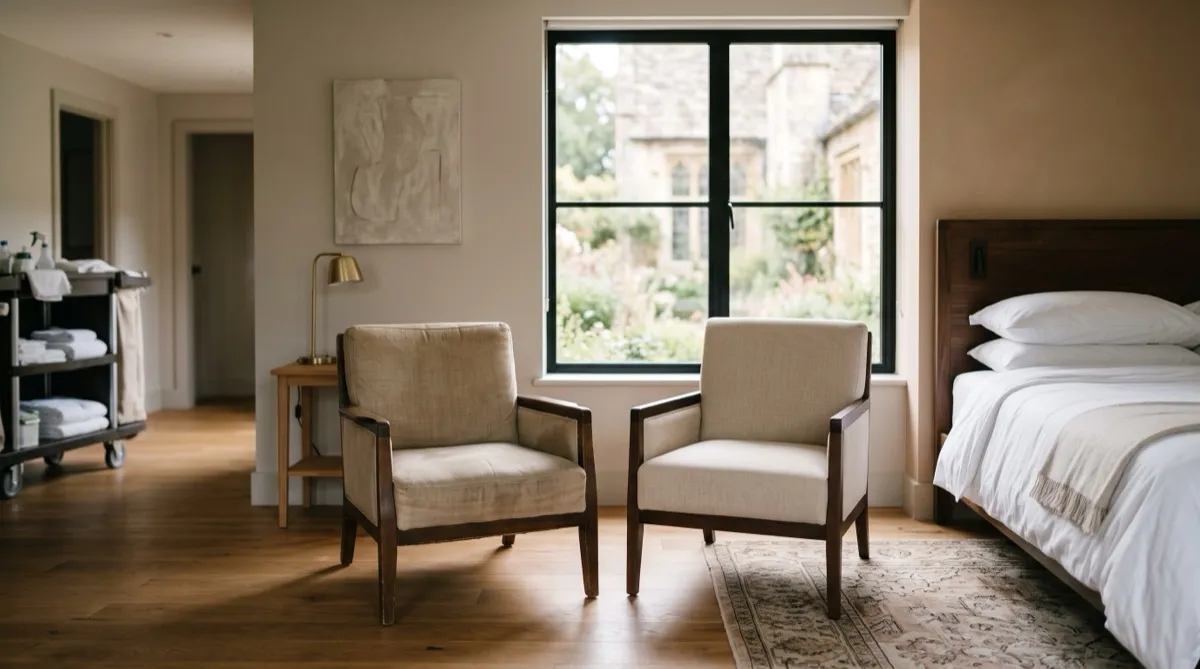
Senior living FF&E covers the dining chairs, lounge seating, occasional tables, and casegoods inside independent living, assisted living, and memory care communities, the furniture residents sit in and gather around every day rather than for a two night stay. It shares product types with hotel FF&E, a well built lounge armchair does similar work in a resident lounge as it does in a hotel lobby, but the procurement program around it runs on a different clock, because the building stays occupied by the same people for years and a refurbishment has to work around residents' routines instead of an empty room waiting for a ribbon cutting.
What makes senior living FF&E different from a hotel program?
The biggest difference is who is in the room when the work happens. A hotel renovation empties a wing between guest stays and finishes before the next booking. A senior living refurbishment happens around residents who live there, some with limited mobility and a real reliance on a predictable layout to navigate a dining room or hallway safely. That changes the sequencing question from how fast a space can turn over to how the work gets done without disorienting the people who depend on that space every day.
Dwell time is different too. A hotel guest sits in a lobby chair for twenty minutes waiting for a car. A resident may sit in the same chair for an hour at a time, several times a day, for years. That longer, repeated dwell time is a real input into the spec, but the detailed selection call on frame and cushion belongs with your design team and the community's clinical staff, not this piece. What belongs here is making sure that requirement gets written into the program's spec sheet before the RFP goes out, not discovered after delivery.
Building licensing and infection control requirements into the spec
Most licensed care settings carry cleanability and infection control expectations that go beyond a typical hospitality upholstery standard, and those expectations need to live in the procurement spec from day one rather than surface as a change order during installation. Confirm your state's specific requirements for fire retardancy and cleanable upholstery with the community's licensing consultant, then write that standard directly into the RFP language so every bidder is quoting against the same cleanability floor. Our FF&E spec sheets guide covers building that level of detail into a spec document that actually holds up through bidding.
Phasing a refurbishment without disrupting residents
Wing by wing or floor by floor phasing is standard practice in occupied senior living work, and the schedule usually follows the community's own rhythm rather than a generic construction calendar. Common areas often move on off hours, early morning before breakfast service or late evening after the activities calendar wraps, so residents experience a swapped chair rather than a disrupted routine. Dining rooms are frequently the hardest room in the building to phase, since a community typically runs three meal services a day and cannot lose the room for an extended install window the way a restaurant can during a slow season.
A detailed installation plan, sequenced by area with clear handoff points between old furniture removal and new furniture placement, keeps a phased program from sprawling past its window. Our FF&E installation and project management guide covers building that sequencing in detail for occupied buildings generally, and the same discipline applies directly here.
Dining room and common area turnover cycles
Contact frequency drives wear the same way it does in a hotel, but the pattern looks different. A senior living dining chair sees three structured seatings a day, every day, from the same rotating group of residents, a more predictable but also more concentrated wear pattern than a hotel restaurant's variable cover count. Resident lounges and activity rooms see lower turnover per piece than dining but longer individual dwell time, which shows up as cushion and mechanism wear before frame wear. Our hotel FF&E replacement cycles breakdown is a useful comparison point even though the underlying numbers shift for a residential population, the logic of tracking wear by zone rather than one property wide schedule carries over directly.
Lounge seating in armchairs sees the heaviest and most concentrated use of any category in a senior living community, since residents return to the same chairs daily rather than distributing wear across a larger transient population. That concentration is worth building into your replacement reserve math rather than assuming a lounge chair will wear at hotel lobby rates.
Budgeting a phased FF&E program across multiple communities
Operators running a portfolio of communities benefit from a standardized spec across properties, one approved chair frame, one approved fabric performance standard, rather than a fresh selection process at every location. That standardization speeds up the RFP at each community and gives volume leverage across the portfolio when quantities are combined rather than bid separately site by site. Use the FF&E budget calculator to model a phased program across multiple wings or communities and see how sequencing the spend across budget years compares to a single large refurbishment push.
Getting timeline and RFP structure right for occupied-building work
An occupied building FF&E program needs more lead time built into the schedule than an empty new build, since phasing around residents stretches the install window even when the order itself ships on a normal production timeline. Our FF&E procurement process resources walk through the full workflow from spec through installation, and the FF&E procurement timeline guide is worth reviewing specifically for how far in advance to start when your install window has to work around a live population rather than an empty building.
Share your community's zones, resident population, and target phasing with us and request a quote to see how a program built around volume pricing and a licensing appropriate spec compares to sourcing site by site.