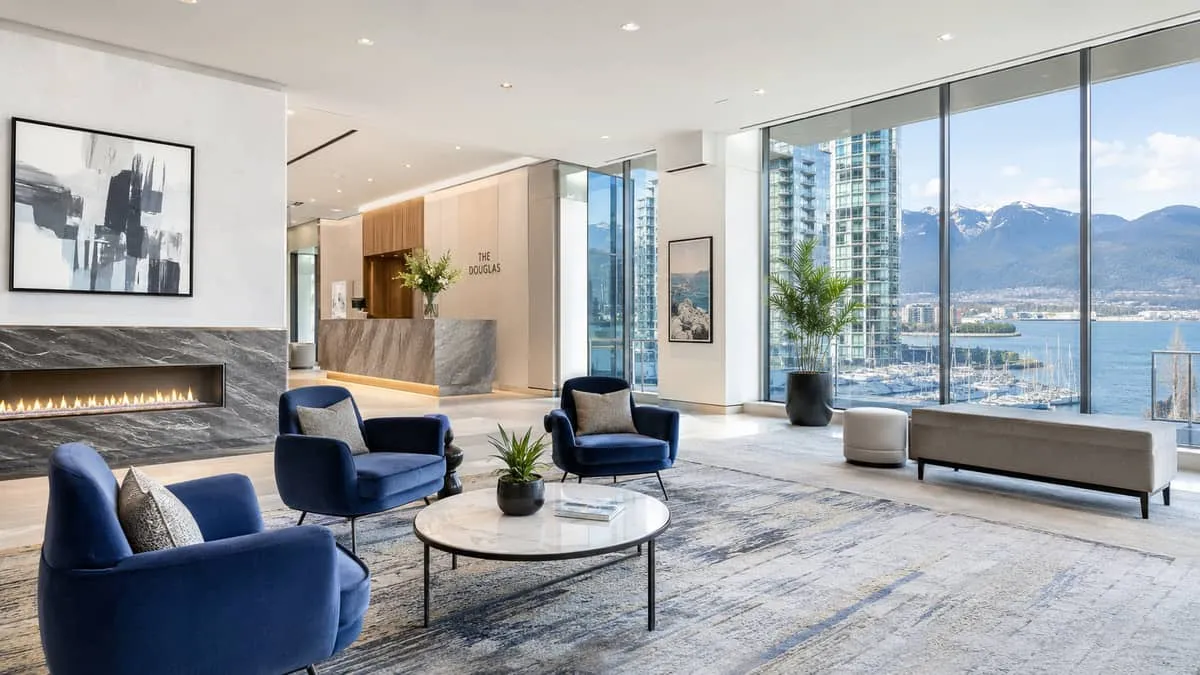
A guest steps off a fourteen-hour flight from Seoul or Tokyo, clears customs at YVR, and forty minutes later walks through the front door of a Coal Harbour boutique hotel. They have just come from cities where lobby design is treated as seriously as architecture. They are paying $400 a night or more. They have stayed at Ace Hotels, at Andaz properties, at boutique hotels in Shibuya and Gangnam. And in the first thirty seconds, before anyone has said hello, before they reach the front desk, their eyes sweep the lobby and they form an impression.
That is the specific pressure Vancouver hotel operators are working against. This is the highest average daily rate hotel market in Canada, serving some of the most design-literate international travelers in the world. In that context, lobby furniture is not a finishing touch. It is a brand statement, made in silence, the moment a guest arrives.
The Asia-Pacific Gateway Problem
Vancouver's competitive position as Canada's primary Asia-Pacific gateway shapes everything about its hospitality market. The city is not just competing with Toronto or Montreal for luxury hotel guests. It is competing with Hong Kong, Singapore, and Seoul for the same high-value traveler who passes through multiple times a year on business or leisure.
That traveler notices detail. They notice when a lobby sofa has gone soft in the cushions, when the upholstery on a reception chair has started to pill at the armrests, when furniture that was clearly bought to fill a space rather than define one. In markets where the quality bar is set by properties like the Fairmont Pacific Rim , where the Coal Harbour waterfront lobby uses materiality to communicate something specific about place and premium , anything that reads as an afterthought registers as exactly that.
Hotel lobby furniture Vancouver boutique operators choose needs to operate at two levels simultaneously: it must perform under relentless physical demand, and it must communicate something true about the property's identity to guests who have an extremely well-developed eye.
Three District Identities, Three Design Languages
Vancouver's hospitality market is concentrated across three distinct districts, and each carries an aesthetic logic that competent furniture specification has to work with, not against.
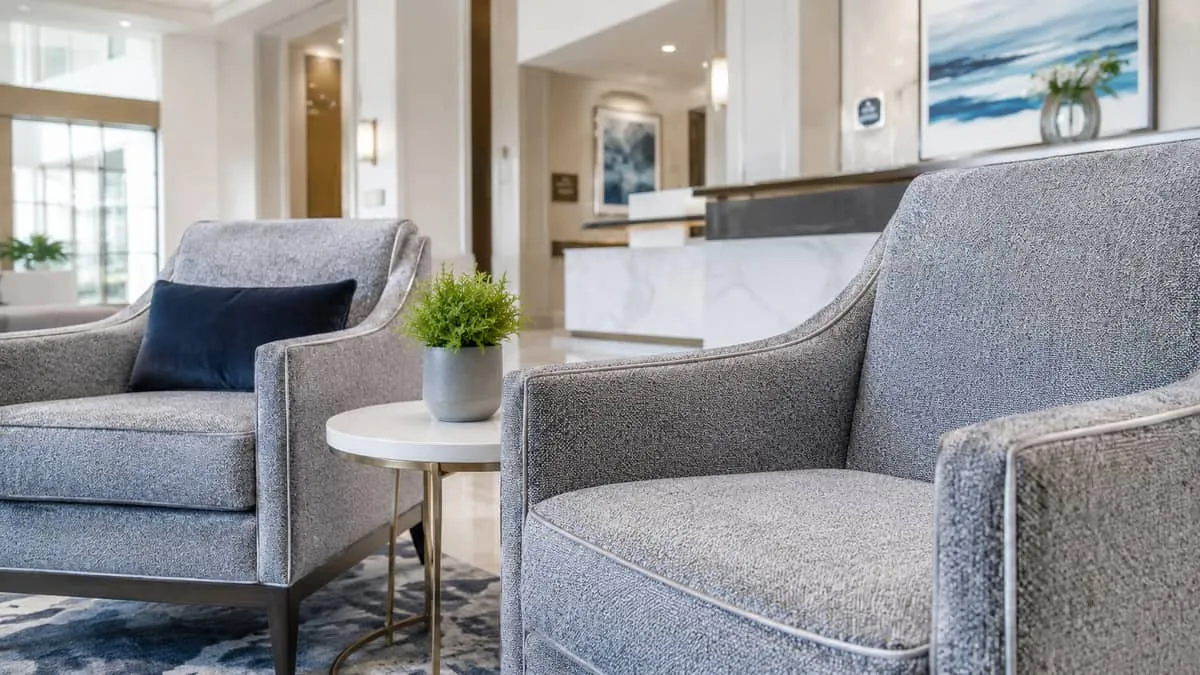
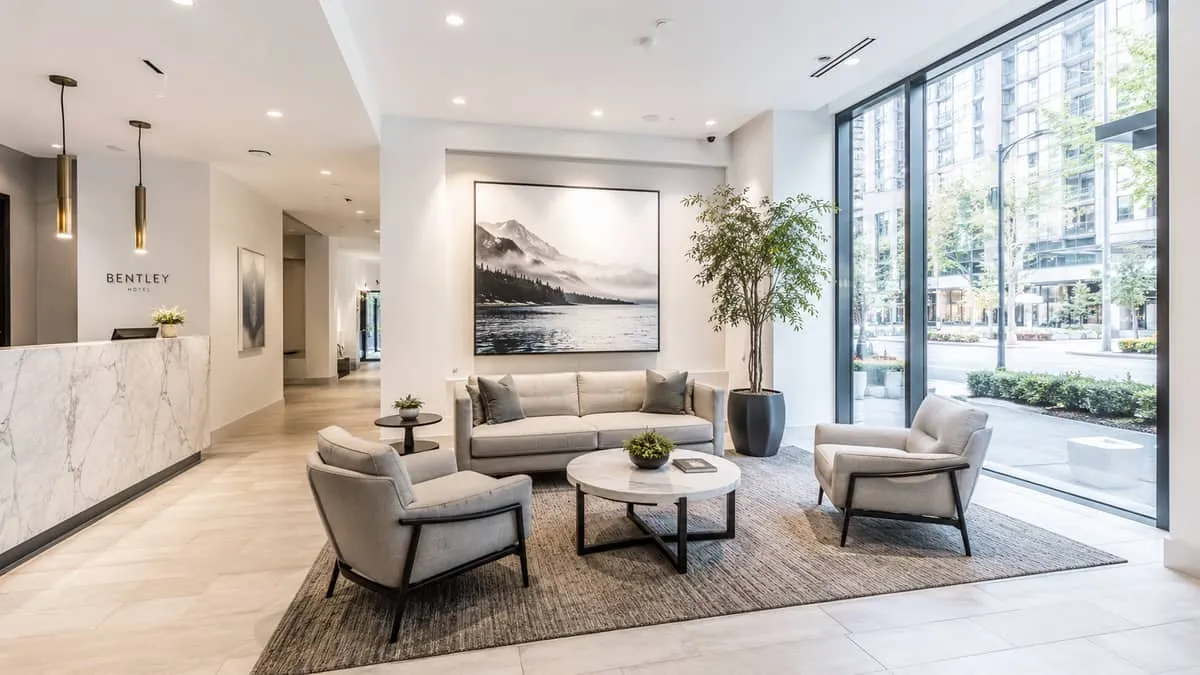
Coal Harbour properties sit at the intersection of waterfront luxury and Pacific Rim ambition. The materiality here leans toward cool neutrals, stone references, and furniture with clean silhouettes and a certain restraint. Pieces that read as heavy or maximalist compete with the view and the architecture. The guest arriving at a Coal Harbour hotel has often just come through the seaplane terminal or up from the cruise ship docks. They are looking for calm and quality. Furniture that delivers both , a deep lounge chair with a subtle curved back, upholstered in a textured wool-blend fabric in a slate or warm white , does the right work. Furniture that tries too hard to impress does not.
Gastown is operating on a different register entirely. The heritage brick warehouses, the exposed timber beams, the cobblestone streets: properties in this neighborhood have a material richness built into the architecture that the furniture needs to respond to rather than override. Leather-accented seating, warm wood tones in side table bases, upholstery in tobacco, cognac, or deep teal that feels like a deliberate choice within the space , this is the design language that reads as authentic here. Gastown boutiques compete on character, and the lobby has to deliver that character immediately. A contemporary metal-and-fabric piece that would feel right in Yaletown tends to look like it arrived in the wrong building in Gastown.
Yaletown has matured into a clean-lined contemporary market. The tech and creative industry clientele that books here expects the lobby to feel curated in a way that leans into a specific visual point of view , minimalism with warmth, not coldness. Furniture with lower profiles, neutral palettes that still have texture depth, and pieces that photograph well for the Instagram posts that happen in hotel lobbies constantly now. For Yaletown, the chair that says something through the precision of its construction is more effective than the chair that tries to say something through detail.
What Vancouver's Rain Actually Costs You
Vancouver's mild, rainy climate is a genuine durability variable that hotel operators in this market deal with differently than operators in Calgary or Toronto. The city has more overcast, wet days than almost anywhere in Canada. Guests are walking in from October through May with damp coats, wet boots, and the general moisture load of a city that averages 1,150 millimeters of rain annually.
For lobby furniture, that has specific practical implications. Upholstery needs to be specified for moisture resistance from day one. Performance textiles with stain-resistant and moisture-resistant treatments are not optional upgrades in this climate , they are baseline requirements. Fabric that is not rated for this kind of regular damp contact will show degradation in the upholstery surface, in the foam underneath, and in the frame joinery, well ahead of what you would see in a drier market.
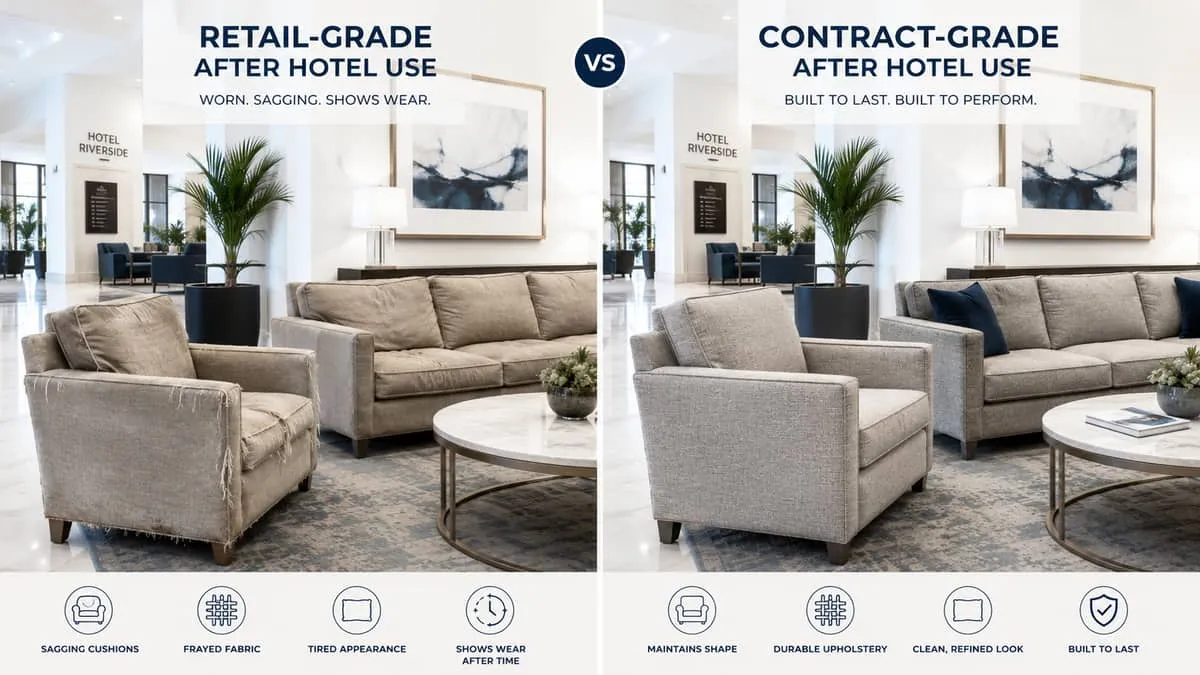
Contract-grade upholstery rated at 100,000 double rubs or higher is the standard spec for high-traffic hotel lobby seating, but the rating system alone does not capture the moisture variable. Ask your supplier specifically about performance textile options designed for wet-contact environments. In a busy Vancouver hotel lobby, the combination of heavy traffic and regular moisture exposure will stress retail-grade furniture significantly faster than either factor alone.
Frame construction matters here for the same reason. Solid hardwood or steel frames with reinforced joinery handle the repeated stress of guests coming and going in wet conditions. Particleboard frames absorb moisture and degrade from the inside. If a piece is going to be repositioned for film industry block bookings , and Vancouver's hotel market sees a significant volume of long-stay film production reservations that often require lobby furniture rearrangement for production meetings and equipment staging , you need joinery that handles repeated movement without loosening.
The Arrival Moment and What It Actually Communicates
There is a specific choreography to the hotel arrival experience that furniture design is a direct participant in. When a guest walks through the front door of a Vancouver boutique hotel, they are processing the space in a sequence that furniture placement either supports or disrupts.
The primary seating cluster , the anchor lounge chairs, the sofa if there is one, the side tables , tells them something about how the hotel understands its own identity within the first sweep of the room. Furniture that is scaled correctly to the ceiling height and square footage of the space reads as confident. Furniture that is too small for the room looks like it was budgeted as an afterthought. Furniture that overwhelms the space creates a pressure that works against the arrival experience you are trying to deliver.
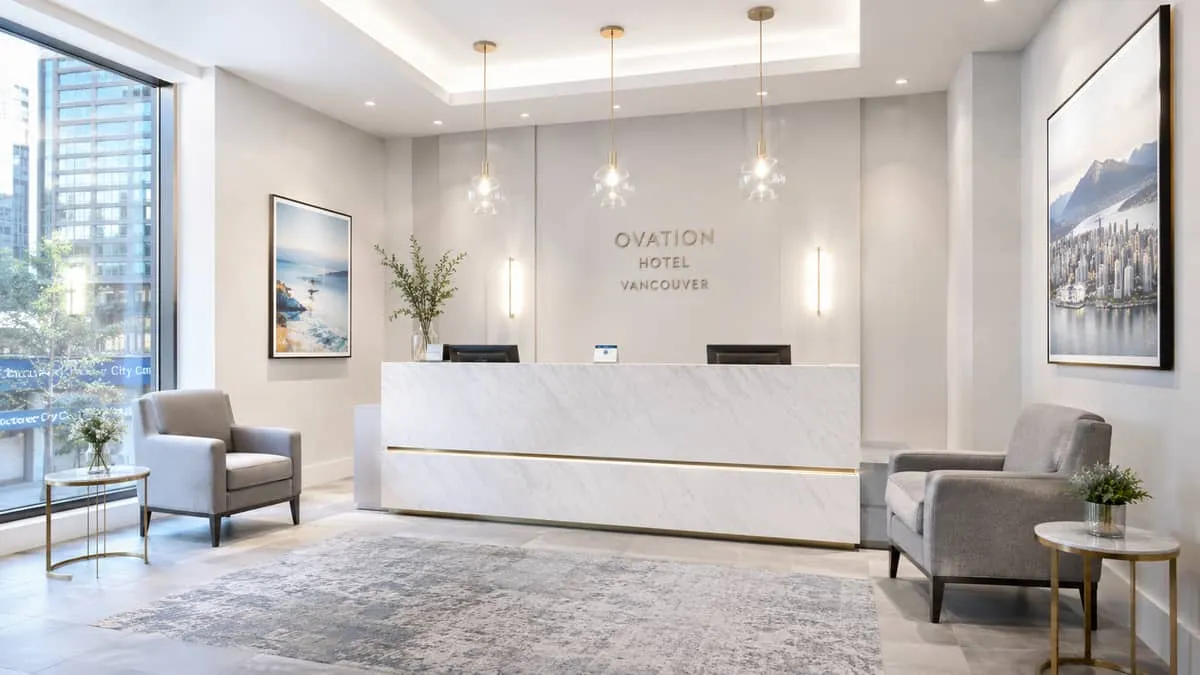
Reception area chairs have a different brief. They need to be comfortable for a short sit , five to fifteen minutes at most , easy to get in and out of without awkwardness, and proportioned so they feel appropriate adjacent to the desk without competing with the desk itself. The reception chair that a guest occupies while waiting for their room is a physical representation of your service ethos. A chair that is low and difficult to exit from communicates something unintended. A chair that is at the right height, with a clean silhouette and upholstery that feels considered rather than generic, reinforces the level of care you are communicating through every other touchpoint.
For properties in the $350 to $500-plus nightly rate bracket, the guest has already made a decision about expected quality. The lobby furniture either confirms that decision was correct, or it introduces doubt that colors everything that follows. That is a high-stakes moment to manage with retail-grade seating.
Specifying for the Full Project Lifecycle
Vancouver hotel renovations and new builds are expensive projects in one of Canada's highest-cost construction markets. The furniture specification decision needs to be evaluated against a realistic project lifecycle, not just an upfront cost comparison.
Contract-grade lobby furniture, properly specified and maintained, is a five-to-seven-year asset. Retail-grade furniture in a high-volume hotel lobby is typically showing significant wear at eighteen to twenty-four months and requires replacement within three to four years. Over a ten-year horizon, the cost difference between those two scenarios often reverses the apparent savings from the cheaper initial purchase. In a market where OTA reviews and social media photographs of your lobby are directly influencing booking decisions, the ongoing cost of managing furniture that is visibly degrading is also a revenue variable, not just a capital one.
Lead times for contract-grade furniture are a real planning factor. Custom and semi-custom pieces are typically built to order with lead times of eight to fourteen weeks from the point of confirmed specification. If you are managing a renovation schedule , or a new build with a hard opening date tied to a major event like a film festival or a cruise season , those lead times need to be factored in early. The projects that go wrong on furniture are almost always the ones where specification was left until the back half of a construction schedule, and the options that arrived on time were not the options that should have been chosen.
COM (customer's own material) options allow you to specify frame and construction from a commercial supplier while using a fabric that aligns precisely with your brand palette. For properties where the design team has developed a specific color story, this is often the right approach. It requires more coordination between your interior designer, the fabric supplier, and the furniture manufacturer, but it produces pieces that read as intentional rather than catalog selections.
The Practical Specification Checklist for Vancouver Properties
When you are working through a lobby furniture specification for a Vancouver hotel, the following variables are specific to this market and worth addressing explicitly with your supplier:
Moisture and cleanability: Performance textile specification for upholstery, with confirmed ratings for stain resistance and moisture resistance appropriate to a year-round wet-climate environment. Not all fabrics rated at high double-rub counts are rated for regular moisture contact.
Frame construction: Solid hardwood or steel frames with reinforced joinery specified for pieces that will be moved regularly, particularly if your property hosts film production clients or event-oriented bookings that require lobby rearrangement.
Scale to architecture: This is district-specific. Coal Harbour and Yaletown spaces often have ceiling heights and spatial volumes where undersized furniture reads immediately. Gastown heritage conversions often have lower ceiling profiles and tighter volumes where oversized pieces create visual compression. Get the scale right for the specific room before committing to a design direction.
Photography performance: Guests photograph hotel lobbies constantly, and those photographs end up on OTA listings, on review platforms, and on social media. Furniture that photographs well , that has texture depth and silhouette clarity in a compressed image frame , contributes to marketing in a way that flat, undifferentiated pieces do not.
Lead time alignment: Confirm lead times before finalizing specification, and factor buffer time for production delays, particularly for COM pieces where fabric sourcing is an additional variable.
Working With a Supplier Who Understands the Market
The difference between a supplier relationship that works for a Vancouver hospitality project and one that does not comes down to whether the supplier understands what they are helping you communicate. Hotel lobby furniture for a Coal Harbour property is not the same brief as hotel lobby furniture for a budget property in a mid-sized Canadian city. The spec requirements overlap , contract grade, appropriate durability ratings, cleanable upholstery , but the design judgment required to get the arrival experience right for an Asia-Pacific traveler paying premium rates is specific.
Work with a supplier who can speak to COM options, who has experience with hospitality projects at the volume and rate category your property operates in, and who understands that the furniture you choose will be photographed, reviewed, and assessed by guests who have a very clear sense of what the competitive set looks like. In Vancouver's market, that competitive set includes some of the best boutique hotel lobbies in North America. The standard is high, and the furniture in your lobby is where guests first understand whether you are meeting it.
We quote hotel lobby furniture for Vancouver operators against their own layouts and order sizes rather than a generic sheet. Request a quote and we will put together pricing for your property.