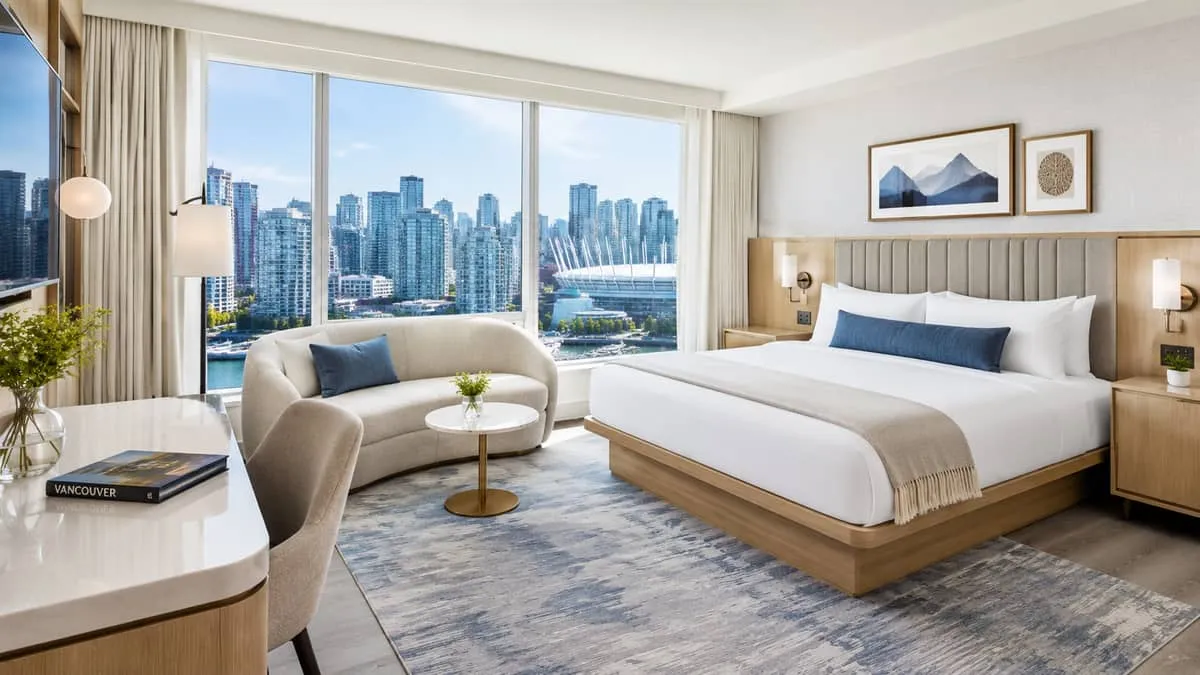
Vancouver's independent boutique hotels are fighting a specific battle. On one side: global flags like the Fairmont Pacific Rim and Four Seasons, with eight-figure renovation budgets and brand design teams. On the other: the same Asia-Pacific guests those chains are competing for , guests who fly into YVR from Tokyo, Hong Kong, and Seoul, who have stayed at the Ace in Portland and the Andaz in Singapore, and who will spend $400 a night without hesitation if the property earns it. The furniture in your Coal Harbour suite or your Gastown heritage room is not decoration. It is the single most tactile signal your property sends about which category it belongs in.
Independent operators across Gastown, Yaletown, and Coal Harbour are learning that the gap between a $250 rate and a $400 rate is not square footage. It is not even location, since properties a block apart can sit in entirely different tiers. What separates them is whether the interior communicates intent from the moment a guest drops their luggage. Furniture is doing most of that work.
The Asia-Pacific Guest and What They Actually Notice
Understanding who is staying in Vancouver's premium boutique rooms changes how you think about every purchasing decision. These are not guests who are easily impressed by novelty. A business traveller from Singapore has stayed in hotels designed by Andre Fu. A leisure traveller from Tokyo has strong opinions about the difference between a well-proportioned chair and one that photographs well but sits badly. Social media engagement in this demographic is high, but it is also discerning , a room that looks good in someone's grid post and feels mediocre in person generates the worst kind of coverage: initial interest that converts to a disappointed review.
The practical consequence for furniture selection is that surface aesthetics and structural quality have to align. A lounge chair with beautiful upholstery and a frame that shifts when you sit down will get noticed immediately by a guest who evaluates hospitality spaces for a living. Conversely, a piece with honest materiality , genuine leather, real wood joinery, visible hardware quality , reads as authentic to a guest who can tell the difference, even if they could not explain exactly why.
Vancouver's boutique hotel guest is also photographically active in specific ways. Bedside setups, desk arrangements, the view from a well-placed reading chair toward a Coal Harbour waterline , these are the shots that end up on Instagram and in review photos on Google. Furniture placement and scale affect those shots directly. A nightstand that is too low for the bed height, or a desk chair that blocks the sightline to the window, is a recurring visual problem in guest-generated content that no amount of marketing photography can fix.
Coal Harbour vs. Gastown: Two Markets, Two Furniture Briefs
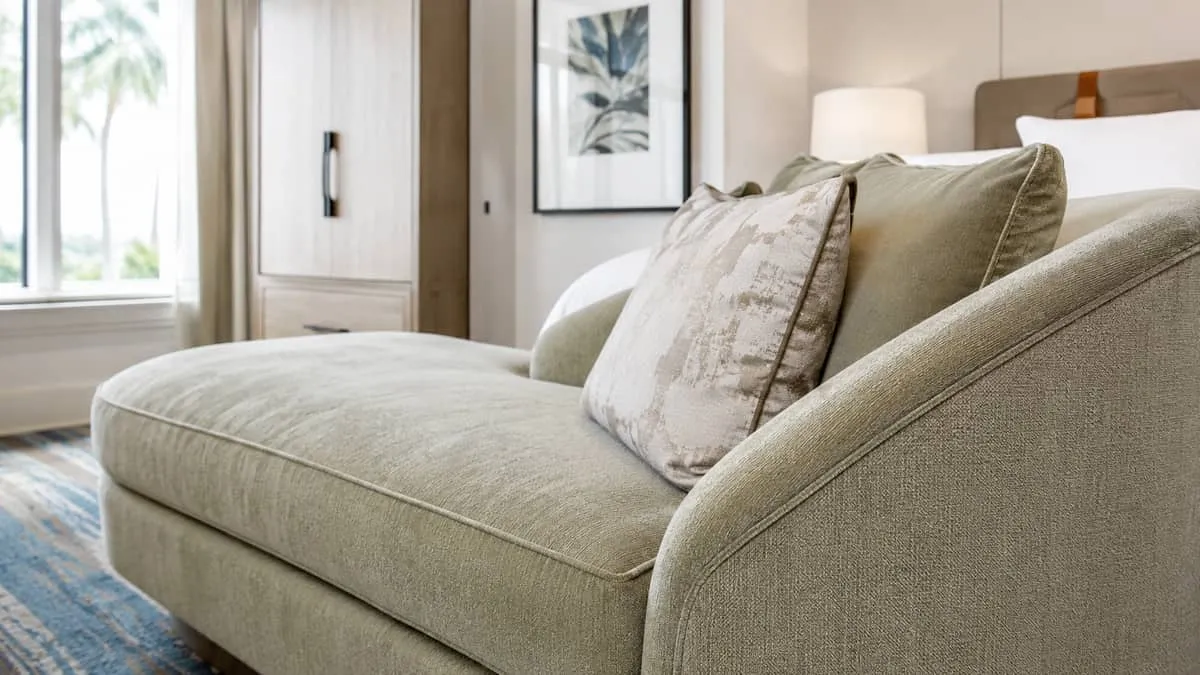
The mistake operators make is treating Vancouver's boutique hotel scene as uniform. Coal Harbour and Gastown represent genuinely different guest expectations, different building typologies, and furniture briefs that should not look the same.
Coal Harbour properties are working with waterfront views, contemporary architecture, and a guest mix that leans toward business and affluent leisure. The palette should feel considered and calm , materials that hold up under natural light changing from overcast grey to direct afternoon sun off the water. This is not a market for statement pieces that compete with the view. What works here is furniture with clean proportion and exceptional materiality: a bed frame in solid walnut or a dark brushed oak, upholstered panels in performance fabric with enough texture to read as tactile without being fussy, a desk and chair combination that a guest can actually work from for four hours. High-density foam under a well-chosen boucle or a tight-weave linen-blend performs better in these rooms than premium-looking materials that compress after six months of continuous use.
Gastown operates on a completely different logic. The building is often the feature , exposed brick, heavy timber, heritage details that predate the city's current skyline by a century. Furniture in these rooms should work with the architecture, not compete with it. Warm metals in matte black or oxidized brass read well against brick. Leather or waxed canvas upholstery in deep cognacs and forest greens picks up the material language of the neighbourhood. The hospitality design that works in Gastown has an editorial quality , it looks like someone made specific decisions, not like a hospitality package was applied to a space. That specificity is what drives the review language that fills a calendar: "felt like staying in someone's beautifully designed apartment" is the Gastown boutique hotel review that operators should be engineering toward.
Yaletown sits between these two registers , converted warehouse bones with a more contemporary, design-forward tenant profile. The guest there often has some connection to Vancouver's tech or film sectors, tends to be design-literate in a specific West Coast modernism direction, and responds well to furniture that references mid-century form with current materiality: clean silhouettes, premium leatherette or performance velvet, visible but refined hardware.
What Contract Grade Means When Your Reviews Are International
When a property in Gastown prices rooms at $380 a night and markets to guests who will compare it directly to properties in Kyoto and Copenhagen, the durability floor for furniture is not what you would apply to a regional business hotel. Contract-grade construction means the piece was built for continuous commercial use, but in Vancouver's premium boutique tier, it also has to sustain that appearance standard across the full lifespan of the piece.
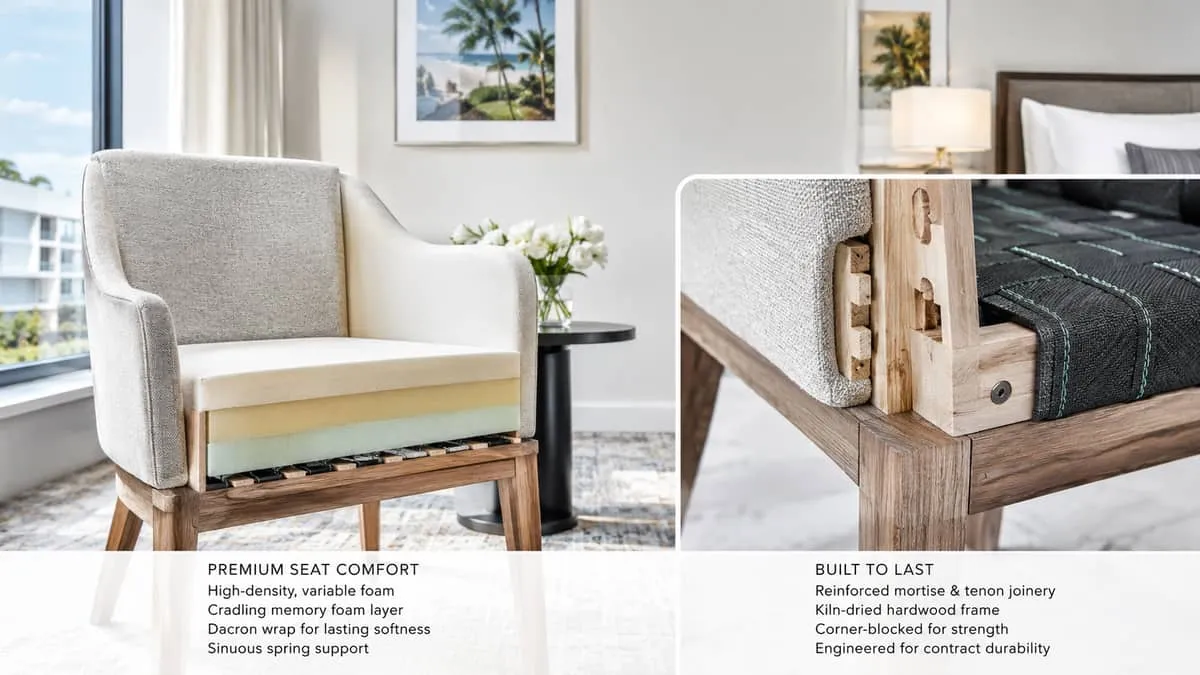
The specific failure modes to protect against: upholstered seating that compresses visibly after eight months of daily use, case goods with veneer edges that lift under the humidity cycling that comes with Vancouver's mild but wet climate, bed frames with joinery that develops movement noise within a year. Each of those failures shows up in reviews, and in the international review ecosystem , TripAdvisor in Japanese, Google reviews from Hong Kong visitors, travel content in Mandarin , they circulate in markets that directly feed Vancouver's premium hotel occupancy.
Double-rub counts on upholstery fabric matter here not as a checkbox but as a safeguard for your visual standard. For seating in rooms that turn daily, 50,000 double rubs is a reasonable floor for performance fabric and 100,000 for anything in a high-contact position like a desk chair or a lobby bench. Kiln-dried hardwood frames resist the seasonal moisture variation Vancouver's climate produces better than engineered alternatives , a chair that sits stable in October can develop movement by March if the frame has absorbed and released humidity unevenly. These are not abstract specifications. They are the difference between an interior that looks like your opening-day photography three years later and one that starts generating maintenance calls eighteen months in.
The $400 Night Signals: Where Furniture Does the Work
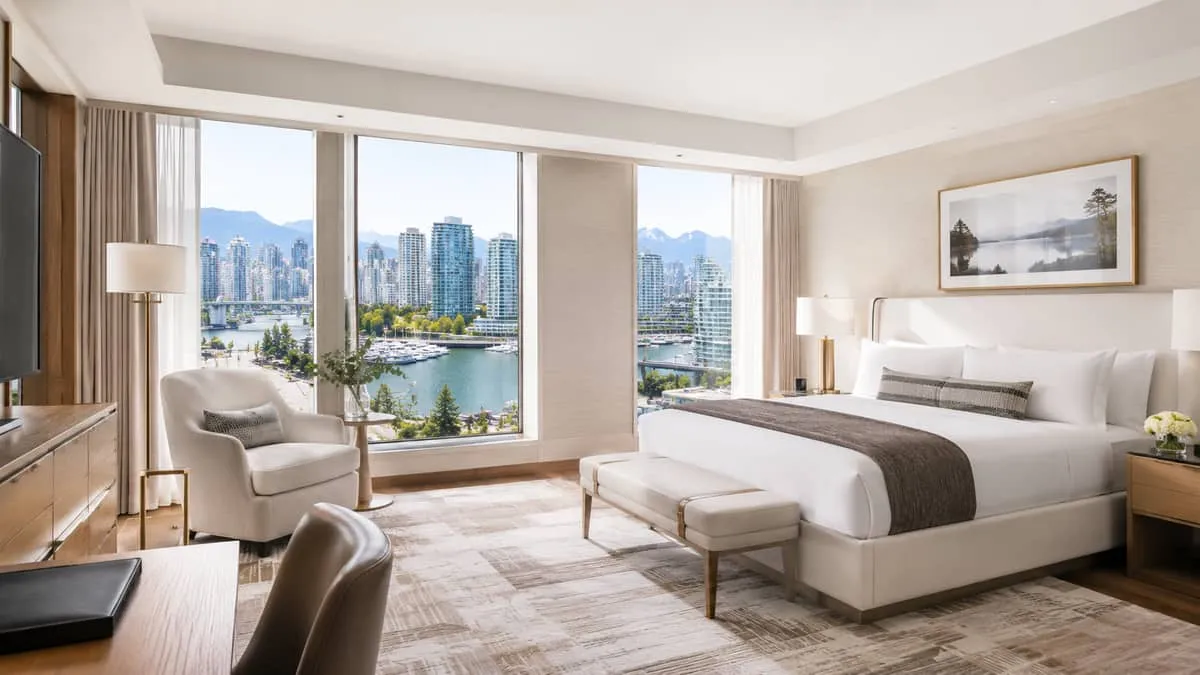
Properties commanding top-tier ADR in Vancouver's boutique sector share a set of furniture decisions that cheaper properties are not making. None of them are individually dramatic. Together, they create the interior that justifies the rate.
Bed frame and headboard construction is the most legible signal. A guest who lies in bed and can see the sightline clearly to a wall-mounted headboard that is flush, stable, and finished on the back reads that as quality even if they never articulate it. A headboard that has a visible gap at the wall, or that shifts when leaned against, communicates the opposite. Custom upholstered headboards built to fit the specific room dimensions , accounting for ceiling height, window placement, the scale relationship to the bedding , are the move for properties in this tier. Stock headboards in standard sizes are visible as stock, especially to the international design-literate guest.
Nightstand and desk specification is where properties often cut corners and where guests notice it most. A nightstand that is not at the right height for the mattress, that has inadequate surface area, or that lacks a useful power situation will show up in reviews specifically about functionality. In the Vancouver boutique market, where guests are traveling with multiple devices and often working across time zones, a desk that does not accommodate a laptop, a charger, and a coffee cup simultaneously is a furniture failure with operational consequences.
Case goods , dressers, wardrobes, media units , benefit most from custom work because the proportion requirements differ room to room in a boutique property, and off-the-shelf commercial case goods in standard dimensions rarely sit correctly in a room with heritage architectural features. A Gastown property with 10-foot ceilings and irregular brick exposure needs case goods specified to that space, not adapted from a catalogue made for 8-foot rooms in a grid-plan building.
Sourcing at Boutique Scale Without Losing Leverage
The structural challenge for independent Vancouver operators is that contract-grade hospitality furniture at the quality level this market requires is largely designed for volume buyers. Minimum order quantities at some North American manufacturers only make economic sense for a 120-room chain. Getting access to the same construction quality at 25 or 40 rooms requires finding suppliers who have actually structured their business around the independent hospitality market, not just listed it as a secondary service.
Vancouver's position as an Asia-Pacific trade hub does create direct import options that operators in Toronto or Montreal do not have at the same logistical cost. Case goods sourced directly through a Hong Kong or Taiwanese manufacturer , inspected at origin and shipped through a Vancouver freight operation , can deliver quality-to-cost ratios that domestic wholesale cannot match at boutique quantities. The risk is quality control and commercial compliance: BC fire code requirements for hospitality furniture, off-gassing certifications, and the practical reality that a case good that arrives with veneer defects at 5,000 kilometres from the factory is expensive to remediate. Direct import works when there is a sourcing agent with genuine quality inspection capability managing origin, not just a purchasing intermediary.
For upholstered pieces, domestic production from suppliers with demonstrated independent hospitality experience typically gives operators more control over the outcome. Custom upholstery in a specific fabric , a performance velvet in a colour that matches the property's visual identity, a leather grade specified for hospitality rather than residential use , is harder to manage across ocean freight with long lead times. The closer the supplier is to the property's commissioning team, the more accurately the final piece reflects the design intent.
Lead times are the variable that kills project timelines most reliably. Custom upholstered pieces from domestic suppliers are typically running 14 to 20 weeks in current production environments. Custom case goods with specific finish requirements add time for material sourcing and finishing. A Coal Harbour opening that brings the furniture conversation in at month four of a six-month construction timeline is not going to get the custom interior it planned for. The properties that open with the interiors that justify their rate started that conversation at the same time as the design conversation , not as a downstream procurement exercise.

The Review Feedback Loop That Drives Bookings
Vancouver's premium boutique hotel market is acutely affected by review dynamics in ways that other Canadian cities are not, because the Asia-Pacific feeder markets that drive high-ADR occupancy are themselves review-driven in specific platforms and specific languages. A property that earns sustained positive review language about its interior , "beautifully designed," "felt intentional," "high-quality finishes" , builds a signal in booking platforms that translates directly to occupancy at rate.
The inverse is also true and more damaging. A property that consistently generates comments about furniture that shows its age, seating that is uncomfortable, or a room that photographs better than it stays in will see that language circulate in markets that are difficult to monitor and harder to respond to. International guests writing in Japanese or Cantonese about their Vancouver stay reach booking communities that an English-language PR response does not touch.
The furniture investment in a 30-room Coal Harbour boutique property is not a sunk cost to be minimized. It is the mechanism by which the property either earns and holds its rate tier or slides back into competing on price with properties that are not really its peers. The math on custom, contract-grade furniture at $8,000 to $12,000 per key looks different when modeled against the ADR differential between a property that holds $380 across twelve months and one that runs promotions to fill at $260. Over a five-year depreciation window on a 30-key property, that rate difference is worth considerably more than the furniture upgrade.
Get the furniture right at the design stage, with suppliers who understand what this market actually demands, and the property can hold the tier it was designed for. That is the only version of this project worth doing.
We quote boutique hotel furniture for Vancouver operators against their own layouts and order sizes rather than a generic sheet. Request a quote and we will put together pricing for your property.