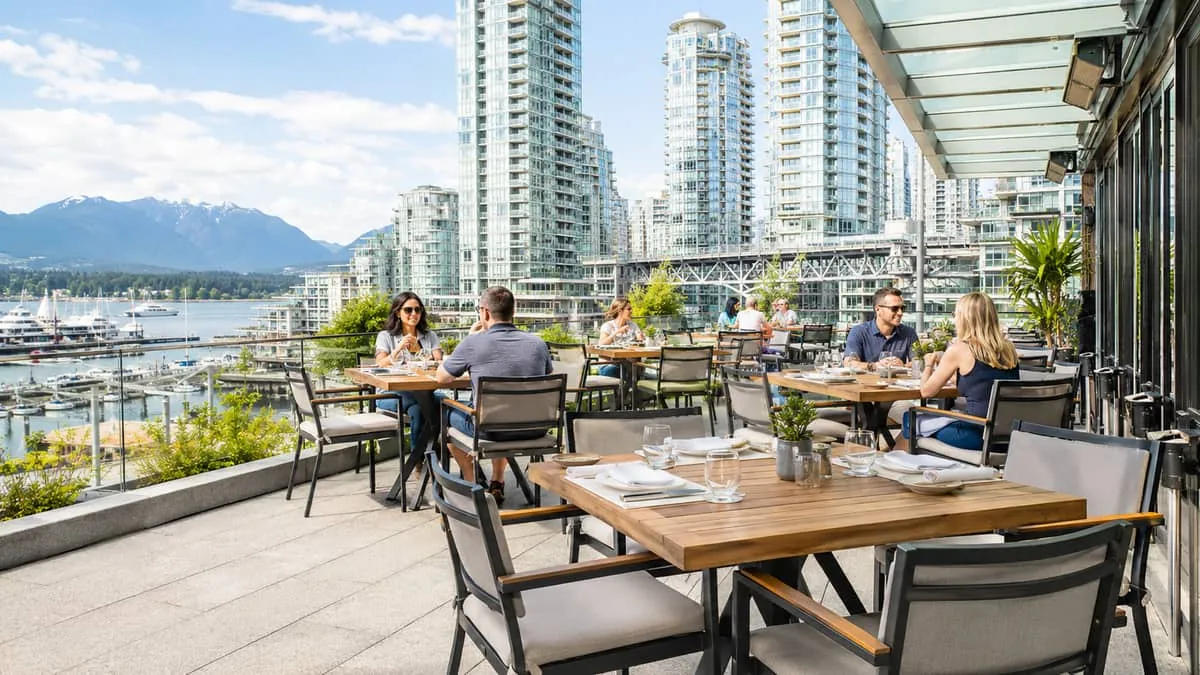
Vancouver does not have a patio season. It has a patio culture , one that operates every month of the year. On a mild January afternoon in Coal Harbour, the heated terraces at Fairmont Pacific Rim fill up before the interior does. In February, Yaletown restaurant patios run propane heaters and sell every covered seat. By March, Kits Beach spots are turning tables on weekends before the cherry blossoms hit their peak. This is not a city where operators close their outdoor program at Thanksgiving and wait for May. This is a city where operators who invested in the right commercial patio furniture in Vancouver are generating outdoor revenue 365 days a year , and those who didn't are leaving serious money on the table.
Understanding that dynamic changes how you approach furniture sourcing entirely. The question is not "what will survive our short summer." The question is "what will survive continuous commercial use in a damp coastal environment, perform under heaters and rain covers, look sharp in front of an Asia-Pacific clientele that has seen the world's best patios, and still look right in year five."
Vancouver Patios Don't Close: What That Means for Durability Specs
Most commercial furniture is rated against a seasonal use model. A patio in Toronto or Calgary is in active service from May through September, then stored for seven months. Assume 150 days of use per year, and a chair rated for 8 to 10 seasons gets you to roughly 1,200 to 1,500 use-days before it starts showing meaningful wear.
Vancouver breaks that model. A well-run patio with proper overhead coverage and heating infrastructure runs close to 300 days of active use annually. That same chair hits its wear threshold in half the time. This is why commercial-grade , truly commercial-grade, not "commercial-style" , matters more in Vancouver than in almost any other Canadian market.
The distinction shows up in frame construction. Consumer patio furniture uses aluminum extrusions in the 0.8mm to 1.0mm wall thickness range. Contract-grade aluminum frames for commercial hospitality start at 1.5mm and go up from there. That difference is invisible when the chair is new. After two years of daily use on a Robson Street patio , staff folding and unfolding, guests leaning back, the frame getting wet and dried repeatedly , it's the difference between a chair that still sits true and one that rocks and flexes at every joint.
Weld quality matters equally. Die-cast corner joints fail under repetitive stress. Properly welded aluminum frames distribute load across the full joint surface. Ask for specs before you order, not after the first season reveals the weak points.
Coastal Air, Constant Moisture, and the Case for the Right Finish
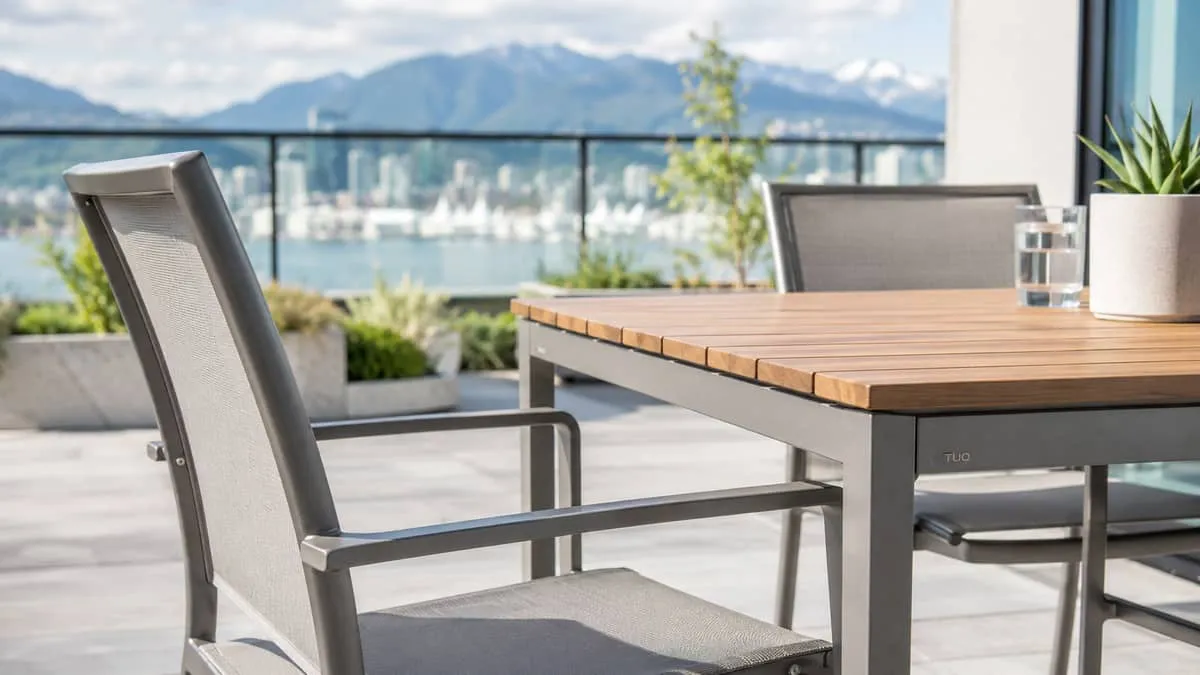
Coal Harbour, the False Creek waterfront, Kits Beach , a significant percentage of Vancouver's most competitive patio real estate sits within a few blocks of salt-influenced marine air. That air accelerates corrosion on any ferrous metal and degrades cheaper powder coat finishes faster than operators expect.
Marine-grade powder coating uses a two-stage process: a zinc phosphate primer layer followed by a polyester topcoat, baked at 200°C or higher. The primer is the critical element , it creates a chemical bond to the aluminum that a single-stage finish cannot match. On a busy waterfront patio, that primer layer is the difference between a finish that holds for seven years and one that starts showing chips and oxidation at the weld points by year two.
For frame material, 6061 marine-grade aluminum is the appropriate specification for any Vancouver waterfront application. It contains magnesium and silicon alloying elements that increase corrosion resistance significantly compared to standard 6063 architectural aluminum. The cost premium is modest , typically 10 to 15 percent on the frame cost , and the performance difference over a five-year horizon is substantial.
Stainless steel hardware throughout, not zinc or galvanized. Every bolt, every pivot point, every leveling glide. This detail is consistently where budget furniture programs fail in coastal environments: the frame holds up, but the hardware corrodes and the joints seize or loosen within a few seasons.
Teak remains the prestige material for Vancouver's fine dining and luxury hotel market. The Fairmont Pacific Rim, boutique properties in Gastown, the waterfront restaurants along the seawall , these operators use teak because the material communicates quality without requiring explanation. A design-literate international guest recognizes teak the moment they sit down. Maintained with annual oiling, a commercial teak program lasts decades. Left to weather naturally without maintenance, it silvers gracefully and still performs structurally. Very few materials offer that margin for error.
What Covered Patio Infrastructure Changes About Furniture Selection
The investment Vancouver operators have made in covered, heated patio infrastructure over the past decade has fundamentally changed the furniture equation. A patio with a retractable roof, overhead radiant heaters, and glass windscreens is not an outdoor space in the traditional sense , it's a semi-conditioned environment that happens to feel like being outside.
That changes what fabrics can do. Standard outdoor solution-dyed acrylics like Sunbrella perform well in fully exposed conditions but are engineered around the assumption that cushions will get thoroughly wet on a regular basis. On a covered Vancouver patio with overhead heat, that assumption doesn't hold. The fabric stays dry most of the time, which means you can use materials with higher thread counts and richer textures , the kind of upholstery that reads as interior-quality but still cleans up if a drink spills or the wind sends unexpected rain sideways under the cover.
For fully exposed applications, Sunbrella or equivalent solution-dyed acrylic remains the right specification. The color is dyed at the fiber level, not coated on the surface, which is why the fade resistance is genuine rather than a marketing claim. It also cleans with diluted bleach without damaging the fiber , critical in a commercial environment where mold prevention is a routine maintenance task, not an occasional emergency.
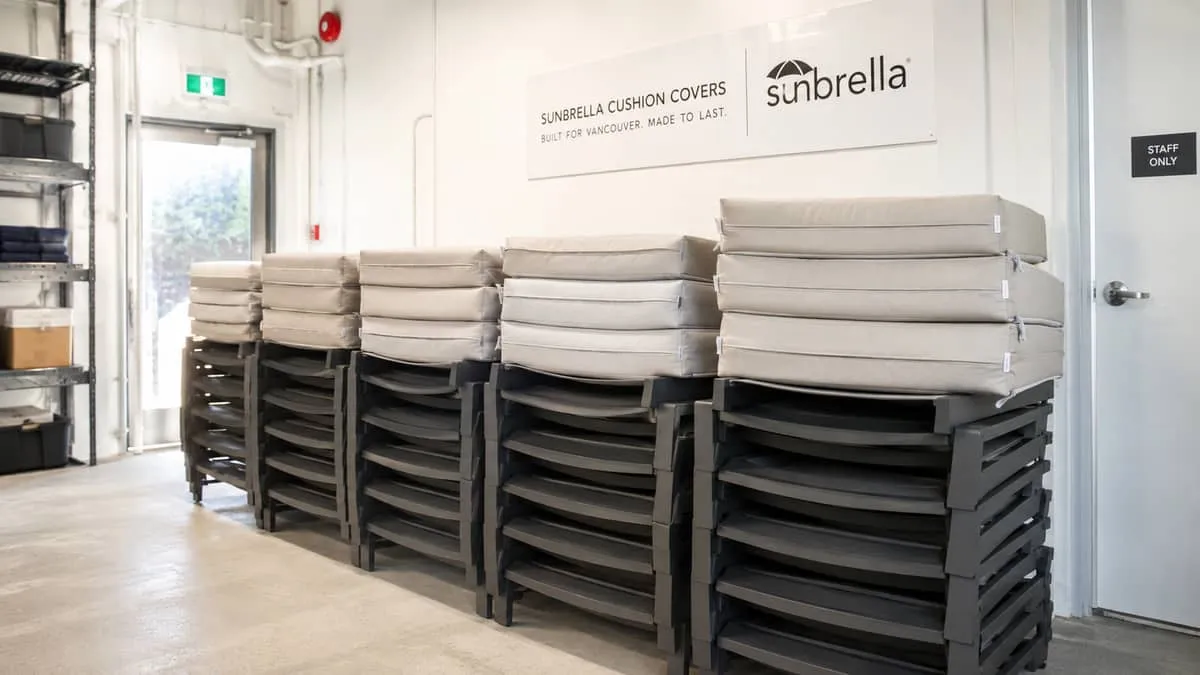
Foam specification matters on covered patios where cushions may stay in place year-round. Standard 1.8 lb density foam compresses and fails in under two years of continuous hospitality use. Commercial seating foam runs 2.0 to 2.5 lb density with a firmer, higher-ILD rating that maintains its profile under heavy rotation. The guest who sits down in the morning and the guest who sits down at 9 PM on a Friday night should feel the same chair.
The Robson Street / Coal Harbour / Kits Beach Aesthetic Split
Vancouver's patio market is not uniform. The design expectations in Coal Harbour are different from Kits, and Kits is different from Gastown. Specifying commercial patio furniture in Vancouver without understanding your neighborhood's design context is how operators end up with furniture that works perfectly well but reads as slightly wrong , too casual for the location, or too corporate for the vibe.
Coal Harbour and the Convention Centre corridor serve international business travelers, film industry clientele, and Asia-Pacific visitors who move fluidly between Vancouver, Tokyo, Singapore, and Hong Kong. These guests have a frame of reference for what fine dining patios look and feel like at the highest level. Furniture programs in this market need to be cohesive and complete: matching side tables, coordinated planters, shade structures that feel designed rather than improvised. Mixing frames from two different programs because one was on clearance reads immediately in this demographic. The design-literate international guest notices.
Robson Street and the West End patio market is high volume, high visibility, and intensely competitive. The Robson patios are street theater , seen by thousands of pedestrians daily. The aesthetic needs to be clear and confident from 20 meters away. Bold color choices in the powder coat or upholstery work here in a way they might not in a Coal Harbour fine dining setting. The furniture needs to be sturdy enough to handle tourist traffic while looking intentional enough to compete with the well-funded programs on either side of you.
Kitsilano Beach operates on a different logic entirely. The Kits patio market skews local and loyal , these guests come back all summer because the patio is theirs, functionally. Durability is paramount because the volume is relentless in season. Design that reads as too precious or precious-hotelier can actually underperform against furniture that feels relaxed and confident. Teak with a natural silver patina, linen-look upholstery in neutral tones, lower-profile seating that encourages lingering , this is a market where comfort earns loyalty as much as aesthetics.
Gastown is its own category. The brick and cobblestone heritage of the neighborhood creates a design grammar that certain furniture contradicts immediately. Sleek, resort-polished aluminum in white or silver reads as imported from another city. The Gastown patio market rewards industrial finishes, darker powder coats in charcoal or deep matte tones, and materials that have visual weight and texture. It also rewards durability: Gastown draws late-night traffic that puts real wear on outdoor furniture.
Revenue-Per-Seat Math and Why Furniture Quality Pays Back Fast
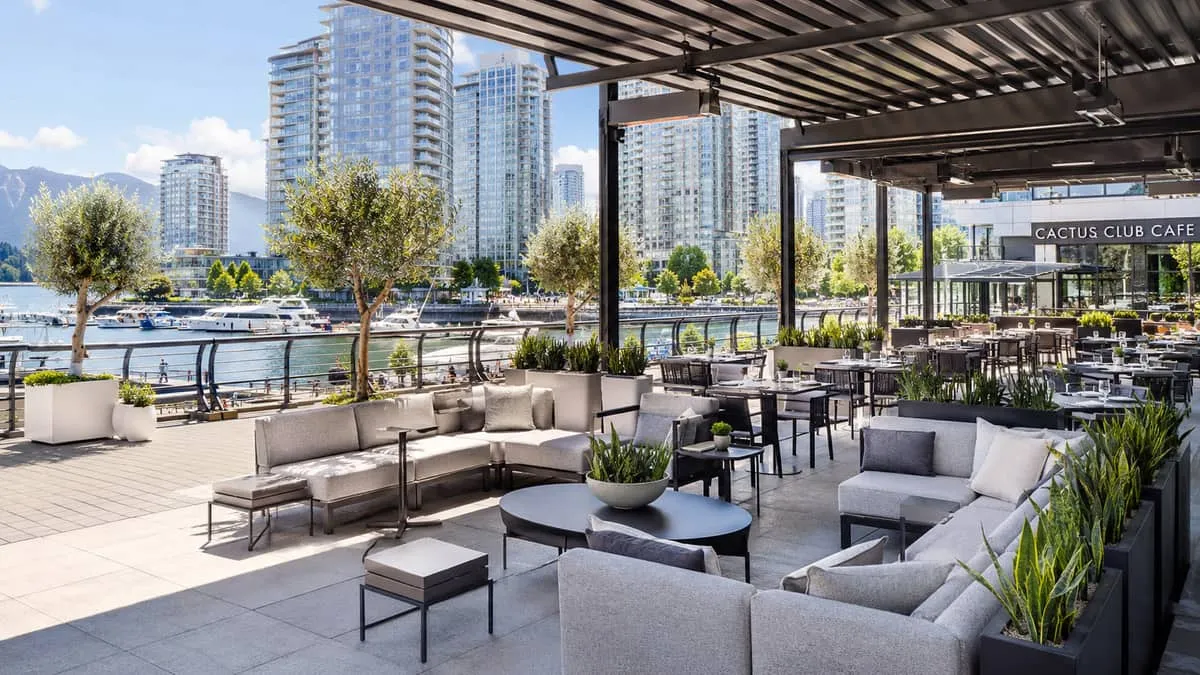
Vancouver has among the highest average daily rates for hotel rooms and among the highest per-cover spend in the Canadian restaurant market. On a Coal Harbour patio doing 2.5 turns on a summer Saturday, the revenue generated at each chair over a year is significant. The math on furniture quality shifts entirely when you run it against that revenue per seat rather than against the purchase price in isolation.
A commercial chair that costs $650 and lasts eight years of Vancouver's year-round use pattern costs roughly $81 per year. A residential-quality chair at $200 that requires replacement every two seasons , and many Vancouver operators have experienced exactly this , costs $100 per year and adds the operational disruption of mid-season procurement, delivery, and the gap where mismatched furniture signals to guests that the program is patched together.
The lifecycle argument is even clearer at the cushion level. Contract-grade cushions with 2.5 lb foam and Sunbrella fabric, stored dry through the shoulder seasons, run five to seven years before meaningful reupholstery is warranted. The reupholstering itself typically costs 40 to 60 percent of replacement, and the frame goes another full cycle. Over a 10-year program, the math strongly favors quality upfront.
Planning for Year-Round Commercial Patio Furniture in Vancouver
The practical implication of Vancouver's extended patio season is that storage planning looks different here than in most Canadian markets. You're not putting the furniture away for seven months. You're rotating cushion storage during the wettest stretches of fall and winter, doing a deep clean and inspection in early spring, and refreshing worn upholstery while the program is still commercially active.
Build storage into your patio program specification from the start. Stackable chairs that nest to a manageable footprint , typically 8 to 12 high depending on the model , dramatically reduce the cubic footage required for cushion storage or mid-season stock rotation. For larger programs, sealed cushion storage systems on wheels allow front-of-house staff to bring cushions out at service start and return them at close without the process becoming a burden.
Work with your supplier to establish a parts relationship, not just a purchase transaction. A supplier who stocks replacement glides, armrest end caps, and cushion inserts for your specific furniture program is worth a price premium over a lower-cost option with no aftermarket support. When a chair needs a repair mid-season on a busy Yaletown patio, the ability to get the part in two days rather than eight weeks is a meaningful operational advantage.
Vancouver's outdoor dining culture is not seasonal. It's structural , built into how this city eats, drinks, and socializes across every month of the year. The operators who recognize that and invest in commercial patio furniture in Vancouver accordingly are the ones whose patios become neighborhood institutions rather than seasonal afterthoughts. The furniture program that looks right, holds up through continuous coastal exposure, and reflects the design expectations of an internationally sophisticated guest is the one that earns its ROI every month it's in service.
We quote commercial patio furniture for Vancouver operators against their own layouts and order sizes rather than a generic sheet. Request a quote and we will put together pricing for your property.