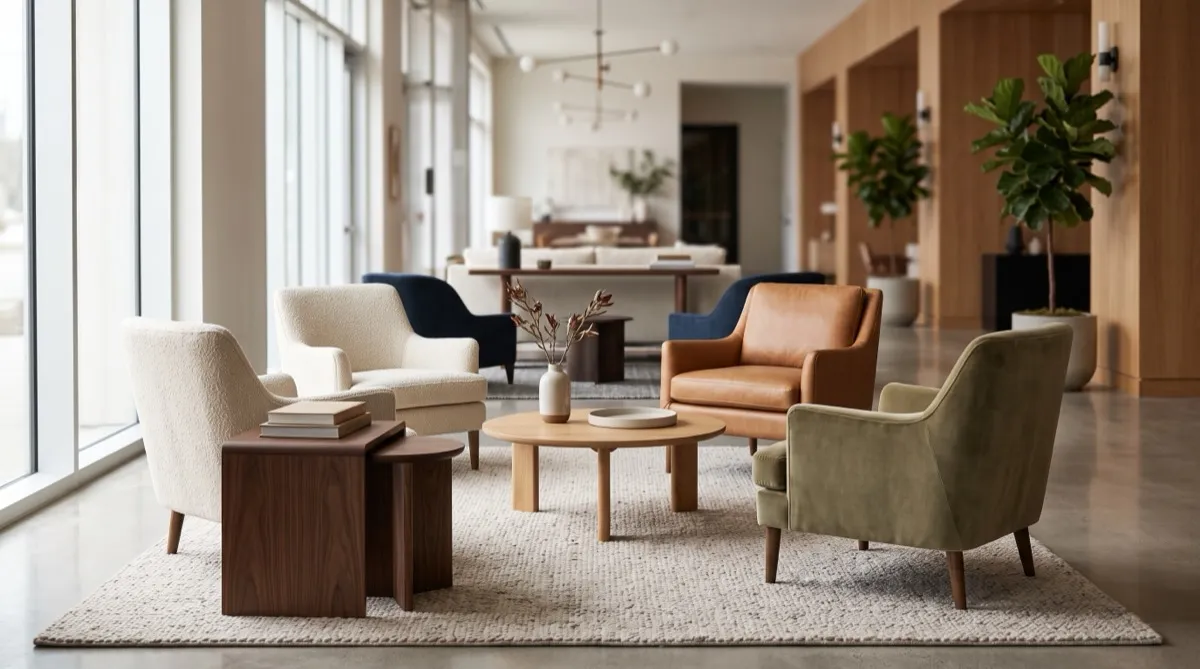
Hospitality furniture is a specific category with specific requirements. What works in a corporate office doesn't work in a hotel lobby. What works in a fast-casual restaurant doesn't work in a boutique hotel room.
Here's what hospitality buyers need from a furniture supplier and how to find the right one.

What makes hospitality furniture different
Hospitality furniture operates at the intersection of durability and aesthetics in a way that most commercial categories don't.
A hotel lobby chair has to survive thousands of guests while looking like it was placed there yesterday. A restaurant booth has to handle daily food service while maintaining the visual appeal that makes guests want to sit there. A hotel room desk has to survive years of guest use without looking worn or institutional.
The durability specification is the same as any commercial furniture: welded frames, 50,000-plus Wyzenbeek upholstery, commercial-density foam. But the aesthetic specification is higher. Hospitality furniture is part of the guest experience and brand expression in a way that office furniture typically isn't.

This means material quality, finish consistency, and upholstery appearance matter at a higher standard in hospitality than in most other commercial categories. The gap between a good result and a mediocre result is visible to every guest.
Certifications hospitality buyers require
Hotel brands and upscale restaurant operators typically require documentation that most generic commercial buyers don't ask for. Know these before you evaluate a supplier.
BIFMA certification is the Business and Institutional Furniture Manufacturer's Association standard for commercial seating. Tests structural integrity, stability, and durability. Required by most major hotel brands for public area seating. Ask for documentation, not just a verbal confirmation.
CAL 117 is the California flammability standard for upholstered furniture. Required in California and standard practice nationally for hospitality furniture. Any supplier working with hotel operators should have this covered.
Greenguard certification covers indoor air quality. Required by many hotel brands for in-room furniture and increasingly requested by health-focused restaurant operators and LEED-certified properties. Ask specifically which products are Greenguard certified.
A legitimate hospitality furniture supplier has all of this documentation ready on request.

What a hospitality furniture supplier should offer
Beyond standard commercial supplier requirements, hospitality projects need specific capabilities.
COM capability: customer's own material. Hospitality projects frequently have custom fabric specifications from an interior designer or FF&E consultant. The supplier needs to be able to upholster in your specified fabric. Ask specifically whether they accept COM and what the lead time impact is.
Custom dimensions: hotel rooms have specific footprint requirements. Restaurant booths have custom depth and width specs from the architect. A hospitality supplier should accommodate non-standard dimensions without treating it as an exceptional request.
Finish matching: hospitality projects often require furniture finishes to coordinate with millwork, flooring, or other fixed elements. Color accuracy and finish consistency across a production run matters more in hospitality than in most commercial categories.
Project management experience: large hospitality projects involve phased delivery, coordination with other trades, and precise scheduling. A supplier experienced in hospitality projects has handled this before and knows how to communicate lead times in the context of a broader project schedule.
Sourcing and lead times for hospitality
Most hospitality furniture is manufactured in China. That's true across the industry including for major hotel brands. What matters is quality control at the factory level and accountability on this end when products arrive.

We manage quality oversight at the manufacturing level and operate locally in North America. In-stock items ship faster. Custom orders, which are typical for hospitality projects, ship factory-direct at 10 to 14 weeks.
For large hotel projects, lead time planning typically starts 12 to 18 months before opening. For a single restaurant, planning 14 to 16 weeks ahead covers most custom orders. Know which situation you're in and work backward from your target date.
We do custom hospitality furniture orders across all categories: COM upholstery, custom dimensions, finish coordination, table bases and tops, lounge and lobby seating. Bring your project spec and we'll confirm what's achievable and what the timeline looks like.

The bottom line
Hospitality furniture requires the same commercial construction fundamentals (frames, foam, upholstery spec) as any commercial product, plus higher aesthetic standards and specific certification documentation. A hospitality furniture supplier who can answer questions about BIFMA, CAL 117, and Greenguard immediately, who accommodates COM and custom dimensions, and who has done projects similar to yours is the right partner. The certifications and capabilities are the differentiator.
Related reading: How Hotels Source Furniture · Commercial Upholstery Fabric Guide · What Is Contract Furniture