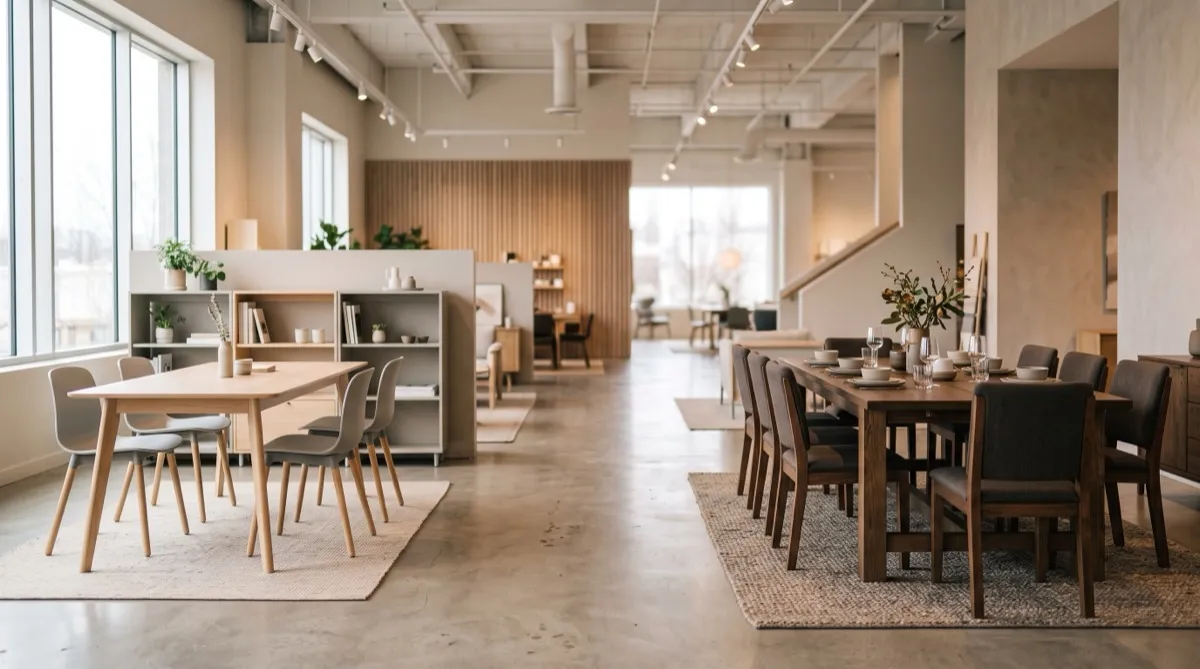
If you're opening a restaurant, a bar, a hotel, or furnishing an office and you're thinking about buying furniture from IKEA, Wayfair, or even Costco, stop.
Not because it won't look good on day one.
Because it won't survive day 90.
Here's exactly what commercial furniture is, why businesses use it, and what it actually costs, because nobody in this industry makes that easy to find.
What actually makes furniture "commercial grade"
Commercial furniture is built to a completely different standard than what you buy at a retail store.

Retail furniture is designed for home use. Maybe one or two people sitting in a chair a few hours a day. That's the load it's tested for.
Commercial furniture is rated for contract use, meaning a barstool that gets sat on by 50 different people a day, every day, for five years straight.
The differences that matter:
- Frame construction: Heavier gauge steel or solid hardwood, not hollow extrusions or particleboard
- Joinery: Reinforced joints, mortise and tenon or welded, not dowels and glue
- Upholstery rating: Commercial fabric is rated for 50,000+ rubs on the Wyzenbeek abrasion test. Most retail fabric fails at 15,000
- Warranty: Commercial pieces carry warranties for commercial use. Retail warranties void the moment you use them in a business
When you put a retail chair in a restaurant, you're not getting five years out of it. You're getting 18 months before the legs wobble, the fabric tears, and you're replacing the whole set.
The real cost comparison
Here's where people get tripped up. They see a commercial barstool at $250 and a retail one at $80 and think the retail one is the obvious choice.
Run the math over five years.
Retail barstool at $80: needs replacing every 18 months in a commercial environment. That's three replacements over five years, plus labor to swap them out. You've spent $240 plus time, disruption, and the damage to your reputation while broken chairs are visible on your floor.
Commercial barstool at $250: still in service in year five. Many carry a warranty. You bought it once.
That's before you factor in what a broken chair looks like to a customer. One wobbly barstool that a guest notices is a review. Maybe a refund. Definitely a bad impression.

The premium chair costs the same over five years and doesn't require a mid-lease replacement project that shuts down tables during service.
How the ordering process actually works
This is what most people don't know going in.
Commercial furniture isn't sold piece by piece on Amazon. It's sold through suppliers with minimum order quantities.
Why? Because commercial furniture is often made to order. Specific finishes, fabrics, dimensions. You're not pulling from a warehouse shelf, you're placing a production run.
Most commercial furniture is manufactured in China. That's true across the industry. What matters is whether your supplier has local inventory for common items, or whether your order ships direct from the factory.

For in-stock items: Turnaround can be a few weeks.
For larger or custom orders shipping factory-direct: Plan 10 to 14 weeks.
Custom orders are available for specific finishes, fabrics, and dimensions, so if you have something in mind for your space, it's worth asking.
Typical minimums: 20 barstools, or 4 lounge chairs. The upside is the per-unit price drops significantly compared to retail, and you're getting something built for your specific environment.
Who to buy from
There are a few ways to source commercial furniture in North America.
Trade shows: NeoCon in Chicago, HD Expo in Las Vegas. These are where the large hospitality and office buyers go. Good for seeing product in person, but not always practical for smaller operators or single-location buildouts.
Direct suppliers: You work directly with the source, get wholesale pricing, and have a real contact for questions about specs, fabrics, and lead times. This is who we are.
Contract furniture dealers: Middlemen who can help with large multi-line projects, but you pay for that service in margin.
For most restaurant owners, bar operators, or anyone doing a single-location buildout, going direct to a supplier is the move. You get better pricing, faster communication, and you're talking to someone who actually knows the product.
The bottom line
Commercial furniture costs more upfront. It costs less over the life of your business.

If you're building out a space that's going to see real commercial use and you want furniture that looks as good in year four as it did on opening day, retail isn't the answer.
The math works out. The quality holds. And you won't spend a Saturday mid-service apologizing to a guest about a wobbly chair.
Related reading: How Long Does Commercial Furniture Last · How to Order Commercial Furniture in Bulk · Commercial Furniture vs IKEA