
You've got a renovation window, a budget, and a hard open date before spring convention season floods the Loop and River North with thousands of guests. The wrong furniture supplier doesn't just cost you money it costs you that window entirely. Chicago hotels don't get soft launches. McCormick Place alone drives over 3 million annual convention visitors, and when a major show hits, River North, the South Loop, and Michigan Avenue properties all go to capacity simultaneously. Furniture that can't handle that volume, or that arrives three weeks late because your supplier missed the lead time conversation, turns a manageable renovation into a crisis. Here's what you need from a hotel furniture supplier Chicago operators actually rely on and how to find one before you sign a purchase order.
Why Retail Furniture Fails in Commercial Hotel Settings
You've probably seen what happens when a budget renovation goes the retail route. A manager pulls pieces from a big-box store, the room looks fine in photos, and within eight months the drawer slides are loose, the chair legs have gouged the flooring, and the finish is lifting near the window edge.

Contract furniture is built to a different standard. The ANSI/BIFMA and ASTM testing protocols that reputable suppliers follow aren't marketing language. They reflect real-world load cycling, finish adhesion requirements, and joint stress tolerances that consumer furniture never has to meet. A guest room case piece in a 200-key River North hotel will be opened, closed, leaned on, and sat on by hundreds of different people over its service life. Retail construction doesn't survive that.
Chicago compounds the problem. Guests tracking slush off Michigan Avenue in January and sweating through 90-degree August humidity put finish and frame stress through ranges that most retail furniture was never engineered for. Properties near the Riverwalk deal with guests arriving wet from boat tours. Boutique hotels in Fulton Market and Wicker Park attract design-conscious travelers who will notice warped veneer edges and wobbling case pieces and they'll leave reviews about it. Contract-grade furniture, sourced from a qualified hotel furniture supplier Chicago properties use for long-term durability, is designed specifically for that kind of repetitive commercial stress.
What to Look for in a Chicago Hotel Furniture Supplier
Not every supplier that calls itself "commercial" is set up to serve a Chicago hotel project well. The city has specific conditions worth vetting for before you sign a purchase order.
FR compliance: Illinois follows NFPA 101 life safety codes, and Chicago enforces its own fire ordinances on top of state requirements. Any upholstered piece going into a guest room or public space needs to meet CA TB 117-2013 at minimum, and many Chicago properties require CAL TB 133 for seating in high-occupancy areas like conference-adjacent lobbies and event pre-function spaces common near McCormick Place. Confirm your supplier's fabric and foam certifications before anything else.
Seasonal durability for outdoor and semi-outdoor spaces: Chicago's restaurant and hospitality scene runs outdoor patios hard from May through October. West Loop restaurant-hotels and rooftop bars in River North fill fast once the weather breaks. If your property includes terrace seating, rooftop dining, or an exposed entryway, you need a hotel furniture supplier Chicago-tested for freeze-thaw cycles. Aluminum frames with marine-grade powder coat and solution-dyed fabrics are the minimum bar anything less and you're replacing pieces every two to three seasons.
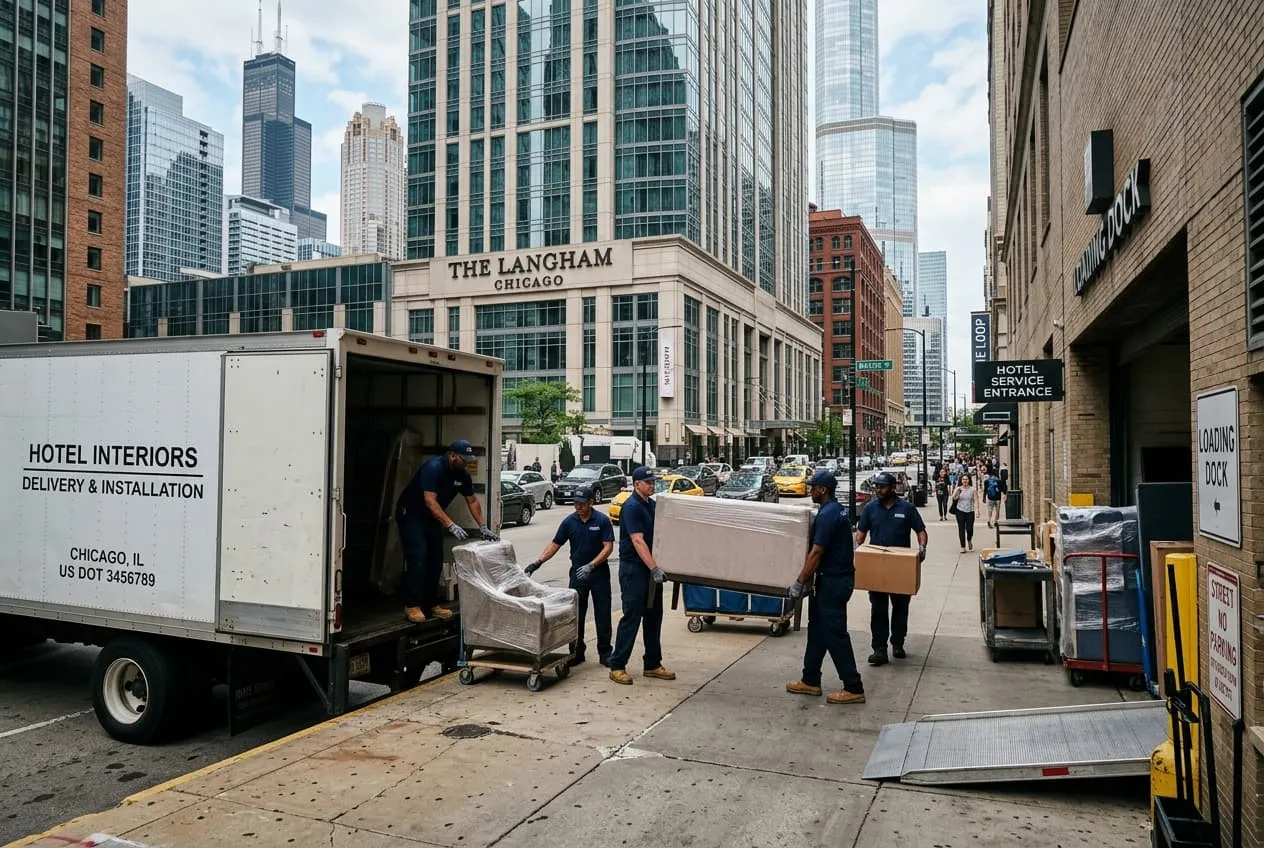
Local project experience: A supplier who has worked with Chicago properties understands the dock access realities of River North mid-blocks, the elevator dimensions in older Michigan Avenue buildings, and the permit and freight timing that affects installation scheduling in the Loop and South Loop. That operational familiarity isn't a bonus it's the difference between a delivery that hits your schedule and one that doesn't.
Lead Times and MOQs: What Chicago Buyers Should Plan For
Lead times are where hotel renovations most often go sideways. Custom contract furniture from an offshore factory typically runs 14 to 20 weeks from order confirmation. Domestic manufacturers can get you to 8 to 12 weeks on standard programs, sometimes less on in-stock lines. For a Chicago property opening before a major McCormick Place convention block or the summer Michigan Avenue tourist surge, that math is non-negotiable.
Minimum order quantities vary widely by supplier type. Large FF&E manufacturers may have MOQs that only make sense for a full property build-out 50 or 100 rooms minimum. Smaller regional suppliers and consolidators often work with boutique properties doing 10 to 20 rooms at a time, which fits the boutique hotel density in neighborhoods like Wicker Park, Fulton Market, and the West Loop. Know your project size before you start supplier conversations so you're not wasting time with vendors who aren't set up for your scale.
Chicago's design-forward hospitality scene particularly properties near the Riverwalk and in the emerging South Loop hotel corridor often pushes toward semi-custom or fully custom furniture programs that match the architectural character of the building. If you're going that route, add 4 to 6 weeks to your lead time estimate and budget for a sample approval round. A qualified hotel furniture supplier Chicago buyers work with for custom programs will build that milestone into the project schedule upfront rather than surfacing it after you've already committed to an opening date.
Working With a Supplier Through a Full Chicago FF&E Project
The most efficient approach for a mid-size Chicago hotel project is to treat your furniture supplier as a project partner from the spec phase not just a vendor you call when you have a purchase order ready.

A good supplier will walk you through finish durability testing, help you coordinate case goods with soft goods from other vendors, and flag specification conflicts before they become field problems. They should provide install coordination, touch-up protocols, and warranty documentation organized for your maintenance team not just a packing slip and a phone number.
Chicago's convention market means your property will face compressed renovation windows. Most full-service hotels in the Loop and River North do guest room refreshes during the January to February slow period before the spring conference season ramps up. Boutique properties in Fulton Market and Wicker Park often target post-summer gaps before the fall convention calendar fills in. Building that specific window into your supplier conversations early confirming delivery and install capacity during those weeks is the kind of coordination that separates smooth projects from chaotic ones.
The Fulton Market District alone has added dozens of boutique and lifestyle hotel rooms in recent years, many in converted industrial buildings with non-standard freight access and mixed-use floors that complicate delivery logistics. A supplier who understands that context comes prepared with solutions. One who doesn't learns it on your dime.
Whether you're outfitting a boutique property in the West Loop, refreshing case goods in a full-service hotel near McCormick Place, or renovating a Michigan Avenue property to compete with the luxury corridor it sits on, finding a hotel furniture supplier Chicago operators have actually vetted for durability, compliance, and local logistics is the work that happens before the purchase order. Get that part right, and the rest of the project runs cleaner.
Hotel Fixtures and Furniture in Chicago FF&E Programs
Chicago buyers researching a hotel furniture supplier often use "hotel fixtures" and "hotel furniture" interchangeably, but the FF&E budget treats them as separate categories. Furniture covers the movable pieces, case goods, seating, tables, that a property replaces on its own cycle. Fixtures cover the built-in and semi-permanent elements, vanity units, closet systems, millwork trim, and some lighting, that are typically specified alongside furniture but installed closer to the construction schedule rather than dropped in after the fact. A qualified hotel furniture supplier Chicago properties work with on a full renovation should be able to speak to both categories, or at minimum coordinate cleanly with the fixture and millwork vendor so finishes match and install sequencing does not create conflicts on-site.
For Chicago properties, that coordination matters more than it might in a market with less compressed renovation windows. A Loop or River North hotel racing to finish guest room refreshes before spring convention season cannot afford a fixture delivery that lands out of sequence with the furniture install, since both crews are often working the same floor within days of each other.
Tell us about your Chicago hotel furniture needs and we will turn your quantities, finishes, and timeline into a firm quote. Request a quote whenever you are ready to compare.
Related reading
- Hotel lobby chairs in Chicago
- Commercial hotel furniture: a sourcing guide for every space
- Boutique hotel furniture: specifying a distinctive, durable look
- What is contract furniture
- Commercial furniture vs retail
- Hospitality furniture supplier guide
- Hotel lounge chairs
- Hotel headboards
- Browse full catalog
- Commercial furniture in Illinois