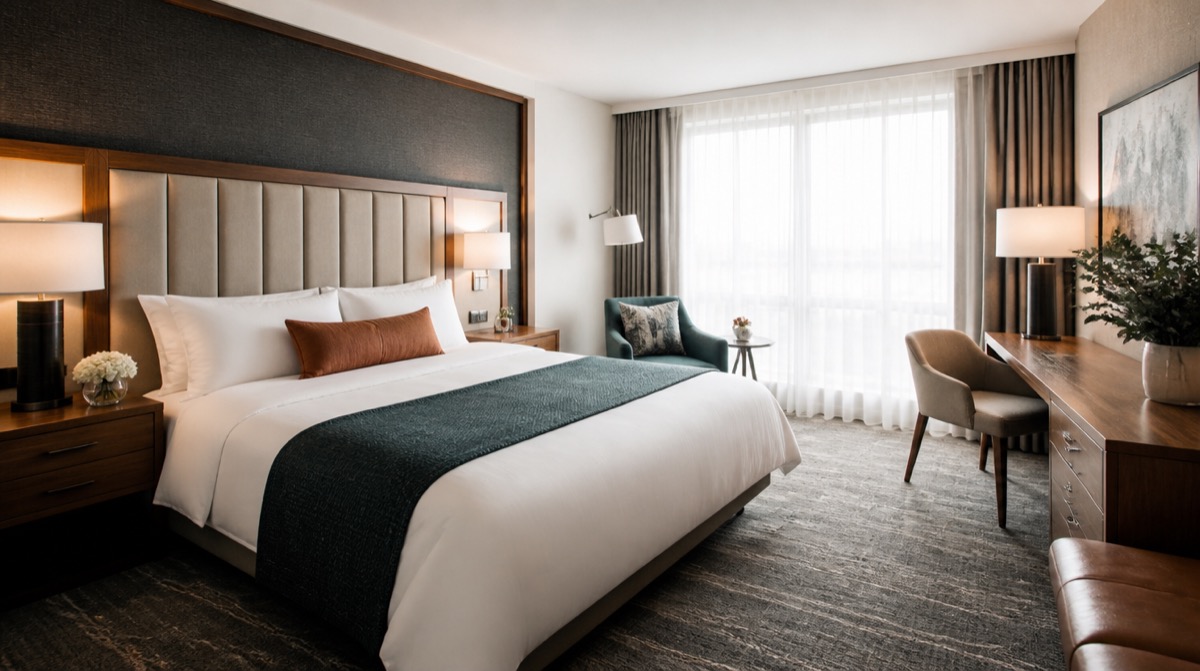
Commercial hotel furniture has to do something residential furniture never does. It has to look inviting to every guest while surviving thousands of them, plus housekeeping, banquet staff, and years of daily use. Sourcing commercial hotel furniture well means understanding that a hotel is really four different environments (lobby, guest rooms, food and beverage, and event space), each with its own durability demands, price points, and lead times. Here is how procurement teams spec a complete property without overpaying or ending up with pieces that fail in eighteen months.
Start with the four zones
A hotel is not one furniture order. It is four coordinated ones, and treating them as a single package keeps your look consistent and your pricing sharper.
Lobby and public areas set the guest's first impression, so this is where design-forward lounge seating, occasional tables, and reception pieces live.
Guest rooms are the highest-volume zone, where casegoods and seating get multiplied by your room count, so small per-unit savings scale fast.
Food and beverage covers restaurant, bar, and cafe seating that faces spills, grease, constant wiping, and heavy turnover.
Event and meeting space is banquet and ballroom furniture built to be set up, stacked, and stored several times a week.
Specifying all four together lets a supplier coordinate finishes and quote volume pricing across the whole property rather than piecemeal.
Durability specs that actually matter
The line between commercial and residential furniture is not marketing, it is measurable. Commercial upholstery should hit 50,000 or more Wyzenbeek double rubs, compared with just 10,000 to 15,000 for residential fabric. That difference is why a hotel sofa still looks presentable after years while a residential-grade one wears through.
Look for commercial foam in the 35 to 40 ILD range, which holds its shape under constant use instead of collapsing. Frames should be hardwood or welded metal, joints should be corner-blocked and glued rather than stapled, and any high-touch surface in F&B should specify a cleanable, moisture-resistant upholstery. For guest room casegoods, ask about edge banding and laminate grades that resist chipping from luggage and housekeeping carts.
Furnishing the lobby and public spaces
The lobby is where you spend on statement pieces, but they still have to be contract grade. Lounge chairs for hotel public areas typically run 300 to 900 dollars per unit at volume depending on frame, fill, and upholstery. Pair them with durable occasional tables and reception seating that reads high-end but shrugs off constant contact.
The trap here is buying residential-looking pieces that cannot take the traffic. A lobby chair may be sat in dozens of times a day by guests with luggage, wet coats, and coffee. Spec the same 50,000-plus double-rub fabric and commercial foam you would use anywhere else, just in a more design-driven silhouette.
Guest rooms and casegoods
Guest rooms are where volume pricing pays off most, because every dollar saved per unit multiplies across your room count. Casegoods (the dressers, nightstands, desks, and storage) plus headboards and seating make up the bulk of the spend. Because these pieces repeat identically across every room, small spec decisions ripple into big budget numbers.
Prioritize scratch and moisture resistance, since housekeeping cleans these surfaces daily. Coordinate your dressers and other casegoods finishes with headboards and soft goods so the room reads as a designed set rather than assembled parts. This is also the zone where custom finishes are most common, which matters for your timeline (more on that below).
FF&E packages and how they save money
FF&E (furniture, fixtures, and equipment) packages bundle a property's entire furniture scope into one coordinated order, and this is where serious procurement savings live. Volume price breaks step down at 50, 100, 250, and 500 or more units, so a full-property package that crosses those thresholds earns better pricing than zone-by-zone buying.
A package approach also gives you one point of accountability for finishes, freight, and delivery scheduling, which matters when you are coordinating an opening or a phased renovation. When you are ready to price a full property, request a quote with your room count and zone breakdown so the numbers reflect real volume tiers rather than list prices.
Plan around lead times
The most common sourcing mistake is underestimating lead time. Custom finishes and custom upholstery run a 10 to 14 week lead time, and that clock starts after specs and approvals are locked, not when you first inquire. For a new-build opening or a full renovation, that means your furniture decisions need to be final months before your target date.
Stock and standard-finish items move faster, so a smart strategy mixes custom statement pieces with standard-finish workhorses to protect your timeline. Build in buffer for freight, delivery windows, and installation, and confirm lead times in writing before you commit to an opening date.
Sourcing hotel furniture locally
Hotel projects benefit from a supplier who understands the local market, from freight lanes to installation crews to the design language guests expect in that city. Browse our commercial furniture supplier directory by city to find your market, or start with a hotel furniture guide for New York, Los Angeles, Chicago, Miami, or Las Vegas.