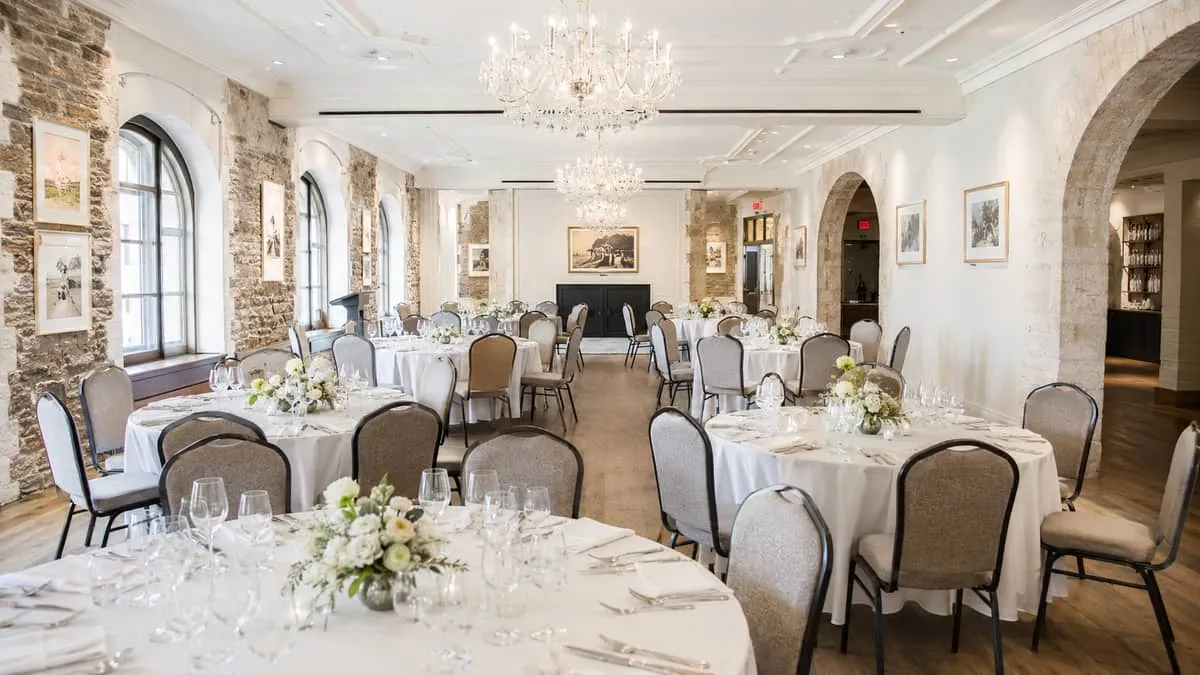
Quebec City operates as two distinct but overlapping hospitality economies. The first is driven by the provincial government. As the capital of Quebec, the city hosts a constant cycle of ministerial dinners, National Assembly receptions, intergovernmental summits, and official functions where French-language protocol is not a preference but a legal and cultural obligation. The second economy is tourism, anchored by Winter Carnival, the Festival d'ete de Quebec, and a destination wedding market that draws couples from across Canada and internationally. Both economies demand banquet furniture that performs under pressure. Neither tolerates visible shortcuts.
Understanding which economy your venue serves, or how it serves both simultaneously, is the starting point for any serious furniture procurement decision in this market.
Government and Official Functions: Where Protocol Sets the Standard
Quebec City venues that cater to provincial government events operate in a context that most Canadian hospitality markets never encounter. Ministerial dinners hosted at properties along Grande Allee, reception functions adjacent to the National Assembly, and intergovernmental gatherings in the Haute-Ville carry formal expectations that are embedded in Quebec's distinct administrative culture. French-language protocol governs everything from place card formatting to service sequencing, and the physical environment is expected to match that formality.
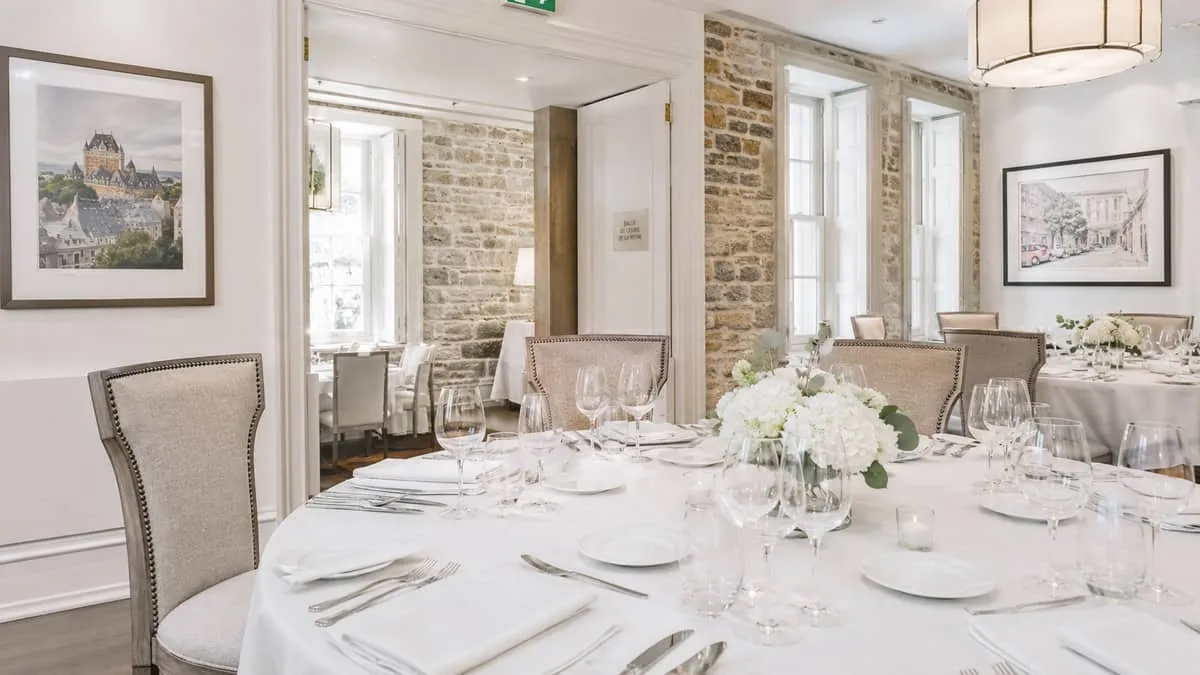
For these events, banquet chair selection is not primarily a cost-per-unit conversation. Fully upholstered banquet chairs in neutral, high-quality fabrics, preferably in tones that complement the warm stone interiors common to Quebec City's government-adjacent venues, are the expected standard. Chair frames should be metal or solid wood construction without visible manufacturing shortcuts. Seat depth and back height matter because these are often long, formally seated events. Stacking capability is still relevant for storage, but the visual profile when chairs are set at table is what clients are evaluating.
Round banquet tables in 60-inch or 72-inch formats remain standard for plated dinner configurations. Linen service is universal at this level of event, which means the table surface itself is secondary to leg stability and height consistency across an entire room. Any variance in table height across a formal set creates a visual inconsistency that is immediately apparent in a plated dinner environment. Invest in tables with reliable leg mechanisms and consistent height tolerances.
Venues that host both government functions and general commercial events benefit from keeping formal and casual inventory separate. Cross-contaminating your premium banquet chair inventory with the chairs used for staff training days or casual reception setups accelerates wear and creates inconsistencies that show up at the worst possible times.
Winter Carnival Corporate Hospitality: Speed, Volume, and Cold
February in Quebec City is a category of its own. Winter Carnival is the world's largest winter carnival, drawing hundreds of thousands of visitors into a relatively compact hospitality market over roughly two weeks. For venue operators, Carnival is not just a busy period. It is a compression event where setup speed, furniture volume, and turnover capacity determine how much revenue you actually capture.
Corporate hospitality during Carnival follows a specific pattern. Companies bring clients and employees into the city for the spectacle, then need indoor warming venues for meals, receptions, and private functions. The demand is real but the window is short and the logistics are punishing. Snow accumulation, loading dock access complications, and the sheer volume of simultaneous venue activity across the city means that any furniture that requires complex setup or specialized staff is a liability during this period.
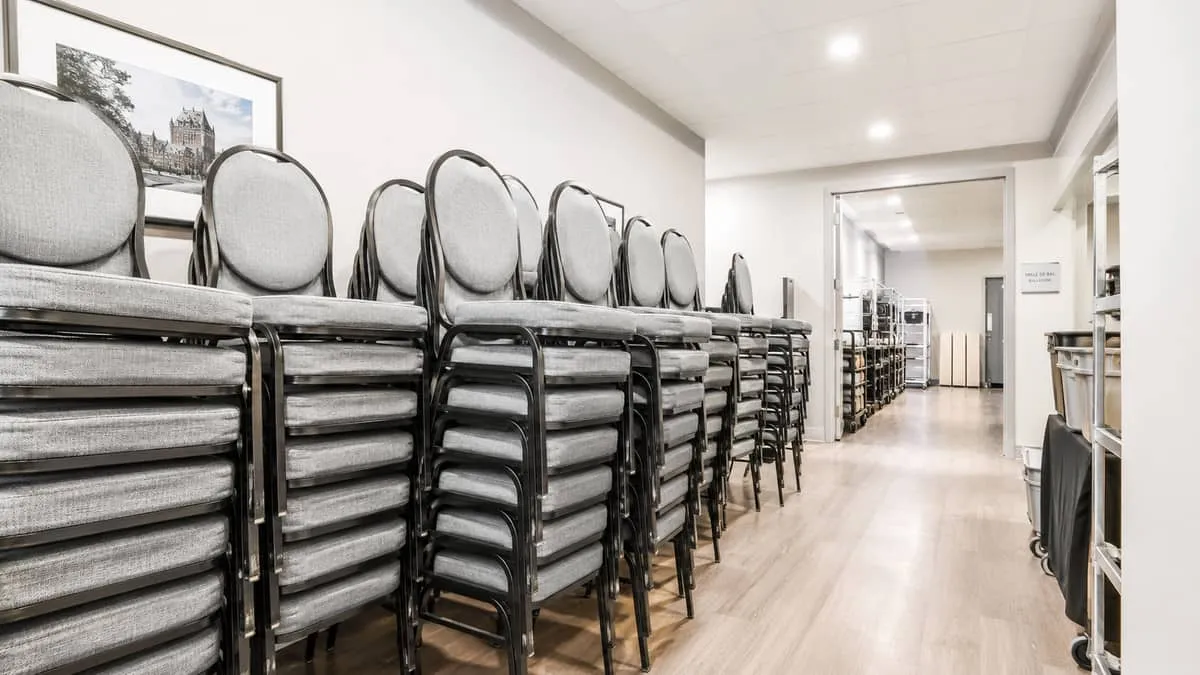
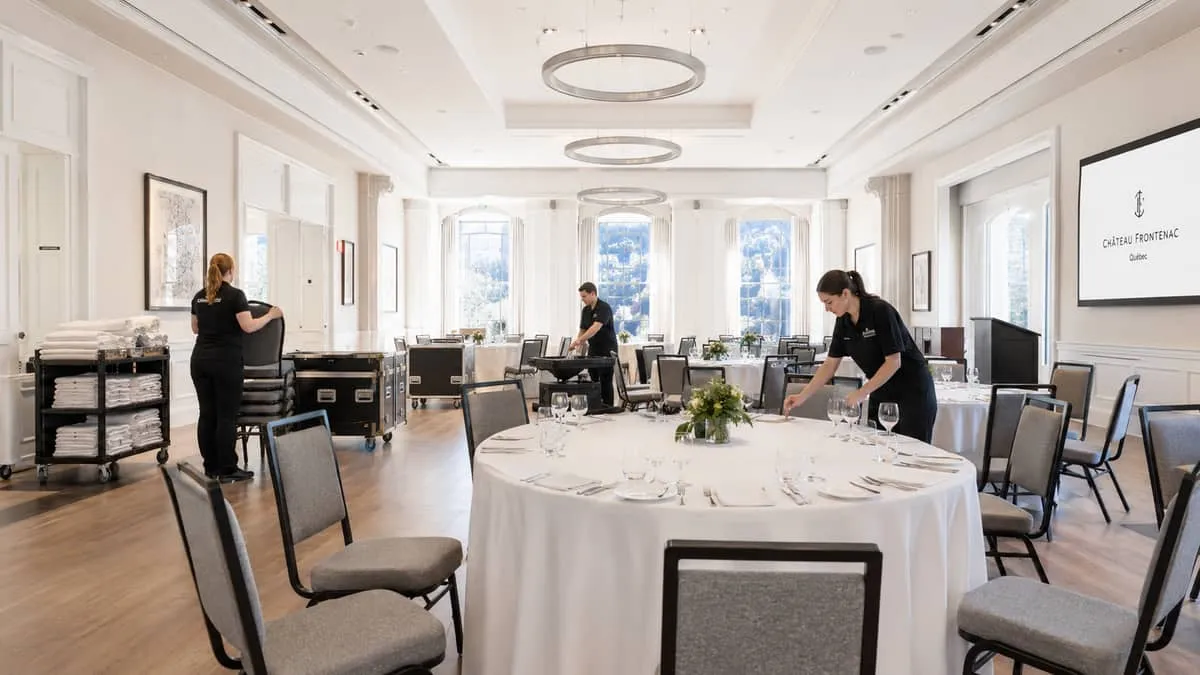
Stacking banquet chairs that load onto transport carts at 10 or more per cart, and that can be set and cleared by a small crew in predictable time, give your operations team the ability to turn rooms over efficiently when Carnival demand is at its peak. Folding tables with one-hand or two-hand mechanisms that open and level quickly are the operational backbone of high-volume Carnival hospitality programming. These are not glamorous specifications, but they are the difference between capturing two seatings per evening and managing only one.
Furniture durability in Quebec City's climate also warrants specific attention. Equipment stored in loading areas, back-of-house corridors, or secondary storage spaces is exposed to significant temperature variation across the year, from the deep freeze of a Carnival-week unloading dock to the humidity of a July festival weekend. Metal frame chairs and tables with powder-coat finishes hold up better through these thermal cycles than cheaper alternatives. BIFMA-certified commercial construction is the baseline specification to require from any supplier pitching to this market.
For the warming-venue format common during Carnival, rectangular folding tables in 6-foot and 8-foot formats are heavily used for buffet lines, self-serve beverage stations, and high-volume casual seating configurations. Having sufficient rectangular table inventory alongside your round banquet sets gives your team the flexibility to configure the room for the event type without supplementing from a rental company at peak-season premium pricing.
Destination Weddings in Old Quebec: Furniture as Part of the Premium
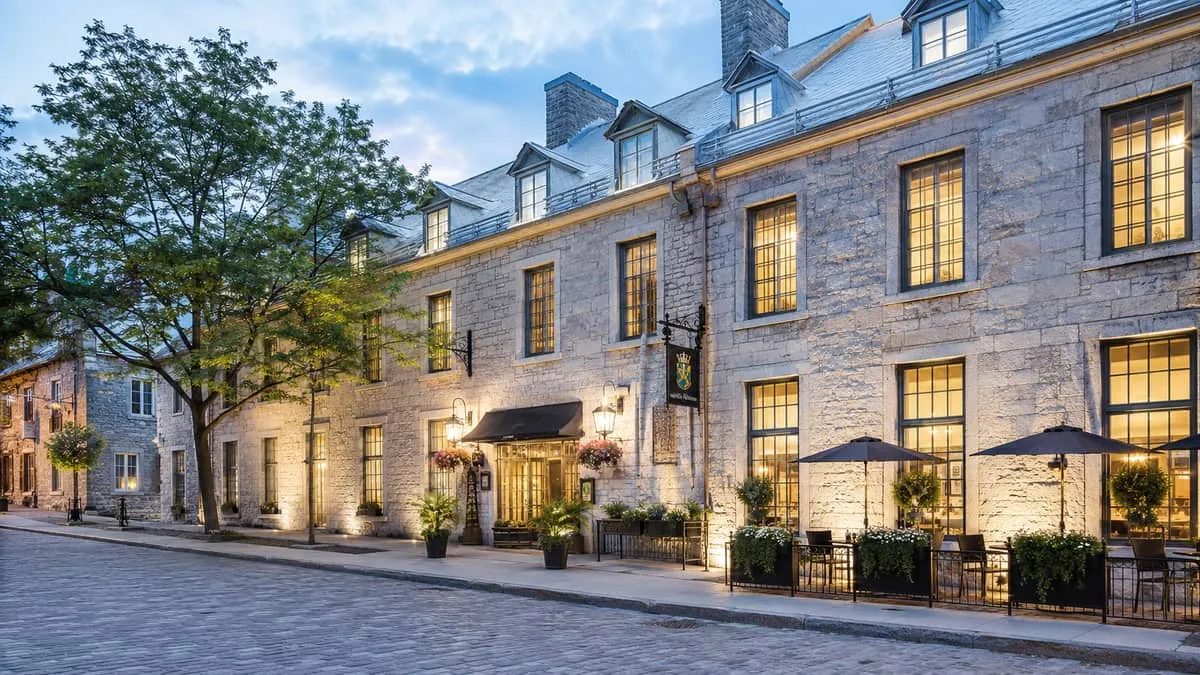
Quebec City is one of Canada's most sought-after destination wedding markets. The UNESCO World Heritage Site designation, the concentration of boutique hotels in Old Quebec relative to the city's size, and the European atmosphere of Basse-Ville and Haute-Ville create a setting that couples are willing to travel significant distances and pay significant premiums to access. Properties like the Auberge Saint-Antoine in Basse-Ville and the institutional grandeur of the Fairmont Le Chateau Frontenac sit at opposite ends of the scale and aesthetic spectrum but both operate in a market where the furniture quality is factored directly into what couples are willing to pay for a venue.
Chiavari chairs remain the standard for formal Quebec City wedding receptions. Gold and champagne finishes continue to perform well in the warm, candlelit environments of Old Quebec's stone-walled event spaces. Resin Chiavaris are the practical choice for most venue operators: they replicate the visual profile of aluminum Chiavaris, resist the humidity fluctuations that stone buildings experience seasonally, and carry meaningfully lower per-unit replacement costs across a venue's operational life. For venues running 80 to 150 weddings per year, that replacement cost differential compounds quickly.
Cross-back chairs and ghost chairs have gained share in the Quebec City wedding market, particularly for couples who prefer a warmer, bistro-influenced aesthetic over formal grandeur. Venues that can offer both a classic Chiavari configuration and a cross-back or ghost chair alternative give their sales team a broader range of couples to close, without needing to carry an unwieldy number of different chair styles. Two strong chair families, selected carefully, serve most of the market.
Farm tables and mixed round-and-rectangular layouts have also grown in the Quebec wedding market. Couples arriving for a destination wedding with a clear aesthetic vision often reference European models, and long farm table configurations are a consistent part of that visual language. If your venue is positioned in the mid-to-upper segment of the destination wedding market, having a farm table inventory alongside your round banquet tables expands the configurations you can sell without an external rental dependency.
The financial logic here is direct. A venue that controls its furniture inventory, can turn over a room to multiple different configurations, and does not need to supplement from a rental company for any of its core event formats has a lower variable cost per event and a higher net margin per booking. In a wedding market this competitive, that margin is what funds the reinvestment cycle that keeps the venue competitive.
Old Quebec Delivery and Storage: The Practical Constraints No One Warns You About
Sourcing and delivering banquet furniture into Old Quebec is operationally different from any other Canadian hospitality market. Cobblestone streets, narrow passage access points, heritage building protections, and stairwell constraints in historic properties create logistics challenges that suppliers who have never delivered into the Haute-Ville or Basse-Ville do not understand until they are standing at a loading entrance that their standard equipment cannot navigate.
If you are purchasing furniture for a venue inside Old Quebec's walls, the logistics conversation with your supplier needs to happen before the purchase order, not after. Confirm that the supplier has delivered into comparable heritage building environments, that their delivery vehicles and methods are compatible with your specific access point, and that their warranty and service process can function in French. National suppliers with Ontario or US manufacturing can and do serve this market successfully, but they need to demonstrate that capability explicitly, not assume it transfers from their standard delivery operations.
For venues in newer commercial districts, Sainte-Foy and Lebourgneuf being the primary examples, standard commercial delivery terms apply and the logistics constraints are minimal. The Old Quebec premium applies specifically to properties within the historic walls and immediately adjacent heritage districts.
Storage planning deserves equal attention. Banquet furniture for 300 guests requires storage space that most operators do not budget adequately when they are designing or renovating. Stack carts and transport dollies are not accessories. They are essential equipment that reduces staff injury risk and speeds room turnover, and they require their own dedicated footprint. Chair models that stack 10 high on a cart occupy significantly less storage floor space than models that max at 6 high. In the compact back-of-house areas common to Old Quebec's historic buildings, that difference can determine whether your full inventory fits in your actual storage space or starts spilling into areas you cannot afford to lose.
Vertical table storage racks recover meaningful floor space compared to flat stacking and are worth specifying before furniture arrives, not retrofitted after you realize flat stacking is creating access problems. The investment in proper storage infrastructure pays back in crew efficiency and furniture longevity.
Building a Furniture Program Across Quebec City's Calendar
The venue that operates well in Quebec City's hospitality market runs a full calendar that moves from New Year's functions in January, through Carnival corporate hospitality in February, into spring government events along Grande Allee, through a wedding season that runs May to October, and into the Festival d'ete corporate entertaining peak in July. No two months look the same. The furniture program that serves all of these contexts is built around a core of versatile, durable inventory supplemented by category-specific items that cover the segments where your venue competes.
A practical core inventory for a mid-to-large Quebec City event venue includes: fully upholstered banquet chairs in a neutral fabric suitable for formal government and gala events; Chiavari chairs in a finish that complements your space for wedding and premium social events; stacking chairs on transport carts for high-volume setup and breakdown scenarios; 60-inch and 72-inch round folding tables as the primary banquet format; 6-foot and 8-foot rectangular folding tables for buffet and support configurations; and a supplementary inventory of farm tables or cross-back chairs if your venue targets the destination wedding segment specifically.
This is not the cheapest path. Contract-grade commercial furniture built to BIFMA standards at competitive per-unit pricing requires a real capital commitment. But the alternative, rebuilding cheap inventory every two to three seasons while losing events to competitors whose furniture looks and functions better, is more expensive across any reasonable time horizon.
Quebec City's hospitality market rewards venues that operate with visible quality and operational reliability. The guests arriving for Carnival are comparing the experience to what they see on social media from the Chateau Frontenac. The couples selecting a destination wedding venue are comparing Old Quebec to European alternatives they could have chosen. The government officials and their staff attending ministerial dinners along Grande Allee bring formal expectations that the setting confirms or contradicts. Your furniture is part of that confirmation. Get the specification right, build the inventory around the calendar you actually run, and the returns compound across every season.
Tell us about your Quebec City banquet and event furniture needs and we will turn your quantities, finishes, and timeline into a firm quote. Request a quote whenever you are ready to compare.