
A banquet chair purchase includes more than the seats in the room. It also includes the stacks, carts, doorways and storage space needed to move that inventory between events. Choose the chair and its handling system together, then compare prices against that complete specification.
Browse banquet chairs once you have a working quantity. This guide covers selection and operations; the banquet chair cost guide covers delivered cost and quote comparisons.
Size the inventory to simultaneous demand
Annual event count does not tell you how many chairs to own. The useful number is the largest seating demand across rooms that operate at the same time, plus a separately chosen reserve for cleaning, repair and replacement.
A planning example: one room needs 120 chairs while another needs 80. That booking requires 200 available chairs. If 10 chairs are unavailable for cleaning or repair, 210 owned chairs would cover that specific situation. Those numbers illustrate inventory arithmetic, not a recommended reserve or purchasing threshold.
Use the banquet seating planner for each room, then check the combined schedule. If ceremony chairs are reused for a reception, confirm that the teardown, transport and reset fit between bookings. Count both sets when that reuse cannot happen in time.
Compare the exact chair, not just the frame material
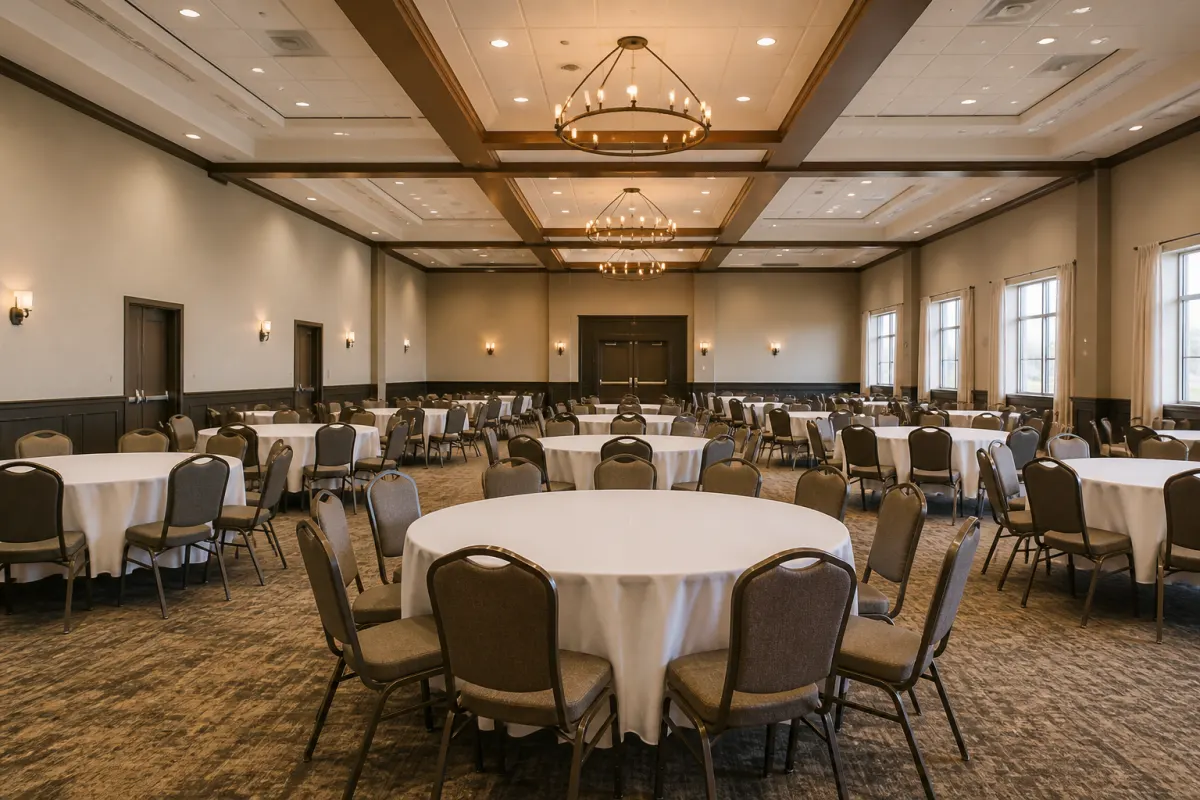
Steel, aluminum, wood and molded designs should be judged by the finished model's documented use, construction and handling requirements. Material alone does not establish a safe load, stack height or service life.
For metal frames, inspect welds, fasteners, stacking-contact points and finish coverage. For wood frames, examine joints and the maker's care requirements. For molded chairs, confirm the permitted environment and stacking method. Compare actual chair weight because staff lift that weight during every reset.
Ask which test standard and configuration support the stated performance. The BIFMA Compliant program provides a registry for products tested to applicable BIFMA standards; a generic commercial label is not a registry entry. Confirm the proposed model's evidence and its stated limits.
Check the seat, upholstery and cleaning method
Sit in the sample long enough to judge the seat edge, back support and ease of standing. Compare foam thickness, construction and the manufacturer's cushion specification. Ask for foam density and firmness separately; one should not be substituted for the other.
For upholstery, record the textile name, test method, result and approved cleaning products. Abrasion is one input. ACT notes that results above its high-traffic guideline do not establish longer fabric life; application, care and other wear mechanisms matter too. See ACT's abrasion guidance and use the fabric durability checker to compare the relevant information.
Get written approval for the cleaning products staff actually use. Also ask whether glides, stacking bumpers, upholstery panels or seat pads can be replaced and whether the parts have an orderable identifier.
Treat the chair and cart as one system
A floor stack and a loaded rolling cart can have different limits. Obtain the manufacturer's approved stack count for each, the compatible cart model and its load rating. Do not increase a stack just because another chair looks similar.
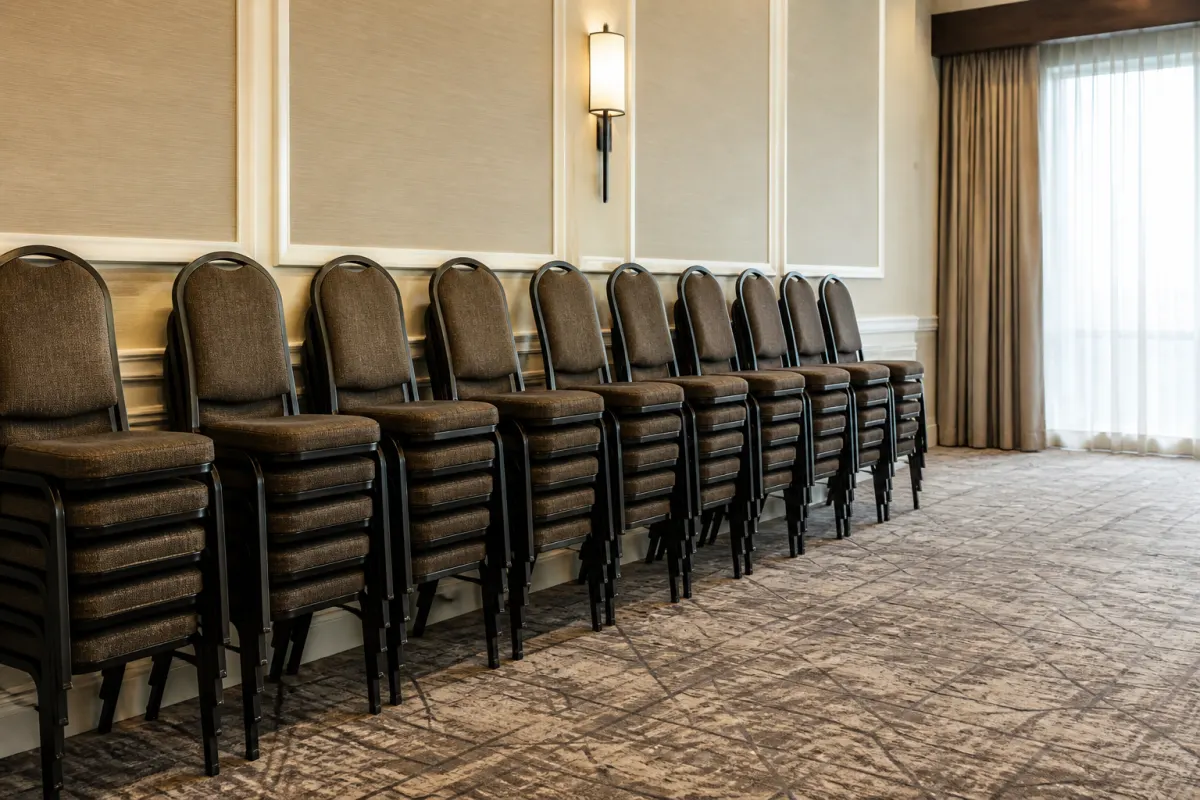
Record the loaded cart's width, length and height, including handles. Compare them with the narrowest service doorway, elevator opening, turning space and storage approach. Check loaded weight against the cart and elevator limits.
The basic count is:
Carts required = chair quantity divided by approved chairs per cart, rounded up.
For example, 180 chairs with a manufacturer-approved 12-chair cart arrangement require 15 carts. The actual storage room needs room for those carts and usable access between them; multiplying cart footprints alone does not prove they can be maneuvered in and out.
The banquet chair storage guide covers storage planning separately. Confirm the proposed system with the supplier before buying carts or committing to a stack count.
Run this sample acceptance check
Use the same checklist for every shortlisted model and keep the results with the quote:
- Identity: the sample matches the quoted model, finish and upholstery.
- Room fit: seat and arm heights suit the actual table; guests can enter and leave the position.
- Handling: staff can lift and position it using the intended working method.
- Stacking: it stacks as the manufacturer instructs, without unexpected leaning, contact damage or snagging.
- Transport: the compatible loaded cart fits the route and storage approach.
- Maintenance: the cleaning method is approved and wear parts can be identified.
- Documentation: intended use, test evidence, warranty and configuration are recorded.
A sample review checks suitability for your room and staff. It does not replace structural testing, and the chair should not be loaded beyond the manufacturer's instructions.
Fit the chair to every planned layout
Overall chair width and depth determine its footprint. Seat height, seat width and arm height answer different fit questions. Keep those measurements labeled in your comparison.
Check the chair with round tables, rectangles and any theater-style layout you intend to run. Chair pullback space and an accessible circulation route serve different functions. Keep the route and exit requirements in the room plan and have the responsible designer or authority verify the final arrangement.
The banquet chair dimensions guide supports that comparison. A chair that fits one table arrangement may reduce capacity in another.
Compare warranties and costs by scope
Ask what the warranty covers on the frame, upholstery, foam, glides and stacking-related components, and what it excludes. Record who handles a claim and whether labor or freight is included. A long frame term does not describe the coverage on every part.
Price chairs, carts, covers, replacement parts and delivery separately. Use the cost guide to compare the same complete package between suppliers. Keep quantities tied to the approved layouts and operating reserve.
Prepare the order and delivery window
Send the supplier the model, configuration, quantities, sample approval, delivery address and required ready-for-use date. Include dock access, liftgate needs, service-elevator limits and the receiving contact. Specify whether unloading, unpacking and placement belong in the quote.
Ask for a schedule that separates approvals, production, shipment, receiving and inspection. Leave time to resolve a damaged or short shipment before the first booking. Confirm any made-to-order fabrics or finishes through the custom program, and request a quote against the final chair-and-cart package.
Check where the complete chair order will live
Test a loaded cart through the actual doors and lifts between the event room and storage. Record the supported stack height for the exact model, and include carts and protective equipment in the order.
If stacks remain in a multipurpose room between events, assess the stored footprint and appearance as part of the purchase. Confirm that the room can still serve its next use without placing stacks in circulation routes.