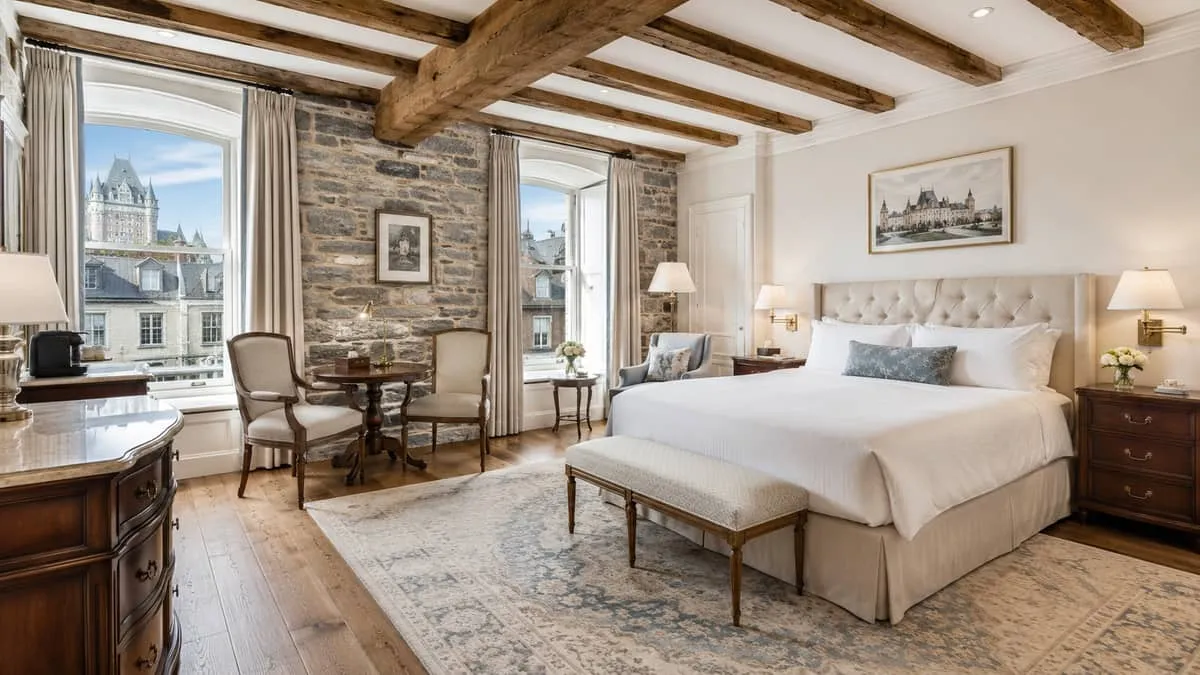
In most Canadian cities, a boutique hotel operator chooses a design direction and then sources furniture to match it. In Quebec City, the building makes the choice for you. Old Quebec is a UNESCO World Heritage Site where the architecture, the street scale, the materiality of the walls, and the layered history of the place constitute the most legible design brief of any hospitality market in Canada. Operators who recognize this and furnish accordingly build properties with a coherent identity that guests remember. Operators who ignore it produce rooms that feel generic in a setting that is anything but.
The guest arriving at a boutique property in the Basse-Ville or the Haute-Ville is not arriving in a neutral context. They have just walked past Place Royale, the site of the first permanent French settlement in North America. They have looked up at the Château Frontenac anchoring the cliff above them. They have navigated cobblestones and centuries of accumulated stone construction. Their benchmark for what this room should feel like is already set before they touch the door handle.
Old Quebec as the Furniture Brief: What Auberge Saint-Antoine Got Right
Auberge Saint-Antoine in the Basse-Ville is the clearest example of what it looks like when a Quebec City property treats its physical context as a design asset. The hotel was built on a site where archaeological excavations uncovered artifacts from the 17th and 18th centuries: navigational instruments, trade goods, domestic objects from the merchant and military history of the port. Rather than relocating those artifacts to a museum and covering the site, the property integrated them directly into the guest experience. Artifacts are displayed in cases built into the walls of guest corridors and public spaces. The furniture palette in common areas responds to the material language of those objects: rough-hewn wood, aged iron hardware, textiles in the earthy tones of a pre-industrial Atlantic world.
The result is a property that international travelers who have stayed at Relais and Chateaux properties in Burgundy or Provence immediately recognize as operating at the same level of intentionality. The furniture is not decorating a room. It is participating in an argument about place and history that the building itself is already making.
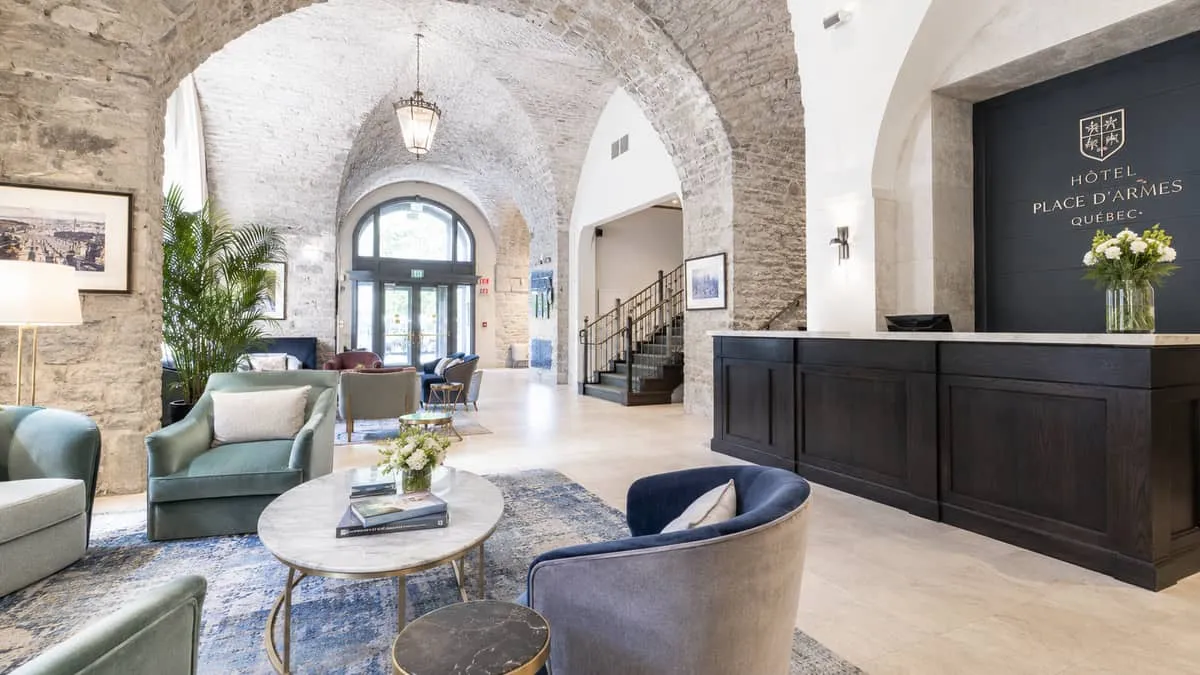
This is the standard the Quebec City boutique market is now calibrated against. Properties on Rue Saint-Paul and throughout the Petit-Champlain quarter are operating in the same competitive set, and their furniture sourcing decisions are evaluated against this benchmark whether they intend it or not.
The Basse-Ville Palette: Material Language of the Lower Town
The Basse-Ville, the lower city clustered around Place Royale, Rue du Petit-Champlain, and the waterfront, has a material palette that reflects its mercantile and working history. Stone warehouses, thick timber construction, iron hardware, surfaces that have been used hard and show it. The hospitality furniture that works in this context shares several consistent characteristics.
Wood treatments lean toward rough-sawn or hand-planed surfaces rather than high-gloss finishes. Oak and walnut in wire-brushed or lightly distressed finishes read as authentic in this context. Heavily lacquered or overly smooth case goods feel imported from a different design language. Contract-grade pieces in this palette need to achieve a surface texture that reads as worn without being structurally compromised, which means working with manufacturers who understand the difference between decorative distressing and finish failure.
Iron is the right metal for hardware, bed frames, and accent elements in Basse-Ville properties. Blackened iron or oil-rubbed bronze finishes on drawer pulls, curtain rods, and light fixtures maintain the palette while meeting the durability requirements of commercial use. Chrome and brushed nickel read as wrong here.
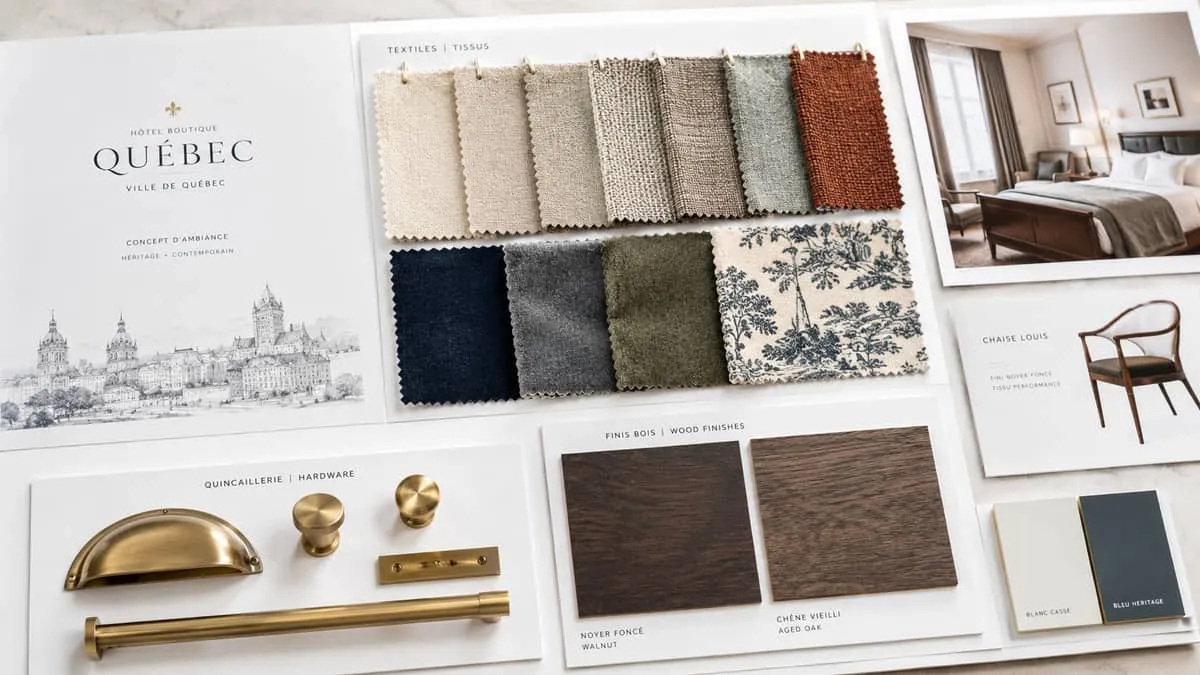
Textiles in this context reference Quebec's own textile history. The province had a significant wool and linen weaving tradition, and fabrics in natural fibers with visible weave structure, muted jewel tones, or the indigo and cream of historical Quebec artisan work all function well. For contract purposes, these looks are achievable in high-rub-count blended fabrics that meet hospitality durability standards without using fragile natural fibers that cannot handle commercial cleaning cycles. Headboards and upholstered seating in this palette should specify fabrics with a minimum 30,000 double rubs for guest room applications, 50,000 or higher for lobby and corridor seating.
Artifact display integrated with furniture is a design move that Auberge Saint-Antoine pioneered in this market and that other Basse-Ville properties are finding ways to adapt. This does not require actual archaeological finds. Antique maps, historical objects, period-appropriate trade goods displayed in millwork built into room furniture create the same sense of layered history without the curatorial complexity. When specifying case goods for properties with this design intent, coordinating with a millwork supplier who can integrate display niches into headboards, wardrobes, or console tables is worth the additional planning time.
The Haute-Ville Palette: Formality on the Cliff
The upper city, anchored by the Château Frontenac and the institutions of the provincial capital, carries a different furniture language. Where the Basse-Ville palette is rough, mercantile, and horizontal in its references, the Haute-Ville palette is more formal, more vertical, and more explicitly French in its colonial inheritance.
Properties on or near the Grande Allée, around the Parliament buildings, and in the Saint-Jean-Baptiste quarter adjacent to Rue Saint-Jean are working with a context that references the administrative and ecclesiastical architecture of New France. The furniture that belongs here has more refined joinery, darker woods, and upholstery in materials that acknowledge that formal tradition.
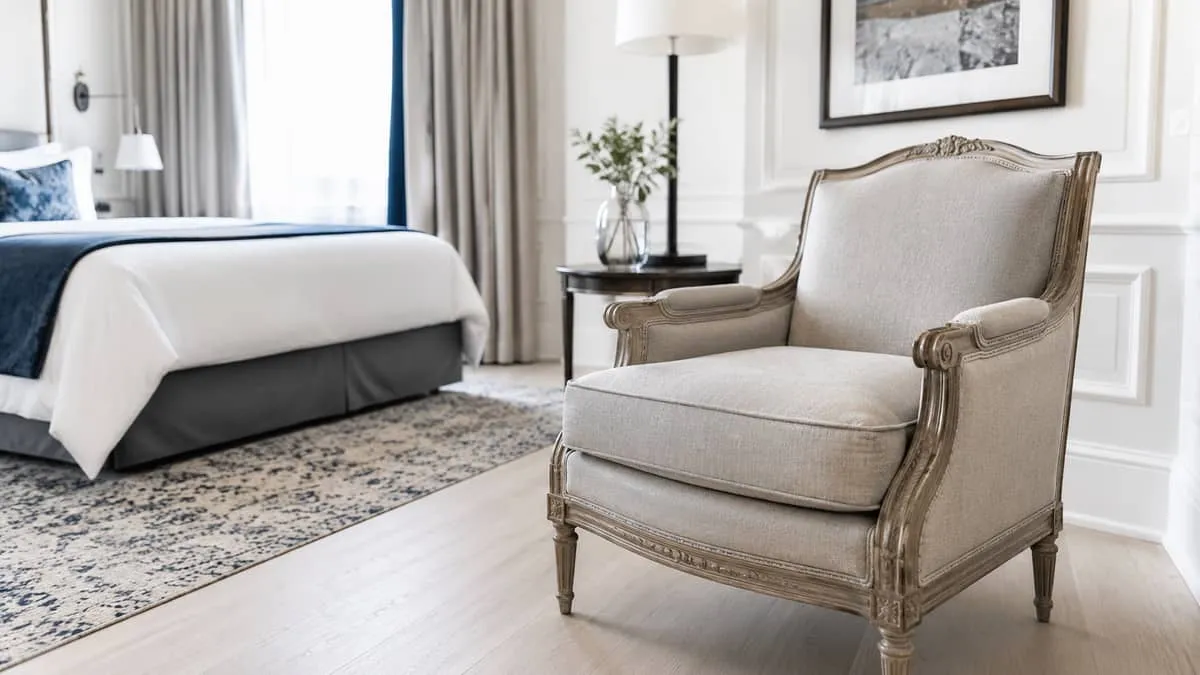
Dark walnut and mahogany-finish case goods read correctly in this context. Chair and sofa frames with turned legs or modest carved detail reference the Louis XV and Louis XVI influences that travelled with French colonization and never entirely left Quebec's formal furniture tradition. This is not a call for reproduction period furniture, which is rarely built to commercial standards and reads as costume in a working hotel. It is a call for contemporary contract furniture that acknowledges those proportions: taller chair backs, more formal seat heights, leg profiles that have some carving or turning rather than the plain tapered legs that work in a Scandinavian-influenced property.
Upholstery in the Haute-Ville context leans toward wool, leather, and velvet in deep greens, burgundy, navy, and charcoal. These are the colors of the Quebec City winter interior, the colors of legislative chambers and formal dining rooms that have been in continuous use for generations. In contract terms, wool-blend fabrics with high durability ratings are the practical choice. Full-grain leather on seating that will take heavy use develops a patina that works in this context where it would look shabby in a lighter-toned, more casual property.
Window treatments in the Haute-Ville context should be weighted and substantial. Lined drapery in wool or heavy linen, floor to ceiling, communicates the formality of the setting and also serves a genuine function in a Quebec City winter, reducing heat loss through heritage windows that are rarely well-insulated.
Competing for the Relais and Chateaux Traveler
The guest who has stayed at Les Baux-de-Provence or Château de la Treyne arrives in Quebec City with a specific set of expectations. They are not price-sensitive in the way a leisure traveler is. They are quality-sensitive in ways that are harder to satisfy with a procurement budget alone. What they are evaluating is coherence: does every element of this space, from the furniture scale to the fabric texture to the hardware finish to the quality of the mattress, tell a consistent story?
For furniture sourcing, this means that the weakest piece in the room sets the perception of the whole room. A beautifully specified upholstered headboard loses its effect if the desk chair is clearly a lower-quality piece sourced from a different supplier with no visual relationship to the rest of the room. Relais and Chateaux travelers notice these discontinuities because they have stayed in properties where someone controlled for them.
The practical implication for Quebec City boutique operators is that furniture sourcing needs to happen from a coordinated brief, not category by category. Case goods, seating, lighting, textiles, and hardware should be specified together, with explicit decisions made about which elements carry the most visual weight and deserve the most investment. In most heritage guest rooms, the headboard and upholstered seating are the two pieces that define the room's character. Those are the right places to put budget. The desk, the luggage bench, and the nightstands can be specified more economically if they are coherent with the palette.
Suppliers who have experience working with independent boutique properties rather than chain hotels understand this logic. They are accustomed to conversations about design intent and can advise on where specification decisions will have the most impact on guest perception.
Heritage Buildings, Small Runs, and the Coordination Problem
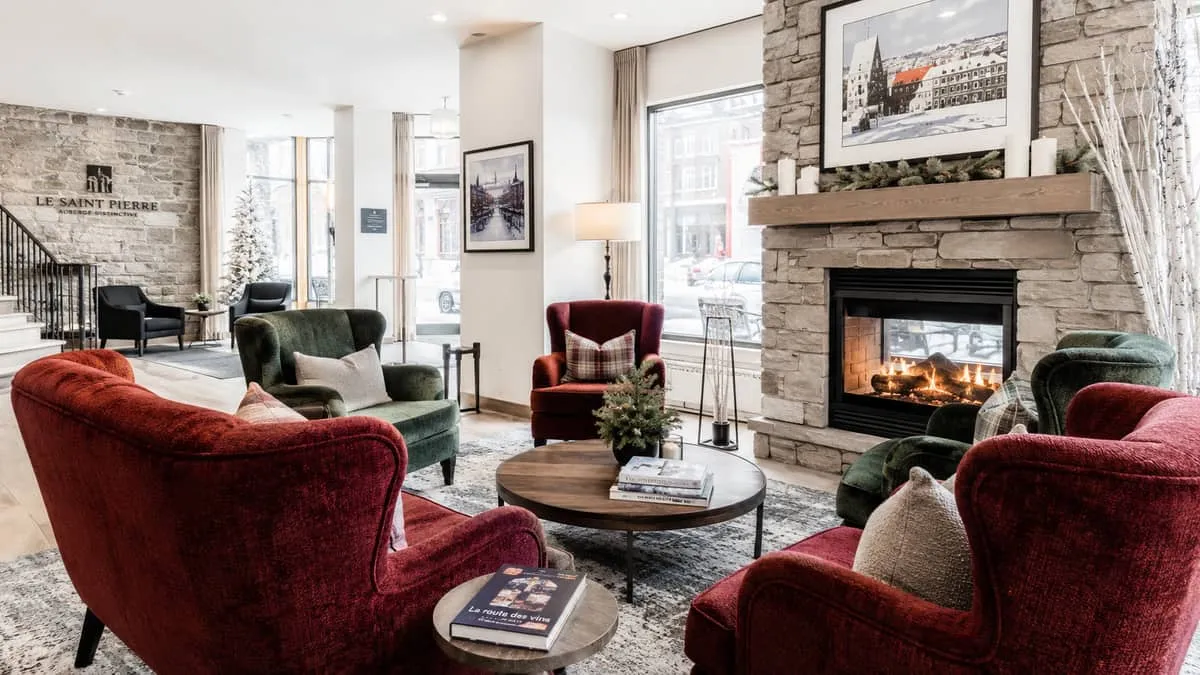
Quebec City boutique properties are rarely large. Converted convents, merchant houses, and early commercial buildings in the Old City produce guest rooms that are irregular in shape, with varying ceiling heights, deep window wells, and load-bearing stone walls that cannot be moved. Corridors are narrow. Elevators, if they exist, were retrofitted and have limited capacity.
This creates a furniture sourcing problem that is different from a new-build hotel. Case goods need to be specified with exact dimensions for each room type, because standard sizes often do not fit the available footprint. Pieces need to be deliverable and installable through constrained access points. And the total quantities are small: a 20-room property in the Petit-Champlain area might need 20 desk chairs, 40 nightstands, and 20 upholstered benches, which is below the minimum order threshold for many large contract suppliers.
The workable model for most Quebec City boutique operators combines a primary contract supplier who is flexible on quantities with a local upholstery partner in the Quebec City or Quebec metro region who can produce custom headboards, window treatments, and any upholstered piece that needs to be fitted to a specific room configuration. Regional manufacturers in Quebec sometimes offer shorter lead times and more flexibility on small runs than importing from US or European suppliers, and they are accustomed to the heritage building constraints that come with Old City projects.
The renovation window in Quebec City is narrow. The highest-demand periods are Winter Carnival in January and February and the summer festival season through July and August. Renovation and re-furnishing work is most practically scheduled for the shoulder seasons: late September through November, or March through May. Lead times for custom or semi-custom furniture need to be calculated against these windows, not against a hypothetical open calendar. A supplier who quotes a 16-week lead time on a custom upholstery order needs to be evaluated against the date your property needs to be operational, not just whether 16 weeks is abstractly acceptable.
Durability in a Climate That Tests Everything
Quebec City winters are not gentle. De-icing salt tracked in from the streets of the Old City in January is corrosive to fabric and damaging to wood finishes. Entry area furniture, lobby seating, and any piece near exterior doors needs to be specified with this in mind. Commercial upholstery fabrics with moisture resistance and soil release properties are not optional in this climate. They are baseline.
The Summer Festival and the warm season from June through September bring a different kind of stress: high occupancy, heavy foot traffic through common areas, and guests who are spending long days walking the city and returning tired and less careful than they might otherwise be. Frame construction needs to handle the cumulative load of back-to-back high-occupancy periods. Kiln-dried hardwood frames with mortise-and-tenon joinery will hold through multiple seasons of this kind of use. Frames built on staple construction or softwood will show fatigue within two or three years.
The seasonal swing also affects patio and terrace furniture for properties that have outdoor space. Quebec City's summer patio season is real and profitable, running from June through September. Furniture for these spaces needs to handle winter storage, which means stacking capability and resistance to the temperature cycling of being moved in and out of storage in conditions ranging from minus 20 to plus 30 Celsius.
Working With a Supplier Who Understands the Brief
The difference between a boutique hotel furniture supplier who can serve a Quebec City property and one who cannot comes down to whether they understand the design context. Suppliers oriented toward chain hotels and large convention properties are not structured for the small runs, the heritage building constraints, and the design specificity that Old Quebec projects require.
Before engaging a supplier, ask directly: have they worked on heritage building projects with access constraints? Can they provide references from independent boutique properties rather than brand-flag hotels? How do they handle COM fabric, and what are their actual minimums for a mixed-category order? What is their realistic lead time for a project that needs to be complete before a specific seasonal window?
Quebec City is a market where the built environment is doing the heavy lifting on guest expectations. The furniture needs to be worthy of the building it is in. That is the brief, and the right supplier will understand it without needing it explained twice.
Tell us about your Quebec City boutique hotel furniture needs and we will turn your quantities, finishes, and timeline into a firm quote. Request a quote whenever you are ready to compare.