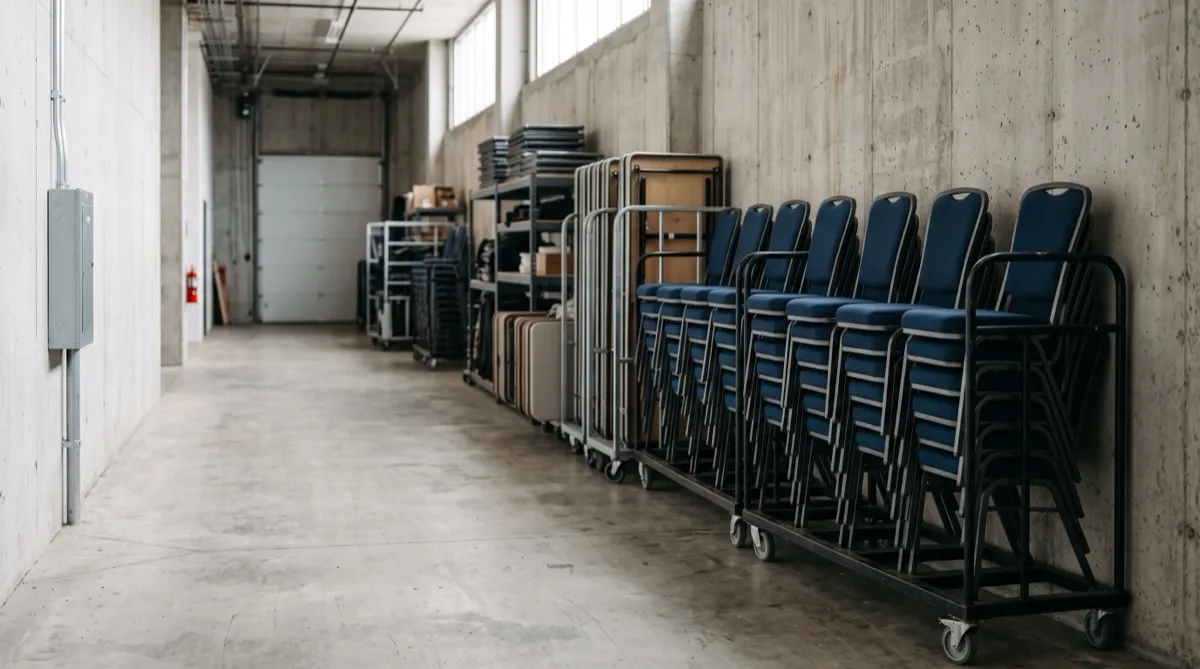
Most venues do not think about banquet chair storage until the chairs arrive and there is nowhere obvious to put them. A ballroom that seats 300 needs somewhere to park 300 chairs between events, and doing that badly costs you staff time, floor space, and chairs that get damaged in a crowded storage room. Getting it right at the planning stage, before you place a bulk order, saves all three.
This guide covers stack heights, chair cart capacities, and the square footage math you need to plan banquet chair storage for a real inventory, whether that is 100 chairs or 1,000.
Why storage planning belongs in the purchasing decision
Storage is not an afterthought to a banquet chair order, it is part of the spec. A chair that stacks 12 high in a stable column takes a fraction of the floor space of a chair that only stacks 6 high before it starts to lean. When you are comparing stacking banquet chairs for a bulk purchase, ask the stack height question before you ask the price question. The difference between a 6-high stack and a 12-high stack, multiplied across 200 or 300 chairs, can mean the difference between one storage room and two.
The same logic applies to chair carts. A cart built for the specific chair you are buying protects the frames during transport and keeps the stack upright in storage. A generic cart, or no cart at all, means chairs get dragged and stacked by hand, which is where frames loosen and finishes scuff.
Stack heights: what to expect by chair type
Stack height varies by frame material and design, and it is worth confirming with the manufacturer rather than assuming.
- Steel-frame stacking banquet chairs commonly stack 8 to 12 high in a stable column, depending on frame gauge and stacking bumper design.
- Aluminum stacking chairs often stack similarly or slightly higher, since the lighter frame puts less cumulative load on the bottom chair.
- Resin Chiavari chairs typically stack lower, often 6 to 8 high, because the frame profile is narrower and less suited to tall columns.
- Wood or aluminum Chiavari chairs usually store individually or in small stacks rather than tall columns, since the ornate frame is not built for heavy stacking.
If your venue is short on square footage, stack height should carry real weight in your decision between chair types, not just aesthetics.
Chair carts and table carts: sizing for your inventory
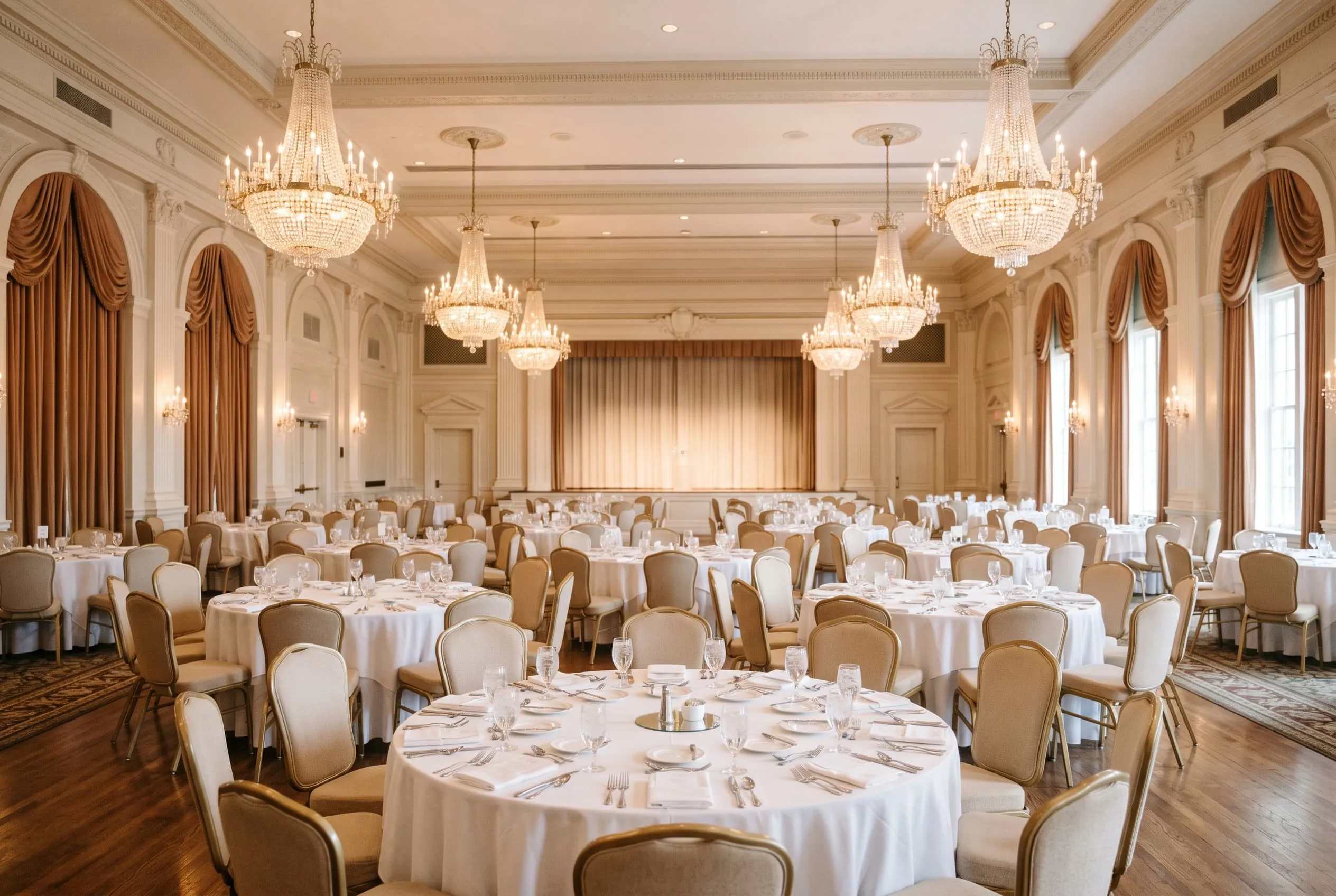
A dedicated chair cart is the single best investment for a venue managing 100 or more banquet chairs. Most commercial chair carts hold somewhere between 12 and 20 chairs per cart, depending on the cart design and the chair's stack profile. For 200 chairs, a hypothetical 20-chair cart would require 10 carts. At 12 chairs per cart, round 200 divided by 12 up to 17 carts. Use the approved capacity for the selected chair/cart combination and distinguish carts that park the whole inventory from carts reused over several moving trips.
Table carts work the same way for your rectangular and round folding tables. A standard table cart holds roughly 10 to 15 folding tables depending on table size, with round 60 inch tops generally taking more room per table than rectangular 6 to 8 foot tables. If you are ordering both chairs and tables in bulk, plan cart counts for each separately, since they do not share equipment.
When you request a quote for a bulk chair or table order, it is worth asking whether carts are sold alongside the furniture or sourced separately, since cart availability affects your total storage plan as much as the chairs themselves.
Square footage: a working formula
Calculate storage from the approved loaded carts rather than a fixed square-feet-per-chair allowance:
- Divide the stored chair quantity by the approved chairs-per-cart capacity and round up.
- Multiply the number of carts by each loaded cart's width and depth, using feet to obtain square feet.
- Draw the carts in the actual room and add the space needed to approach, turn and remove them.
- Check the loaded height against doors, lifts and the storage position. A higher ceiling does not authorize a taller stack than the maker permits.
For a calculation example, assume 100 chairs, an approved capacity of 20 chairs per cart and a loaded parking footprint of 2 by 3 feet per cart. Five carts occupy 30 square feet before access lanes or turning space are added. Those are hypothetical cart dimensions, not specifications for a product. Replace them with the loaded dimensions of the chair/cart system under consideration.
Separate parking area from handling space. A room may have enough total area and still fail if a cart cannot turn through the door or reach the aisle. Test the intended route and retrieval sequence with the approved equipment before finalizing the order.
Covers and protection during storage
If chairs sit in storage for extended stretches between events, especially upholstered banquet chairs, a breathable cover protects fabric and foam from dust without trapping moisture. Vinyl and performance fabric seats hold up fine uncovered for shorter storage windows, but covers are worth the modest cost for chairs that see long gaps between use, such as seasonal or event-specific inventory.
Floor protection matters too. Confirm your chairs have glides or bumpers rated for repeated stacking, since a chair without proper glides can scuff both its own frame and the frames beneath it in a tall stack.
What to check before you order at volume
Before placing a bulk banquet chair order, confirm stack height and whether it holds a straight column at full height, whether a matching chair cart is available and its per cart capacity, frame gauge and weld quality, fabric double rub rating for upholstered seats, weight rating, and warranty coverage on stacking related wear. It is also worth getting a sample chair first to test the actual stack height and cart fit before committing to 100 or more units.
Freight and lead times factor into the plan as well. Bulk chair and cart orders typically ship LTL or full truckload, and cost depends on your delivery zip code, whether the site has a loading dock or needs a liftgate, and whether the address is commercial or limited access. For an early scheduling scenario, test 2 to 6 weeks for a stocked configuration and 8 to 14 weeks for custom finishes or fabrics. These are planning assumptions, not verified stock or supplier commitments. Confirm availability and written approval, production, transit and delivery milestones for the selected chair/cart system before setting the storage room buildout date.
Getting a quote
If you are sizing a banquet chair storage plan alongside a bulk purchase, request a quote with your chair count, finish, delivery zip, timeline and storage measurements for relevant independent suppliers to review. Ask the supplier to identify the compatible cart, approved capacity and loaded dimensions in its proposal; compare those documents with your storage room and handling route. Use the furniture cost calculator to model allowances across chairs, carts and tables, then replace those assumptions with itemized supplier pricing before you finalize quantities.