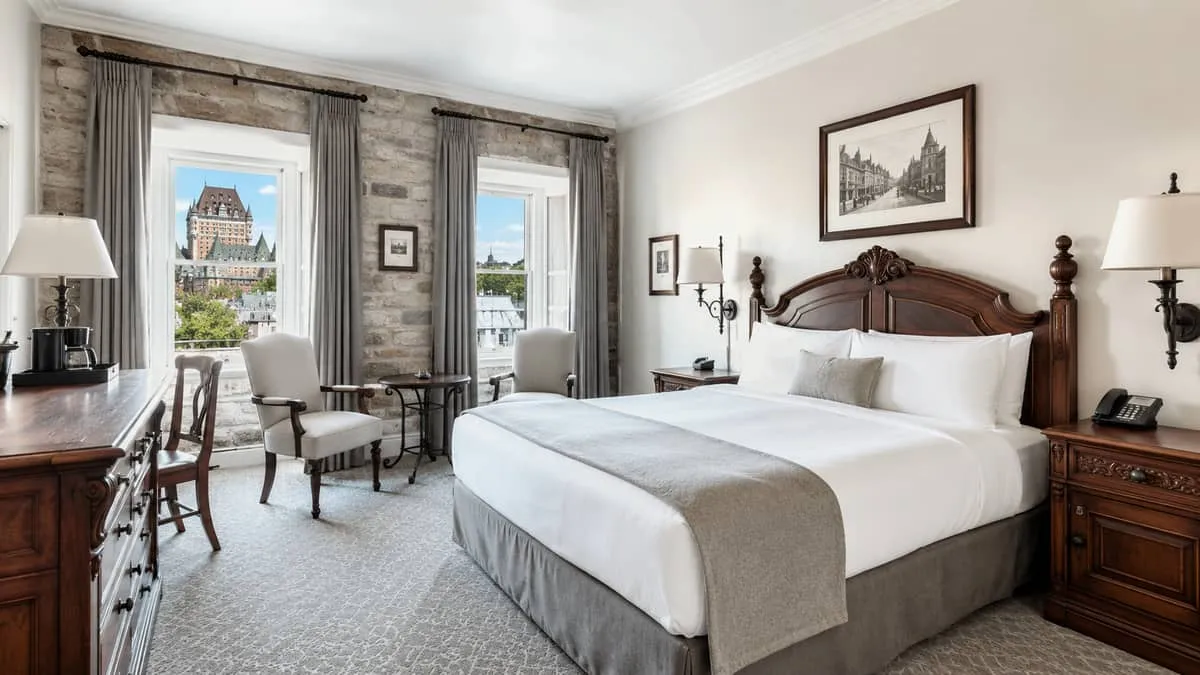
Quebec City is the most heritage-constrained hotel market in Canada. Old Quebec is a UNESCO World Heritage Site, and that designation is not ceremonial. Almost every property inside the walls of the Haute-Ville and along the Basse-Ville's Rue Saint-Paul operates inside stone structures built in the 17th, 18th, or 19th century. Those buildings do not bend to renovation schedules, freight specifications, or standard furniture dimensions. The furniture has to fit the building, not the other way around.
That reality makes sourcing for this market genuinely different from furnishing a hotel in a city where most of the building stock was built after 1960. A hotel furniture supplier serving Quebec City properties needs to understand what it means to work inside load-bearing rubble-stone walls, how to plan logistics on streets where a full-size furniture truck cannot turn around, and what finish palette holds up against the visual weight of original wood floors and exposed stone.
The Heritage Building Problem: Freight Access, Ceiling Heights, and Room Geometry
Most of the boutique properties in the Haute-Ville sit inside buildings that were never designed for commercial hospitality at modern scale. The elevator problem is real and worth understanding before you select a single piece. Heritage buildings in Old Quebec typically cannot accommodate a freight lift without structural intervention that heritage regulators will not approve. If your property has an elevator at all, it is almost certainly a small passenger unit. Furniture that cannot move through a standard door frame and up a standard staircase does not make it into the room.
That means case goods over 36 inches wide become a project management problem, not just a design choice. Dressers, armoires, and headboard assemblies all need to be specced with the actual stair width and landing geometry in mind. For properties like Hotel du Vieux-Quebec, which operates inside a building from the 1800s on Rue Sainte-Anne, this is not a hypothetical constraint. It shapes every procurement decision.
Ceiling heights compound the issue. Rooms in Haute-Ville heritage properties commonly run 8 to 8.5 feet, not the 9 to 10 foot ceilings that modern hotel design assumes. Tall case goods, canopy beds, or any furniture with vertical proportions designed for contemporary construction will feel wrong in these spaces and in some configurations will physically not fit. The right supplier will help you select pieces scaled to the actual room, not the spec sheet.
Wall geometry in heritage buildings is rarely square. Stone walls shift over centuries. A headboard or built-in panel specified to standard dimensions will gap at one corner or bind at another. Suppliers with experience in this market build float tolerances into their specs and coordinate with millwork trades who understand heritage site conditions.
What Auberge Saint-Antoine Has Set as the Basse-Ville Benchmark
The Basse-Ville market, centred around Place Royale and the Quartier Petit Champlain, operates at a different register than much of the rest of the city. Auberge Saint-Antoine is the reason. The property has built one of the strongest boutique hotel reputations in the country by combining genuine heritage, an archaeological artifact collection displayed throughout the building, and a furniture and finish program that holds up against that context without trying to compete with it.
For any operator entering or renovating in the Basse-Ville, Auberge Saint-Antoine is the implicit benchmark. Guests who have stayed there arrive with calibrated expectations. The furniture program has to be substantial, well-made, and specific to the setting. Generic hospitality case goods in a reclaimed-wood veneer finish will read as a budget shortcut against that standard.
What that benchmark means in practice is that fabric selection matters more in this market than in most Canadian cities. Wool blends, textured linens, and leather seating that shows honest wear all fit the visual register of the Basse-Ville. Contract vinyl upholstery in a standard hospitality colorway reads as institutional and out of place. Higher rub counts in appropriate materials, typically 50,000 Martindale cycles or above, remain a requirement, but the material itself has to be chosen for how it ages in this specific context.
Metalwork finishes follow the same logic. Aged brass, blackened steel, and unlacquered bronze all work against stone and heavy timber. Polished chrome and bright nickel are visually inconsistent with the Basse-Ville's material palette. A supplier who cannot source or recommend appropriate hardware finishes for this market is missing a significant part of what the project requires.
The Chateau Frontenac Effect on Guest Expectations Across the City

Fairmont Le Chateau Frontenac does not compete with other Quebec City properties. It occupies its own category. But its presence on the skyline, visible from almost every point in the city and from across the river in Levis, does something important to guest expectations. Visitors arrive in Quebec City having seen that building in photographs for their entire lives. It sets a visual and experiential standard that every other property in the city is implicitly measured against.
This does not mean boutique properties need to furnish rooms to Chateau Frontenac standards, which would be neither achievable nor appropriate. What it means is that guests in this market, particularly the international visitors who come specifically for the UNESCO heritage experience, arrive with an elevated sense of what a Quebec City hotel is supposed to feel like. They are not comparing your property to the Fairmont. They are comparing it to a general idea of quality and heritage authenticity that the Chateau has spent over a century establishing.
For procurement, that translates to a higher threshold for quality of finish and material than you would encounter in most regional Canadian markets. Furniture that might be perfectly acceptable in a mid-market property in a non-heritage city will look underfurnished here. Case goods need visible joinery quality. Upholstery needs to sit well and hold its shape. Bed frames and headboards need to have genuine visual weight. This market will not tolerate hollow-core construction or thin veneers over particleboard, regardless of whether the finish color is correct.
Planning Around Quebec City's Renovation Windows

Quebec City's tourism calendar creates some of the tightest renovation windows in the country. Summer season, from late June through August, generates the highest occupancy in most properties. Winter Carnival in late January and February produces a second sharp demand peak. That leaves two workable renovation windows, roughly September through November and late February through early May, and both are compressed by shoulder-season bookings on either end.
Custom contract furniture for a full floor renovation typically requires 12 to 16 weeks from confirmed order to delivery. For heritage building projects where millwork needs to be coordinated alongside case goods, that timeline often extends further. A property planning to have rooms ready for the summer season needs to place orders no later than January. For Winter Carnival readiness, the order window closes around September.
The supplier's ability to manage phased delivery matters significantly in Quebec City. Many properties cannot close an entire floor for renovation while staying in operation, so they cycle rooms in smaller batches. A supplier who cannot hold partial inventory in warehouse or who requires delivery of the full order in a single window will not be compatible with how most Old Quebec properties actually operate.
Climate adds a delivery logistics layer that suppliers without regional experience underestimate. Furniture truck access to the narrow streets of the Haute-Ville, including Rue Saint-Louis, Rue des Remparts, and the lanes around the Place d'Armes, is genuinely difficult in winter conditions. Suppliers need to have worked these logistics before. An unplanned delivery on an icy February morning on a street that a 53-foot trailer cannot navigate is a project delay that costs money and damages supplier relationships.
Finish and Material Selection Against Heritage Interiors
The finish palette for Old Quebec hotel interiors is narrower than many suppliers initially assume. The existing material environment in these buildings is demanding: cut limestone walls, original wide-plank wood floors, exposed timber beams where structural conditions allowed them to be preserved, and in some cases original hardware or millwork details that heritage conditions require be left in place.
Against that environment, furniture finishes need to contribute without fighting. Medium to dark wood tones in oak, walnut, and cherry read well against stone walls and aged floors. Painted case goods work if the color weight is appropriate, typically muted and desaturated tones rather than bright or high-contrast finishes. Light Scandinavian ash or birch finishes, common in contemporary hospitality design, tend to look thin and disconnected against the visual weight of heritage Quebec interiors.
Upholstery colors follow similar logic. Warm neutrals, deep greens, burgundy, and navy have a historical consistency with this environment. Cool grays and stark whites that work in a contemporary downtown hotel read as wrong in a building from 1750. The supplier should be able to present color and material samples in the context of the actual room conditions, not just against a showroom wall.
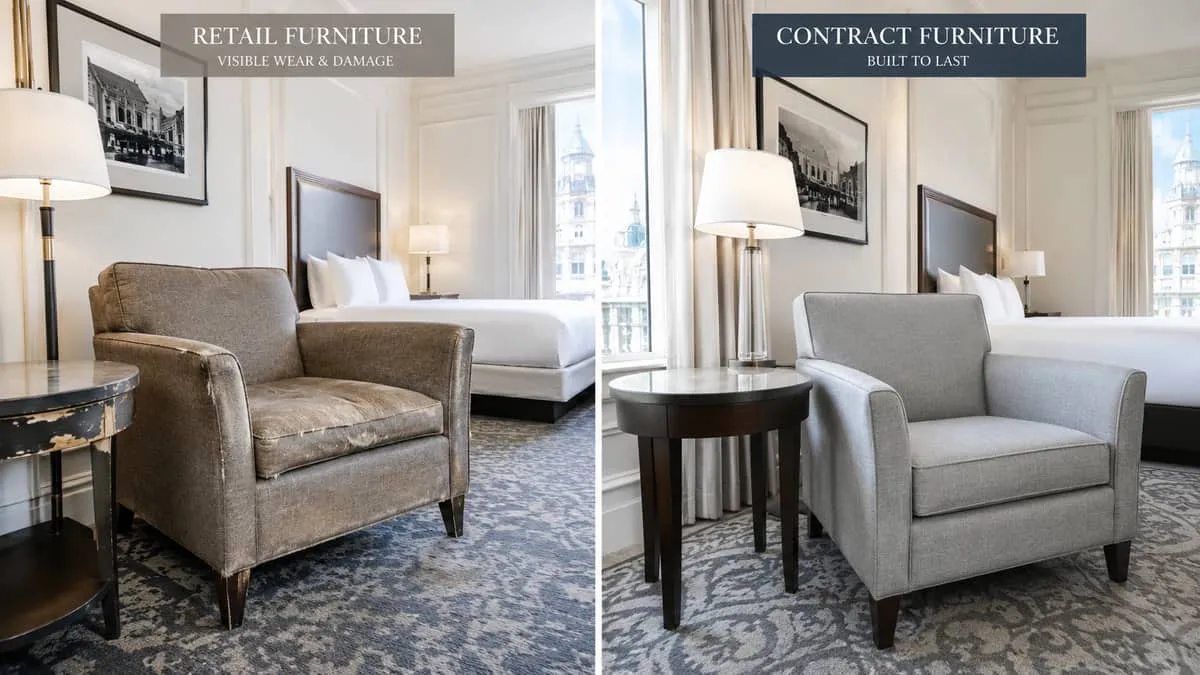
Fire code compliance is non-negotiable for any contract furniture placed in a Quebec guest room. Canadian fire retardancy standards apply regardless of building age, and heritage status does not create any exemption. Retail furniture that has not been tested and rated for commercial environments creates liability and will fail an insurance review. A qualified contract supplier will provide documentation confirming compliance as a standard part of the order package.
Sourcing Logistics and French-Language Operations

Quebec City is a predominantly French-speaking business environment, and the procurement process reflects that. Ownership groups, management companies, and procurement teams in this market largely operate in French. A supplier without francophone staff or French-language documentation will slow down every stage of the process, from RFQ responses to contract review to delivery coordination with property management.
Beyond language, the supplier's operational familiarity with the Quebec City region matters. Deliveries to Old Quebec require advance coordination with the city for access permits on certain restricted streets, particularly in the Haute-Ville. A supplier making their first delivery to this area will encounter those logistics for the first time on your project. A supplier who has delivered to Hotel du Vieux-Quebec or to properties along Rue Saint-Louis has already worked through the permit process, knows which streets allow what vehicle sizes, and understands that a backup plan is always needed.
Regional suppliers with showrooms in Quebec City or Montreal can provide site visits that national-only operations cannot. For heritage properties where the room geometry is non-standard, having a supplier representative measure the actual space before finalizing specs prevents the kind of fit problems that are expensive to resolve after furniture has shipped. That service is worth factoring into your supplier evaluation alongside price and lead time.
The Grande Allee and Saint-Jean-Baptiste neighborhoods outside the walls, which house a mix of restaurant groups, smaller inns, and the brasserie corridor along Grande Allee, operate under less strict heritage constraints but draw guests with similar expectations. Suppliers serving those properties benefit from the same regional experience, since guest standards set by Old Quebec properties extend outward across the city's hospitality offer.
Selecting a hotel furniture supplier for Quebec City is a decision with a longer horizon than most procurement choices. The furniture you place in a heritage room will be there for a decade or more, operating against an environment that will make inferior material quality visible from the first year. Vet your supplier on heritage project experience, regional logistics capability, and whether their product line actually fits the aesthetic register of this market before you commit to a purchase order.
Planning hotel furniture for your Quebec City project? Share your specs and quantities and we will build pricing around your actual program. Request a quote to get numbers for your space.