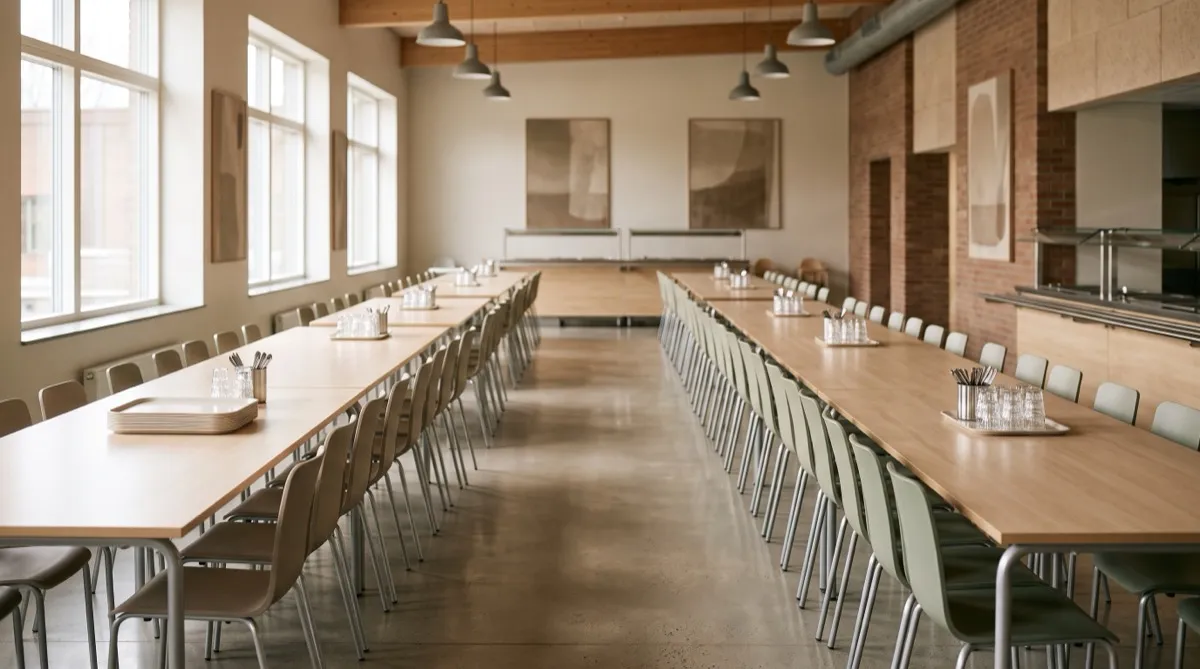
Build a school furniture order around the actual funding, approval, construction, receiving, installation, and staff-handover calendar. Spring approvals and June-July work are examples to confirm with the district, not a universal purchasing pattern. Plan contingencies with the project team rather than assuming a missed date requires rush freight or temporary gym furniture.
Here is how to buy cafeteria tables, classroom furniture, and auditorium seating at volume without blowing the summer install window.
Why school furniture buying works differently
Confirm the district's procurement process and all permitted delivery and installation windows. An 8-to-10-week summer period can be a planning scenario, but fiscal-year approvals and school calendars vary. Include removal, floor work, receiving, assembly, inspection, and staff readiness in the actual schedule.
Build the supplier and installation milestones into the actual school calendar. Compare the exact models' intended age/use, tests, assembly, care, parts, and warranty. A commercial label does not prove a decade of service, and a summer window should include receiving, floor work, assembly, and staff handover.
Realistic order sizes and budget ranges
Use this table to compare illustrative quantity and unit-cost inputs. It is not verified current supplier pricing; currency is unspecified. Totals multiply the lowest quantity by the lowest unit input and the highest quantity by the highest input, before freight, assembly, or installation. Confirm tax and all included scope in dated, itemized quotes.
| Order type | Typical quantity | Est. per-unit range | Est. total budget range |
|---|---|---|---|
| Single cafeteria (tables + benches) | 20 to 40 tables | $250 to $600 per table | $5,000 to $24,000 |
| Auditorium reseating | 200 to 600 seats | $70 to $180 per seat | $14,000 to $108,000 |
| Classroom stacking chairs, single school | 150 to 400 chairs | $45 to $90 per chair | $6,750 to $36,000 |
| District-wide classroom refresh | 1,000+ chairs across sites | $45 to $90 per chair | $45,000 to $90,000 per 1,000 chairs |
Compare itemized configurations rather than ranking categories by cost. Cafeteria mechanisms, classroom chairs, and upholstered auditorium options need their own quoted specification. For upholstery, obtain the exact abrasion method/result and cleaning information; rub counts alone do not establish heavier use tolerance or service life.
What "bulk" pricing actually means for a district
If your district is splitting an order across multiple school sites with different delivery docks, say so upfront. Freight for bulk school furniture typically ships LTL or full truckload, and cost depends heavily on whether each site has a loading dock, whether a liftgate is needed, and whether the address counts as a limited-access delivery point. Have delivery details for every site ready before you request pricing, since a single quote covering four schools needs four sets of delivery specifics to be accurate.
Lead times and the summer window
For early scheduling, you can test 2 to 6 weeks for a standard-order scenario and 8 to 14 weeks for a custom one, but these are unconfirmed placeholders. Obtain exact availability, production, dispatch, transit, assembly, and installation dates for each site. Compare that full sequence with the board approval and summer handover dates before selecting custom options.
What to check before placing the order
Confirm each model's intended age/use, dimensions, loads and their basis, relevant tests, assembly, maintenance, parts, and warranty. Obtain approved stack/cart limits for classroom chairs and the actual cafeteria folding/locking instructions. Review upholstery samples and cleaning, and confirm glides or caps suited to the floors. Frame gauge, a commercial label, or a grade-level description alone does not establish suitability.
Getting a quote for a district-wide order
Use the district's actual approval and handover dates to set procurement milestones. The /furniture-cost-calculator supports early budget scenarios. Send a request through /quote with item types, site quantities, options, receiving requirements, currency, and dates for relevant independent suppliers to review. Each supplier confirms its actual products, documentation, costs, and delivery terms for the funding review.