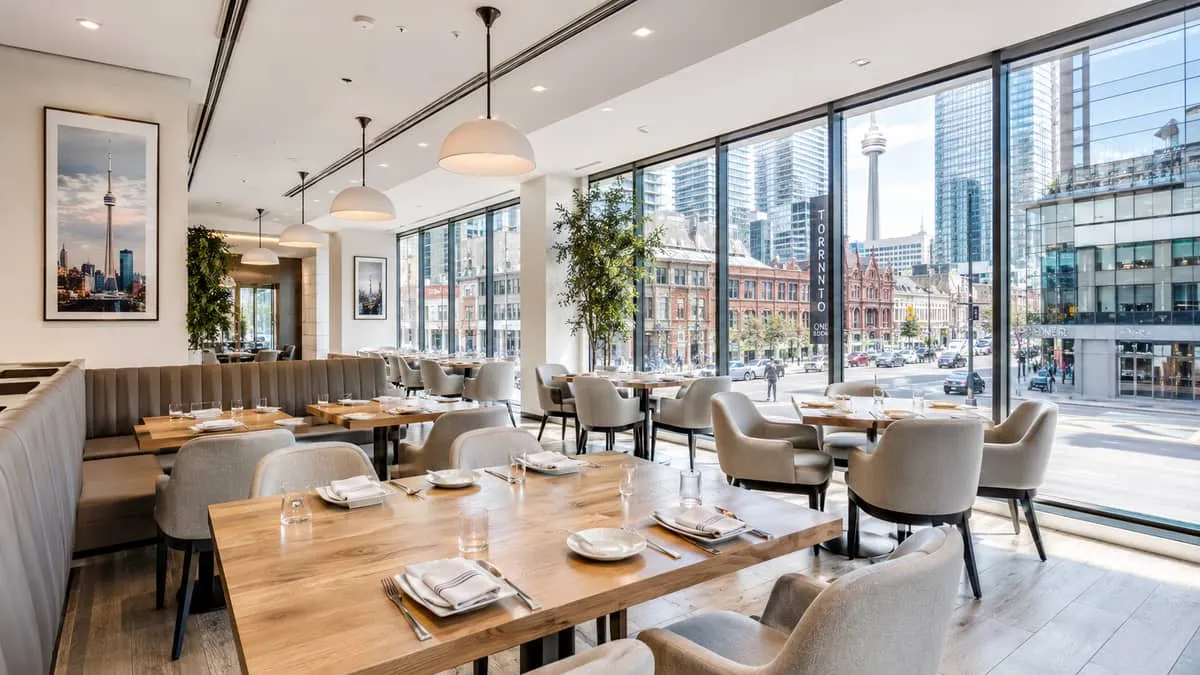
Toronto is the most competitive restaurant market in Canada. Over 9,000 licensed restaurants operate in this city, and the diners filling those rooms have eaten in New York, London, and Tokyo. They notice when a chair wobbles. They notice when the banquette looks deflated at 8 PM on a Saturday. They photograph everything and post it before dessert arrives. If you're outfitting a new restaurant or refreshing an existing room, the furniture decisions you make today will either cost you repeat business or protect your investment for the next five years.
This guide covers the specific demands of four distinct Toronto dining environments: King West high-volume dining, Chinatown and Kensington Market neighbourhood restaurants, Yorkville fine dining, and the Distillery District's heritage-facing tourist trade. Each neighborhood has a different customer, a different aesthetic, and a different set of furniture performance requirements.
King West: Built for Three Turns a Night
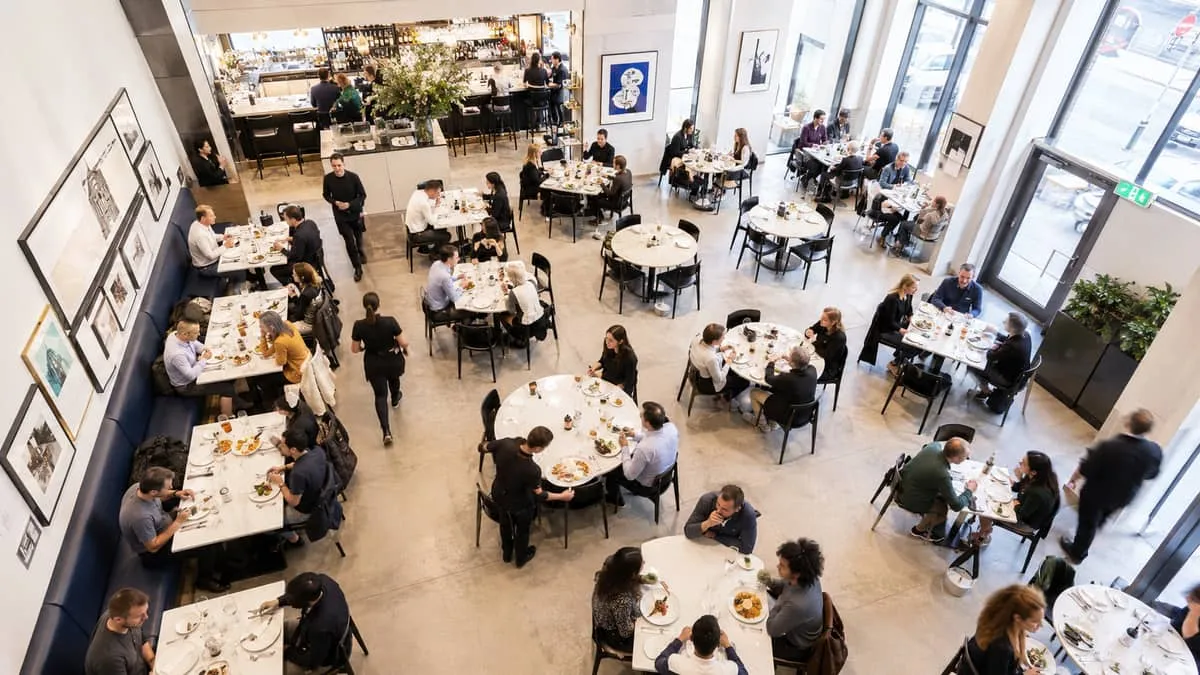
The stretch of King Street West between Bathurst and Spadina is one of the highest-revenue dining corridors in the country. Restaurants here are not destination dining in the Yorkville sense. They are high-energy, high-volume operations running three to four seat turns on a Friday and Saturday night. The furniture has to perform under that pressure, and it also has to photograph well, because a significant portion of King West's clientele is choosing where to eat based on what the room looks like on Instagram.
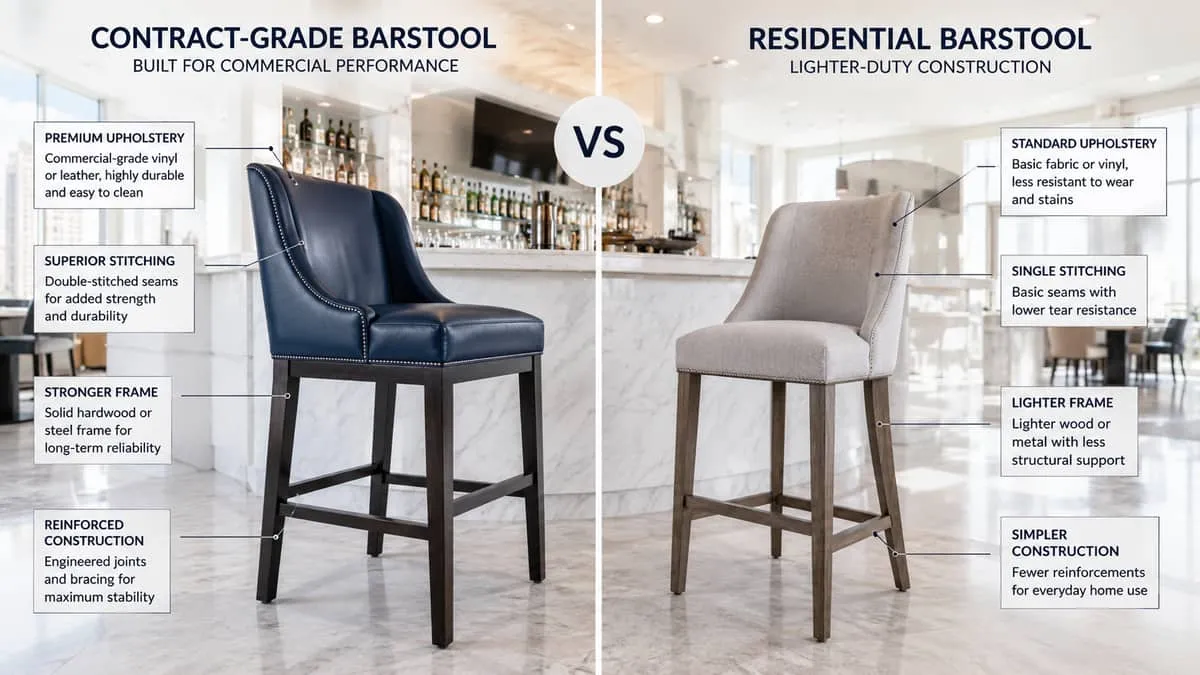
For dining chairs in this environment, the structural requirement is simple: rated for a minimum of 250,000 sit-stand cycles, with welded or bolted metal reinforcement at the seat-to-leg joint. Solid beech and ash frames with steel corner brackets are the industry standard for good reason. Avoid finger-jointed wood frames in a room running four turns a night. The cumulative stress from guests pushing back and dropping into seats accelerates joint failure in a way that only shows up twelve to eighteen months in, after the warranty conversation has expired.
Seat height matters operationally. Standard dining height is 17 to 18 inches. At King West restaurants running bar-height community tables alongside standard dining, you need to specify the correct stool height for your bar rail or counter. A mismatch of two inches creates ergonomic discomfort that guests associate with the restaurant, not with a specification error.
For upholstery, the performance requirement in a room that turns four times a night is a minimum 100,000 double rubs on the Wyzenbeek scale. Faux-leather and performance vinyl have improved significantly in recent years and are worth serious consideration for seats in high-spill zones. In a city where hospitality photography matters as much as it does in Toronto, the visual quality of these materials at spec level now matches many woven fabrics. Choose a colour that holds well under warm restaurant lighting and does not show the impression of previous sitters after ten minutes.
Table bases at King West volume should be cast-iron or heavy steel. Lightweight aluminum pedestal bases work in lower-volume environments, but under four turns a night with guests dragging tables together for larger parties, they drift and tip. Cross-base designs in cast iron are the workhorses of this market. For tops, high-pressure laminate in wood-grain or solid-colour finishes is the contract standard: scratch-resistant, heat-tolerant, and resurfaceable when a top reaches end of life.
Chinatown and Kensington Market: Maximum Character, Built to Last
The restaurants along Spadina Avenue through Chinatown, and into Kensington Market on Augusta and Baldwin, operate in a completely different economic register from King West. Margins are tighter, rents have historically been lower, and the design aesthetic is neighbourhood character rather than polished hospitality brand. But the performance requirements are just as demanding, and in some cases more so, because these rooms run at high occupancy for longer daily windows with less downtime for maintenance.
The best specification approach for this part of the city combines durable commercial frames with flexible aesthetic choices that fit the existing neighbourhood character. A lacquered hardwood chair in dark walnut or ebony finish holds up as well as a painted metal chair in a dry interior environment, and it photographs with the warmth that suits a Cantonese restaurant or a Korean diner better than an industrial metal look.
Stack chairs are worth serious consideration for any Kensington or Chinatown operator running private events or needing flexible floor plans. A commercial-grade stack chair rated for outdoor use doubles as a patio chair in summer, which matters during Toronto's patio season from May through October when Kensington's outdoor seating along the pedestrian area fills every weekend. Look for a powder-coat finish rated for UV and moisture resistance rather than standard paint, which chalks and chips under seasonal stress.
Booth seating is common in Chinatown's longer-format dining rooms. Booth banquettes built on solid plywood bases with high-density foam rated at 1.8 pounds per cubic foot or higher are the correct specification. Lower-density foam compresses within eighteen months of regular use and creates a sunken, worn look that the room cannot recover from without full reupholstery. The vinyl or faux-leather cover on booth seating in a high-traffic neighbourhood restaurant should be contract-rated and seam-welded rather than sewn at high-stress points.
Yorkville: Quiet Materials, Long Dining Times, Residential Feel
Yorkville is a different problem entirely. The Four Seasons on Bay Street, Soho House on Mercer, the dining rooms anchored by the Hazelton Hotel on Yorkville Avenue, these are venues where guests are spending two to three hours at table and making judgments about the experience based on whether the room feels genuinely luxurious or merely expensive-looking. The furniture specification supports one of the most demanding hospitality environments in Canada.
In fine dining rooms running long covers, comfort is a revenue tool. A chair that becomes uncomfortable at ninety minutes shortens the dining experience and reduces per-table spend on additional courses and wine. The specification benchmark for Yorkville dining chairs is a minimum seat depth of 18 inches and a fully upholstered back that provides lumbar support without requiring the guest to sit perfectly upright. Foam density in seat cushions should be a minimum of 2.0 pounds per cubic foot with a top layer of softer memory foam or a loose seat cushion.
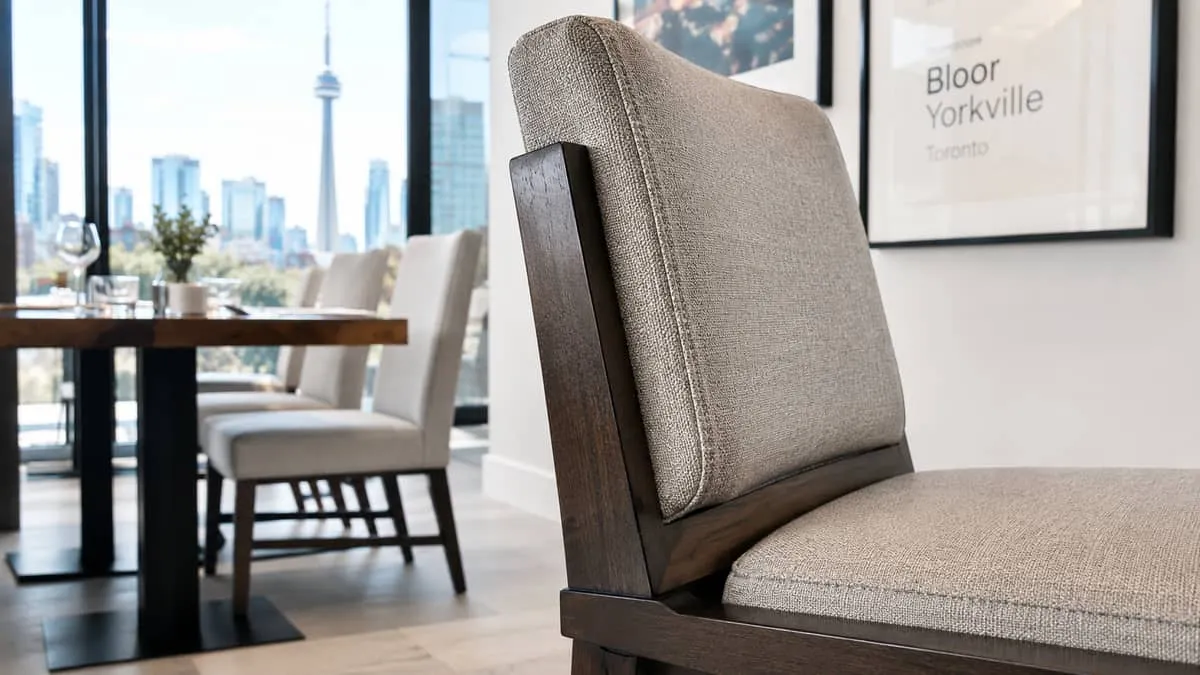
Materials in Yorkville dining rooms need to communicate quality without contributing to noise. Upholstered chairs on carpet or area rugs are the acoustic baseline for a fine dining room. Hard-shell chairs, metal frames, and stone or tile flooring combinations create reverberation that makes conversation difficult and signals the wrong price point to a Yorkville clientele. Solid wood frames with fully upholstered seats and backs, in COM fabric rated at 75,000 double rubs minimum for a lower-volume room, are the appropriate specification.
Table bases in Yorkville should be weighted and stable enough that they do not move when a guest rests their arm on the edge. A dining table in a fine dining room that shifts under light pressure is an immediate credibility problem. Solid cast-iron pedestal bases or heavy X-base designs in brushed steel are appropriate. Table tops in solid hardwood or stone are common in this tier and require more maintenance protocols, but they communicate the material quality the market expects.
For booth seating in private dining rooms or semi-private sections, tight-back upholstered booths in full-grain or premium faux-leather are appropriate. The key specification is that the foam density must not compress visibly within the dining window. A booth that looks slightly sunken by 9 PM on a Saturday was specified incorrectly.
Distillery District: Heritage Industrial with Weekend Volume Pressure
The Distillery District is one of Toronto's most visited neighbourhoods, drawing tourists, event traffic, and weekend brunch crowds to its restored Victorian industrial buildings along Trinity Street and Tank House Lane. The restaurants and cafes operating in these spaces face a specific combination of constraints: the aesthetic must honour the heritage industrial architecture of exposed brick, heavy timber, and cast-iron columns, and the furniture must withstand weekend volume that rivals King West without looking like it was selected for durability at the expense of character.
The correct specification for Distillery District restaurants leans into the aesthetic constraints rather than fighting them. Metal-frame dining chairs in blackened steel or raw iron finishes read as authentic within the heritage context and are among the most durable commercial frames available. A welded steel chair frame with a wood or upholstered seat is appropriate for almost every concept in this district, from the casual lunch spots along the pedestrian laneway to the higher-end dinner rooms in the Tank House and Young Centre areas.
Cast-iron table bases are the strongest fit for Distillery District floor conditions. These buildings have heritage flagstone, original brick, and restored concrete floors that are uneven by design. A cast-iron base with floor levelers handles these surfaces reliably. Lightweight bases drift on uneven floors and create the wobble that guests notice immediately. The heritage aesthetic also gives you latitude to use raw or lightly treated steel bases that would look unfinished in another context but read as intentional here.
Weekend volume in the Distillery District, particularly during TIFF in September, the Christmas Market from November through December, and summer long weekends when Harbourfront and the district draw significant tourist traffic, means your furniture is under maximum stress during the periods when it most needs to look its best. Specify replaceable seat pads or upholstered drop-in seats on your dining chairs so that the wear surface can be refreshed between seasons without replacing the entire chair.
Patios and Seasonal Seating Across Toronto
Toronto's patio season is shorter than Vancouver's but more intense. From May through October, every King West courtyard, every Distillery District laneway table, every Harbourfront deck chair, and every Kensington Market sidewalk setup is in continuous use. The furniture failure rate on patios is dramatically higher than indoors because the exposure conditions are significantly harsher.
For outdoor dining chairs, powder-coated aluminum is the dominant commercial specification. It does not rust, it does not require seasonal refinishing, and it is light enough to stack and store over winter without requiring a large storage footprint. Stack ratings for outdoor chairs matter practically. A chair that stacks to six is a better use of your winter storage space than a chair that stacks to three.
Wicker and synthetic rattan chairs have improved as commercial products and are popular on Yorkville terraces and Distillery District patios where the aesthetic is warmer than metal allows. The commercial-grade synthetic versions are UV-stabilized and rated for year-round outdoor use in Canadian climate conditions, which matters in a city that gets both high summer heat and late-season rain before patio furniture goes into storage.
For patio table tops, HPL and through-colour sintered stone are the two most practical options. Wood tops require sealing and are prone to cracking and warping through Toronto's freeze-thaw cycles. HPL is low-maintenance and handles temperature variation well. Sintered stone is heavier and more expensive but creates the premium aesthetic that Yorkville and higher-end Distillery District patios are specifying in increasing numbers.
Patio table bases need to anchor against wind. A standard cast-iron pedestal base is appropriate for protected courtyard and terrace settings. For exposed patios near the Harbourfront or elevated hotel terraces, umbrella-hole bases with ballast weights, or base designs compatible with patio anchoring systems, are the correct specification.
Sourcing, Lead Times, and the Cost of Getting It Wrong

Toronto operators have access to strong contract furniture suppliers through local dealers and Canadian distributors representing North American and European manufacturers. The practical advice is to build a relationship with one primary supplier before you have an urgent need, because the moments when you need furniture quickly are exactly the moments when a cold sourcing call fails you.
Lead times for custom upholstery and custom finishes are eight to sixteen weeks from most contract suppliers. If you are opening a new room or refreshing ahead of TIFF or the December holiday push in the Distillery District, that timeline needs to be in your project plan before you sign the lease. Operators who discover the lead time after they have committed to an opening date are the ones paying premium freight charges for expedited shipping from overseas manufacturers.
Ask every supplier you evaluate the same set of questions: how many shifts per day is this product rated for, what does the commercial warranty cover versus exclude, can you source replacement parts and matching upholstery panels five years from now, and what is your in-stock program for quick-turn orders. A supplier with a strong in-stock program for their most popular commercial frames can often ship replacement chairs in one to three weeks, which matters when you lose seating to damage or theft mid-season.
Volume pricing is available from most contract suppliers at order thresholds that most multi-location Toronto operators will reach. If you are outfitting more than one location across the city, negotiate the volume tier before you place the first order, not after. Project coordination support is also available from most commercial suppliers for larger orders, and it is worth asking for explicitly. Having a dedicated contact for specification, delivery scheduling, and installation questions is worth the conversation upfront.
The restaurants that hold up in Toronto's 9,000-operator market are the ones where nothing breaks, nothing looks worn, and nothing apologizes for itself when the room is full on a Saturday night. Furniture that fails that test costs you money in repairs and costs you something harder to recover from in reputation. Get the contract-grade specification right from the start, calibrated to your specific neighborhood and volume, and the furniture becomes the last thing you are thinking about during service.
Ready to spec restaurant furniture for your Toronto project? Send us the details and we will price it around your requirements. Request a quote to start.