The sofa in a reception area gets sat on for short stretches by people who are, more often than not, a little nervous. A candidate waiting for an interview. A vendor waiting on a decision-maker. A client waiting to hear whether the deal closed. Nobody lounges on a reception sofa the way they do at home, which means the design job is different from a residential sofa even though the two categories can look similar in a catalog photo.
Office and reception sofas also sit in the most visually prominent spot in the building for anyone walking in the front door, so the gap between a piece that reads professional and one that reads worn or dated is more visible here than almost anywhere else in the office.
Seat depth for short waits, not long lounging
Residential sofas are built deep, often 22 to 24 inches of seat depth, because the assumption is someone will sink in and stay a while. A reception sofa should run shallower, closer to 20 to 21 inches, so a guest in business attire can sit upright and get up cleanly without an awkward push off a deep cushion. Depth that is right for a living room reads sloppy and impractical in a lobby, and guests in professional dress notice the difference immediately even if they cannot articulate why.
Firmer cushion density also matters more here than in a residential setting. A soft, sink-in cushion looks inviting in a showroom but becomes a minor embarrassment when a guest in a suit has to struggle up from it in front of the person greeting them. Commercial-density foam in the 1.8 to 2.2 pound range holds shape through repeated short sits far better than residential-density foam, and it recovers its shape between uses instead of developing a permanent body impression within months.
Arms take the most contact
Arms on a reception sofa get more contact than any other component, since guests rest hands, bags, coats, and laptop cases on them constantly while waiting. Exposed wood arms should be a hard, commercial-grade finish that resists scuffing from bag straps and rings from set-down drinks. Upholstered arms need a tighter, more structural build than a seat cushion, since arms take direct pressure and impact in a way loose back cushions do not.
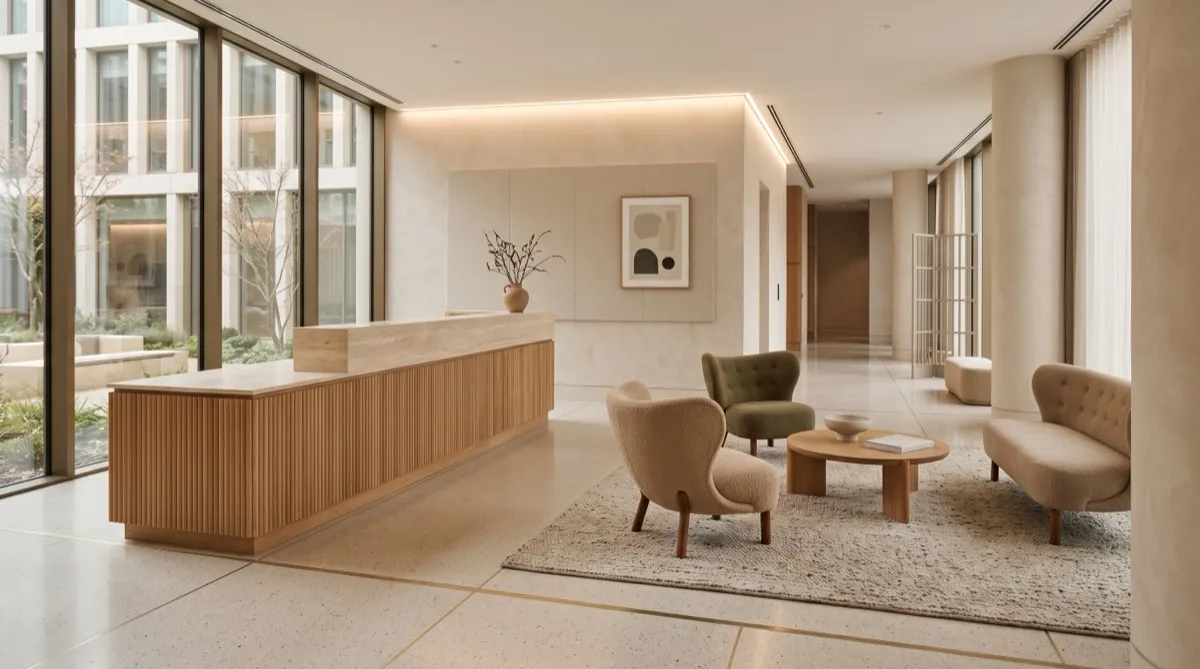
Track-arm and low-profile arm designs tend to hold up better under commercial use than a heavily rolled or pillowed arm style, simply because there is less loose upholstery to compress unevenly over time.
Fabric and cleanability
A reception sofa needs a fabric that wipes clean without a special protocol, because reception areas rarely get the deep cleaning attention that a hotel lobby or restaurant does, and spills or marks tend to sit until someone notices them. Performance fabrics and commercial-grade vinyl both hold up well, with a minimum 50,000 Wyzenbeek rating for any fabric option under real reception-area use.
Color and pattern choices should account for the fact that a reception sofa is rarely reupholstered on its own; it usually gets replaced as part of a broader lobby refresh. A conservative, on-brand color that will not look dated in five years is worth choosing over a trend color that photographs well today but ages the space quickly.
Sizing the seating count
Reception areas rarely need more seating than they get credit for. A two-seat loveseat plus a pair of armchairs typically outperforms a single large three-seat sofa in most reception areas, since it gives waiting guests the option of privacy from a stranger rather than forcing shared seating on a single sofa. Confirm your realistic peak wait volume before sizing the room, since over-furnishing a reception area crowds the entry and under-furnishing leaves guests standing during busy periods. See our commercial loveseats guide for sizing smaller-footprint seating alongside a reception sofa.
Matching the reception desk and layout
A reception sofa should coordinate with the reception desk in tone and finish rather than being sourced as an afterthought once the desk order is placed. For the full breakdown of how seating, the desk, and traffic flow work together in a lobby, see our reception area furniture guide. Browse our sofas category for finishes and configurations built for reception and lobby use specifically, distinct from lounge sofas meant for longer-stay hospitality settings.
Traffic flow around the sofa matters as much as the piece itself. Position seating so guests can sit without blocking the path between the entry door and the reception desk, and leave enough clearance that a guest standing up does not step directly into the walkway of someone approaching the desk. This is a common oversight in smaller lobbies where the sofa gets placed for visual balance rather than for how people actually move through the space during a busy check-in period.
Budgeting the reception refresh
Run a full reception area refresh, sofa, chairs, and coffee table together, through the furniture cost calculator before committing to a design, since ordering the full vignette from one supplier keeps finish and fabric consistent and often simplifies lead time coordination. Custom fabric or COM upholstery typically adds several weeks to a standard lead time, so lock the spec early if a lobby renovation has a fixed reopening date.
When you are ready to spec a reception or office lobby seating package, request a quote and a specialist can match seat depth, fabric, and finish to how your reception area actually gets used.