Not every lounge zone has room for a full sofa, and not every application needs one. A guestroom sitting area, a small waiting nook outside an executive suite, a corner of a restaurant lounge that needs seating without dominating the floor plan: these are loveseat problems, and treating them like scaled-down sofa problems usually produces the wrong piece.
A loveseat is not just a sofa with fewer cushions. Scale, proportion, and even structural spec shift once you drop to a two-seat frame, and getting those right is what separates a piece that reads intentional from one that looks like a sofa that got cut short.
Where loveseats actually earn their space
Guestroom sitting areas are the most common hospitality application. A king or suite-configured room with a dedicated seating nook typically has room for a loveseat and a small occasional table, not a full sofa, and the loveseat gives guests a place to sit that is not the bed without eating into the room's usable floor space.
Small lounge and waiting zones outside a boutique retail space, a spa, or an executive office corridor benefit the same way. These are spaces where a sofa would overwhelm the footprint but bare chairs feel underfurnished, and a loveseat threads that gap.
Restaurant and bar lounge corners use loveseats to anchor a two-top or small-group seating zone that needs more presence than a chair pairing but does not have the floor space for a full sectional or sofa run. Paired with an occasional table, a loveseat reads as a defined seating moment rather than overflow seating.
Scale and proportion
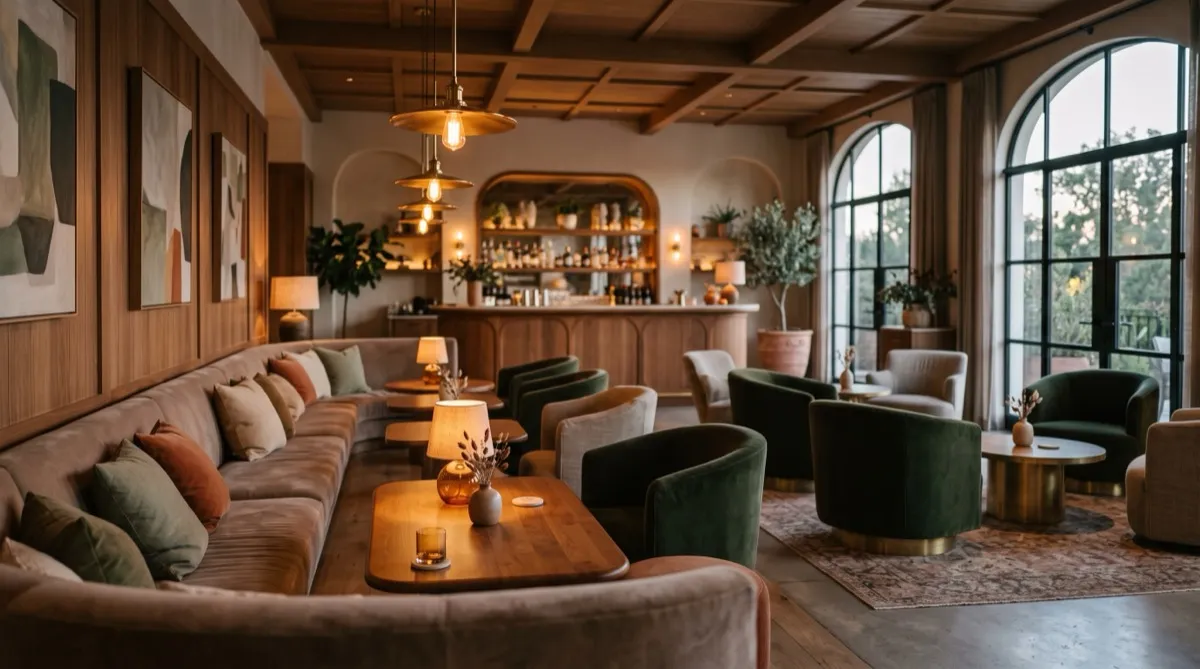
A standard commercial loveseat runs roughly 52 to 60 inches wide, compared to 72 inches and up for a standard three-seat sofa. That width difference is exactly why a loveseat fits spaces a sofa cannot, but it also means arm width and cushion proportion need to scale down correctly rather than simply shortening a sofa frame by cutting out the center cushion.
A well-proportioned loveseat keeps arm width and cushion depth consistent with what a guest expects from commercial lounge seating generally, typically 24 to 26 inches of seat depth and arms in the 6 to 10 inch range depending on style. Oversized arms on an already narrow frame eat into usable seat width fast, leaving less room than the footprint suggests. If a loveseat is meant to comfortably seat two adults rather than one adult and a bag, confirm the actual clear seat width, not just the overall frame width, before ordering across a property.
Frame and fabric grade
The structural standard for a commercial loveseat is identical to any other commercial lounge seating, and cutting corners on frame or fabric because the piece is smaller is a mistake. A loveseat in a guestroom or lounge sees the same guest behavior a sofa does: full weight on the arms, luggage contact, spills, and daily contact from housekeeping or cleaning staff.
Insist on a hardwood frame that has been kiln dried so it will not warp, with corner blocks and reinforced joinery, or welded steel where the silhouette suits it. Seat foam should be commercial density in the 1.8 to 2.5 lb range so the two cushions hold their shape rather than dishing out, and upholstery should carry at least a 50,000 Wyzenbeek double-rub rating for any guest-facing spot. A loveseat that skips these specs to hit a lower per-unit cost fails on the same timeline a poorly specified sofa would, just in a smaller footprint.
Matching to the room
Guestroom loveseats generally match the room's overall fabric and finish palette rather than standing out as a statement piece, since the room's design hierarchy usually puts the bed and headboard first. A quieter fabric and a frame finish that coordinates with casegoods keeps the loveseat from competing with the rest of the room.
Lounge and public-space loveseats have more room to be a design statement, particularly when used to anchor a specific seating zone within a larger open lounge. A bolder fabric or a distinct frame silhouette can help define that zone visually within a room that otherwise uses more neutral sofa and sectional seating.
For the full lounge seating category, including sofas, sectionals, and accent chairs that pair with loveseats in a mixed seating plan, see our commercial lounge seating guide.
Ordering at volume
Because a two-seat frame is smaller, minimums on loveseats tend to sit around 4 to 6 pieces per style, and most properties order them to a frame finish and fabric that already appears elsewhere in the seating plan. Those custom pairings are open to you at that quantity, which is what lets a loveseat read as a deliberate companion to a room's larger sofa or sectional rather than a bolt-on. Expect roughly 10 to 14 weeks of production on a fully custom pairing, and less if you draw the frame and fabric from stock. To see where the two-seaters land against the bigger pieces in a full property count, work the furniture cost calculator.
Order loveseats on the same timeline as any other made-to-order lounge seating, since splitting a property order across multiple lead times creates avoidable scheduling headaches during a renovation or new build. If a property is ordering loveseats alongside a larger sofa or sectional run, request matched fabric lots across all pieces at once. Fabric dye lots can shift subtly between production runs, and a loveseat ordered months after its matching sofa may not read as an exact match once both pieces are in the room.
Legs and casters deserve a quick spec check too. A loveseat that moves regularly, such as one used in a flexible meeting or event space, benefits from locking casters rather than fixed glides, while a loveseat placed permanently in a guestroom nook is better served by a fixed leg that will not shift position during routine cleaning. Confirm which configuration your application calls for before the order goes in, since swapping leg hardware after delivery is rarely simple on a commercial frame.
Once your zone plan and per-room counts are set, request a quote and a commercial specialist can help balance the two-seaters against full sofas and sectionals in a single coordinated order.