Walk through most office furniture proposals and you will notice the guest chair gets one line item, chosen mostly to match the desk finish, while the executive chair across from it gets paragraphs of spec detail. That imbalance does not match how the chair actually gets used. A guest or side chair in a private office, conference room, or interview space sees a rotating stream of different sitters, none of whom own it or take care of it the way a primary chair occupant would, and it often gets moved, stacked, or dragged between rooms far more than the desk chair ever does.
Guest seating deserves the same commercial-grade thinking as any other piece in the office, because a wobbly or worn-out guest chair is the first thing a client, candidate, or visitor sits in and notices.
Sled base versus four-leg versus stack
The base style decides how the chair holds up under the specific abuse pattern of guest seating, which is different from task seating abuse. Guest chairs get pulled out, sat in briefly, pushed back, and sometimes slid across the floor rather than lifted, especially in conference rooms where the chair moves in and out constantly during meetings.
Sled base chairs, a continuous curved metal frame under the seat, glide well on hard flooring and carpet tile without the leg-joint stress that a four-leg chair takes from repeated sliding. They read as more contemporary and tend to be the default choice for conference rooms and modern private offices. Four-leg chairs are the traditional guest chair silhouette and remain a strong choice for executive offices going for a more formal look, but the leg-to-seat joints need to be commercial-rated, welded or reinforced, not just screwed, because sliding motion puts lateral stress directly on those joints.
Stacking guest chairs earn their place in flexible spaces, training rooms, overflow seating for large meetings, where chair count needs change room to room and day to day. A commercial stacking chair should handle repeated stacking without the frame loosening or the finish scuffing at contact points. If a space genuinely needs stacking flexibility, spec for it directly rather than trying to make a fixed guest chair do double duty.
Arm durability: the detail that fails first
Guest-chair arms may be used to help a visitor stand, as well as to support elbows or bags. Ask whether the selected model permits that use and obtain its arm-strength and durability documentation. The core material or a residential label alone does not establish that an armrest will crack or loosen within a year.
Commercial-grade arms use a reinforced core, typically hard urethane or a metal-framed pad, bonded or bolted securely to the frame rather than snapped into a plastic sleeve. Fixed arms are simpler and generally more durable than height-adjustable arms on a guest chair, since the adjustment mechanism itself is a wear point that guest seating rarely needs the way task seating does. Save adjustable arms for the desk chair, and spec fixed, reinforced arms on guest and side chairs.
Fabric, foam, and matching the room
Ask for the upholstery's actual abrasion test method and result. The 30,000 Wyzenbeek double-rub figure is a test reference, not a service-life forecast or a universal office requirement; textile category and traffic matter. ACT's abrasion guidance explains why higher results do not directly predict longer life. For the existing 1.8 to 2.5 foam-density example, confirm the unit with the maker, normally pounds per cubic foot when that convention is used. Density does not establish firmness or guarantee shape retention; request those specifications separately.
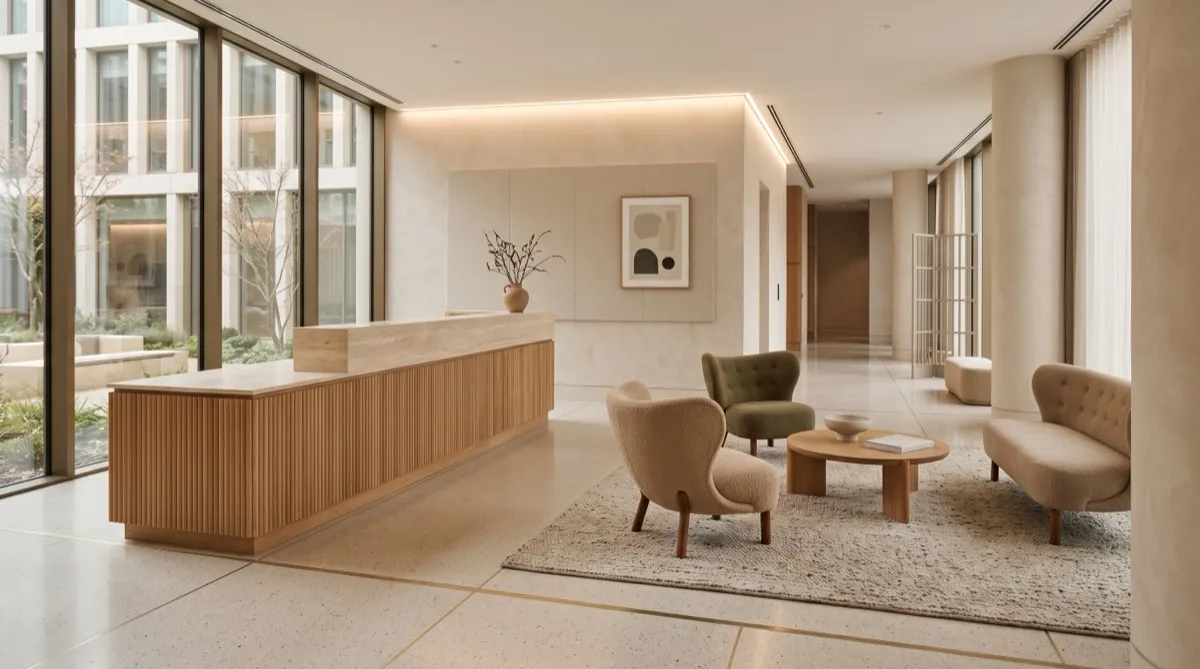
Coordinate finish and fabric with the desk line and the reception furniture in the same building. A mismatched guest chair, right function, wrong finish, reads as an afterthought to anyone who notices, and clients and candidates notice more than employees do because they are seeing the space for the first time. If your office has a reception area with its own seating, review our reception area furniture guide alongside this one so the finish story is consistent from the front door to the private office.
Sizing and quantity per office
A private office typically needs one to two guest chairs depending on room size and how meetings are actually held there. A conference room needs a chair count matched exactly to the table capacity, with a small overflow allowance rather than exact seats-to-headcount, since meetings routinely run one or two people over the planned attendee count. Interview rooms and smaller huddle spaces often do best with two matching side chairs rather than a mismatched mix pulled from storage.
Run your full office layout, private office count, conference room capacities, huddle space count, through our furniture cost calculator to model total guest seating spend alongside the rest of the buildout, since guest chairs are easy to undercount when the primary focus is desks and task seating.
Ordering guest seating with the rest of the office
Where practical, coordinate guest seating, task chairs and desks on a documented finish schedule, and record fabric lots and approved samples for later phases. Treat 10 to 20 pieces per style and a 10 to 14 week custom window as provisional planning assumptions only. Ask each supplier to confirm minimum quantities, available custom options, stock status, production milestones and delivery dates for the exact selections.
For the complete office furniture picture, desks, task seating, and storage alongside guest seating, see our commercial office furniture guide.
Browse side-chair concepts for style references rather than verified stocked models. Submit a furniture request with the office layout, quantities, proposed finishes and intended use so relevant independent suppliers may confirm actual options, specifications and delivered quotes.