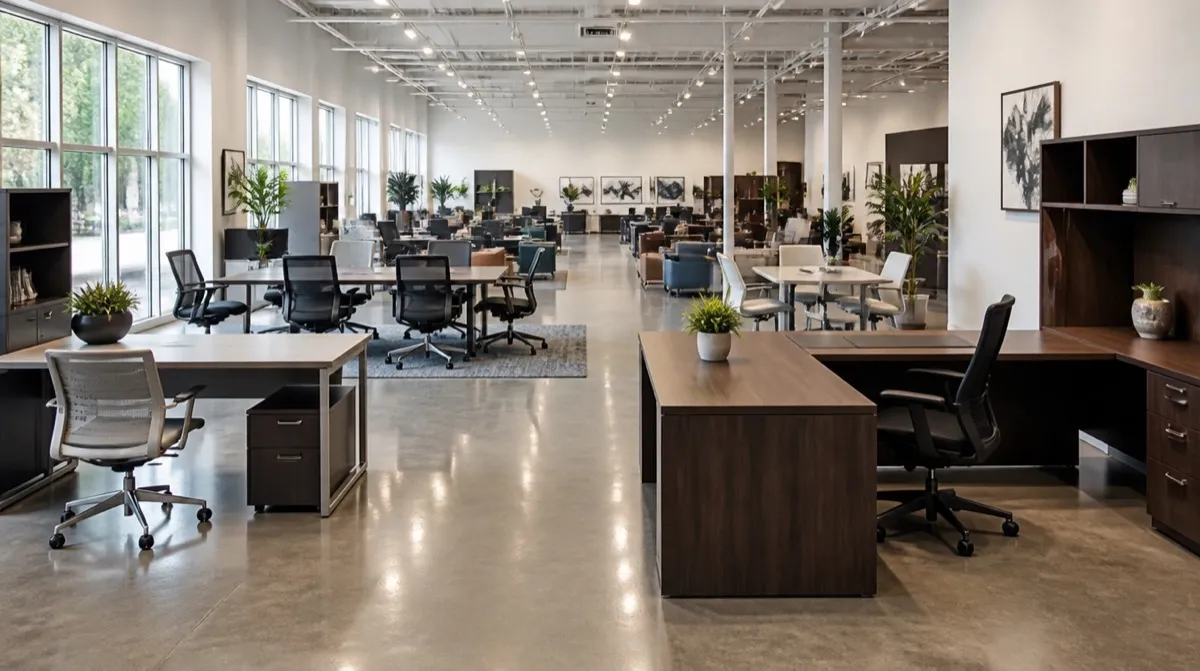
When you need to furnish a workplace, the first instinct is to find office furniture stores and start comparing chairs. That works fine for a small office. It stops working the moment the order gets large, because office furniture stores and contract suppliers are two different buying channels built for two different buyers.
This guide breaks down what office furniture stores are actually good at, where contract furniture suppliers take over, and how to tell which one your project belongs in. Getting the channel right the first time saves you from paying retail markup on a volume order, or from waiting on a custom production run you did not need.
What office furniture stores are built for
An office furniture store, whether a big-box retailer or a local showroom, is built around the walk-in buyer. The model is stocked inventory, fast checkout, and small quantities. You see the chair, you buy the chair, you take it home or have it delivered that week.
That model has real strengths. If you are furnishing a single office, a home workspace, or a small team of five to ten people, a store gives you speed and simplicity. There is no minimum order, no formal quote, and no lead time on stocked items. For a handful of desks and chairs, that convenience is worth a lot.
The limits show up on two fronts: price at volume and the grade of the product. Store pricing is set for individual buyers, so it does not step down the way volume pricing does. And a lot of what fills a store floor is residential or light-commercial grade, built for a home office rather than a room full of people using it eight hours a day.
What contract furniture suppliers are built for
A contract furniture supplier is built around the volume buyer. The model is specification, quoting, and delivery of large orders, drawing from contract furniture manufacturing rather than retail stock.

The product itself is the first difference. Contract furniture is engineered to survive continuous commercial use. Seating upholstery is specified to 50,000 or more Wyzenbeek double rubs, versus 10,000 to 15,000 for residential fabric. Foam runs 35 to 40 ILD (indentation load deflection) so it holds its shape under all-day use. Frames, casters, and tilt mechanisms are rated for far more cycles than store-grade equivalents. In North America the mark to look for is BIFMA certification, which confirms a piece has been independently tested for commercial use.
The pricing model is the second difference. Contract suppliers price at volume, with breaks that typically step down at 50, 100, 250, and 500 or more units. A hundred-desk order carries a meaningfully lower per-unit cost through a supplier than the same quantity bought off a store floor. That is the whole reason the channel exists.
The trade-off is process. A contract order runs on a formal quote, sometimes a minimum order, and a lead time on custom finishes. Our commercial office furniture guide covers the specs and cost side in detail if you want to go deeper on what you are actually buying.
The comparison, side by side
| Factor | Office furniture stores | Contract furniture suppliers | | --- | --- | --- | | Built for | Walk-in buyers, small quantities | Volume orders, full buildouts | | Product grade | Often residential or light-commercial | Contract-grade, BIFMA-tested | | Pricing | Fixed retail, no volume breaks | Volume breaks at 50 / 100 / 250 / 500+ units | | Minimum order | None | Sometimes applies | | Lead time | Fast on stocked items | Fast on stock, 10 to 14 weeks on custom | | Best for | A room or a small team | 20+ desks, matched finishes, durability |
How to tell which channel your project belongs in
The clearest signal is quantity. Under roughly ten to twenty workstations of stocked, standard pieces, an office furniture store is usually the simpler path. Above that, the volume pricing and the durability of a contract supplier start to matter more than the walk-in convenience of a store.
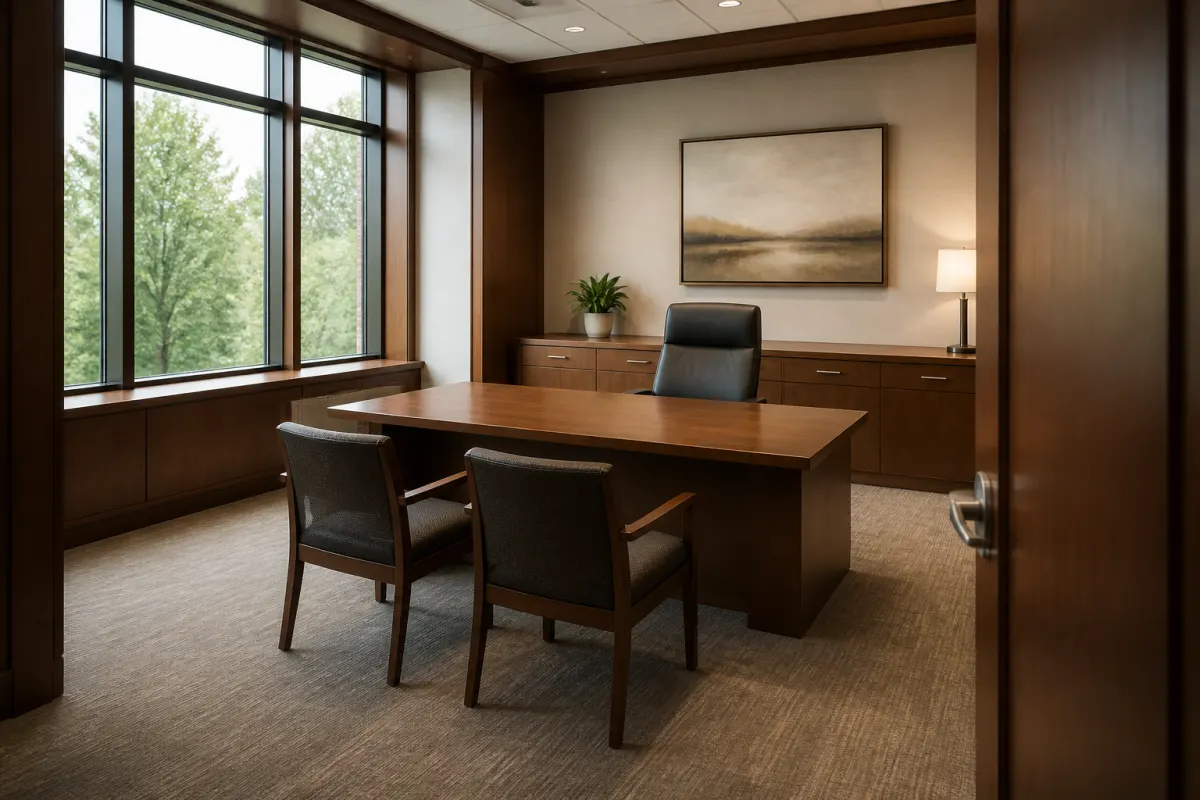
Durability is the second signal. If the furniture will take all-day use by a range of people for years, contract grade pays for itself by not needing replacement in three years. A store-grade task chair used eight hours a day is on a short clock.
Consistency is the third. If you need every desk and chair to match across a floor, or across phases of a buildout completed months apart, a contract supplier can lock the finish and hold it. A store sells what is on the floor this month, and that stock rotates.
Timeline is the fourth. If you need furniture this week and the pieces are standard, a store wins on speed. If your move-in date is weeks out and you want the order right, a supplier can plan the schedule around it. Sort your selections into stocked and custom early so the custom lead time does not surprise you.
How to read product grade on a store floor
Even when a store is the right channel, it helps to spot which pieces are built for real office use and which are dressed-up home furniture. A few tells give it away. Check the weight rating on task seating, since a chair rated near 250 pounds is built for lighter home use, while contract seating is usually rated higher and states its cycle testing. Ask for the Wyzenbeek double-rub number on the upholstery; a fabric under 15,000 double rubs is a residential spec that wears through under daily office use. Look underneath at the base and casters, because a plastic base and hard casters signal a light-duty build, while a five-star metal base on commercial casters signals a contract one. Work surfaces should be high-pressure laminate or thermofused, not thin veneer that chips at the edges. None of these checks require a supplier relationship, and they keep you from paying office prices for residential grade.
When to use both
Plenty of projects use both channels, and that is a sensible move. A growing company might buy a few interim pieces from a store to cover an immediate need, then place the real buildout through a contract supplier once the headcount and floor plan are locked. The mistake is running the whole large order through the retail channel by default, because that is where the markup and the grade gap cost you the most.
If you are also outfitting shared or public-facing areas, the reception seating, lounge zones, and collaboration spaces usually belong on the contract side too, since they take heavier and more varied use than a private office. Our coworking and shared workspace furniture guide covers those areas.
Making the contract channel easy
The reason volume buyers stick with a contract supplier is that one relationship covers specification, quoting, freight, and a single point of contact across many manufacturers. To move forward, request physical samples before you commit, confirm which items are stocked and which are custom, and budget freight and installation from the start, since they typically add roughly 14 to 26 percent over the furniture cost.
To model the delivered cost of a real order, run it through our FF&E budget calculator, and when you are ready to price actual quantities, request a quote. You can browse contract-grade options directly in the desk chairs and desks categories.
Related reading
- Commercial Office Furniture: A Buyer's Guide to Specs and Cost
- Contract vs Retail Furniture: Which Should You Buy?
- Where Do Businesses Buy Furniture?
Our take
The channel comparison lands the durability point, but there is a serviceability angle underneath it that matters even more once a fleet is a few years old. Contract task seating is built to be repaired, not thrown away. Casters, gas cylinders, arm pads, and tilt mechanisms are replaceable parts on a contract chair, and the supplier keeps a pipeline for them, so a floor of a hundred identical chairs can have its highest-wear components swapped and stay in service long past the point a store chair would be scrapped. A store-grade chair usually fails at a molded, non-serviceable part, and by the time it does the exact model has rotated off the floor, so a single broken cylinder means the whole chair goes to the curb and the replacement no longer matches the rest of the room. When you are furnishing a floor rather than a desk, ask the contract question the store cannot answer: which components are field-replaceable, and will parts be available for this model in three years. That answer is what turns a chair fleet into an asset you maintain instead of one you keep re-buying.
The bottom line: Beyond grade and price, weigh serviceability. Contract task chairs have field-replaceable casters, cylinders, and mechanisms with a parts pipeline, so a whole floor stays repairable for years, while a store chair with one failed molded part gets scrapped and no longer matches the room.