
Your restaurant furniture isn't falling apart. But it's not looking the way it did on opening day either. The fabric on a few chairs is worn. Some finishes are scuffed. A couple of joints are loose.
Full replacement is expensive, disruptive, and requires planning you may not have capacity for right now. But doing nothing means the slow decline continues.
Here's how to think through a furniture refresh: what's worth fixing, what's worth replacing, and how to do it without shutting down.

Assess what you actually have
Before you spend anything, audit your current furniture honestly. You need three categories: keep as-is, repair or reupholster, replace.
Frames: Follow the manufacturer's inspection instructions and record damage, looseness and missing parts. Remove suspect pieces from use and seek a qualified repair assessment; do not sit in or rock a damaged chair as an improvised strength test. Confirm whether repair or replacement is appropriate.
Upholstery: Obtain an actual reupholstery quote after checking the frame and cushion condition. Compare cover, foam, labor, transport and downtime with the complete cost of replacement.
Finish: Ask the manufacturer or repair provider what touch-up or refinishing the actual surface permits. Compare cost and appearance with replacement rather than assuming every powder coat or wood finish is repairable.
Record keep, repair and replace decisions from the actual assessment. Appearance alone does not establish frame integrity or prove that most pieces need only cosmetic work.
Reupholstering vs replacing: how to decide
Reupholstering makes sense when:
Reupholstery may suit a chair whose frame is assessed as fit for continued use, whose design remains appropriate and whose complete repair quote compares favorably with replacement. A material label alone does not establish years of remaining life.
Replacing makes more sense when:
The frame is compromised: wobbly joints that tighten temporarily before loosening again, cracked welds, broken hardware that can't be sourced. The chair style is dated and no longer fits your brand. You're doing a broader renovation and want a fresh look throughout rather than a patchwork of old and new.
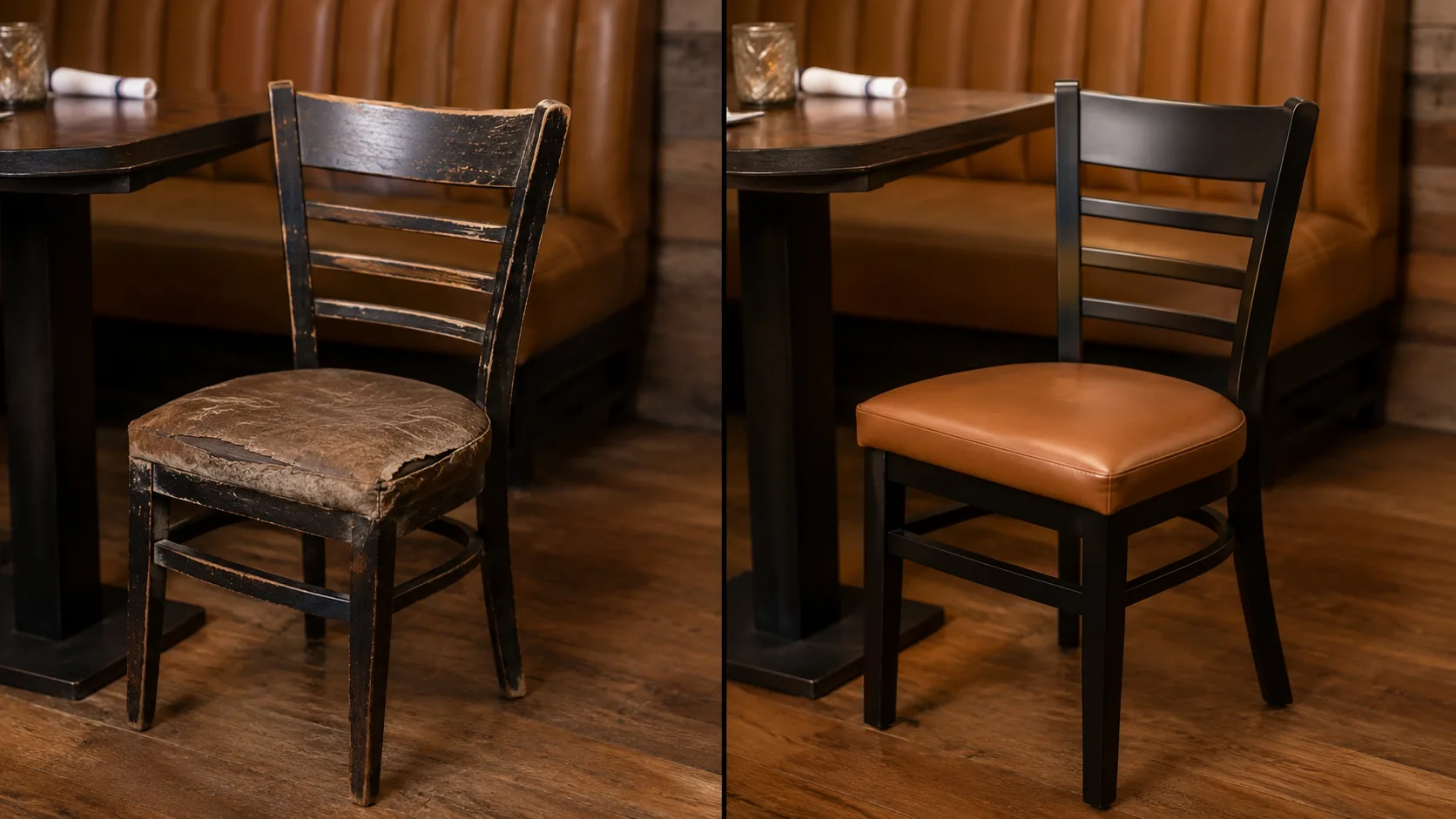
Compare a mixed repair/replacement approach with full replacement, including finish matching and operational downtime. It is an option to price, not automatically the cheapest or least disruptive path.
Adding new pieces without a full replacement
One of the most effective approaches: replace the most visible and most worn pieces first, hold the rest.
Your waiting area chairs may see fewer use cycles than your dining chairs and could still be in solid shape. Your barstools may be more worn than your dining seating. Your lounge area chairs may be the best condition pieces in the room. The audit tells you this.
Prioritize replacing what guests interact with most and what's most visible from the entrance. A fresh set of dining chairs at the four tables closest to the entrance, combined with reupholstered chairs further back, is a refresh most guests won't analyze, but will feel.

When you add new pieces, match the finish direction of what you're keeping, or use the refresh as the moment to establish a consistent palette you'll carry forward on future replacement cycles. A refresh that introduces a cohesive palette can actually improve the overall look more than a full replacement would.
Planning the next full cycle
A refresh changes the condition of specific components; it does not promise another two to four years for the complete chair.
Use the inventory to plan future procurement and obtain current supplier timelines. CFD connects inquiries with independent suppliers; custom availability and a ten to fourteen week window require confirmation for the actual order.
Align the next planned assessment with lease, renovation and operating milestones, while retaining a process to act on damage discovered sooner.

The bottom line
Audit first, obtain qualified repair decisions and compare complete quotes. Phase suitable work where operations allow and coordinate the refreshed and replacement finishes. Neither lower cost nor another two to four years follows automatically from a refresh.
Related reading: How Long Does Commercial Furniture Last · Commercial Upholstery Fabric Guide · Restaurant Tables and Seating