Nightstands deserve a separate line in the guestroom specification: bedside reach, charging, lamp placement, surface care and housekeeping access. Matching the headboard finish alone does not establish those functions or a first-year service outcome.
Evaluate the nightstand in the actual room mock-up for charging, bedside reach, drawer operation and surface care. Thousands of turnovers and a five-year holding period are possible planning scenarios, not forecasts of complaint-free service or a failure date. Keep inspection and repair records for the selected model.
Power and connectivity come first
List the property's actual charging needs and test how guests can reach them from the bed. Two or three devices per guest is a chosen capacity example, not measured demand for every property. Charging can be provided through approved furniture or another accessible bedside arrangement; integrated power is not the only workable option.
If the brief includes a built-in outlet and USB-A or USB-C port, have the responsible electrical reviewer confirm the exact module, installation and permitted use. Mock up top, drawer-face or rear-edge placement for reach and cables. An alternative approved bedside charging arrangement may meet the brief without putting power in the nightstand itself.
Coordinate the electrical rough-in with your general contractor before the nightstands arrive. A nightstand with a beautifully integrated outlet is useless if the wall behind it was never wired for it, and retrofitting power after drywall is closed up costs far more than specifying it correctly at the design phase.
Floating versus freestanding
The mounting method changes the housekeeping math and the room's visual weight, and it is worth deciding deliberately rather than defaulting to whatever the last renovation used.
For a floating nightstand, obtain the exact bracket, load, wall support and installation instructions from the maker and project team. An open floor below may simplify access, but housekeeping time depends on the actual arrangement. Confirm wall conditions and any required blocking before installation.
For a freestanding option, confirm stability, any required anchoring and floor clearances under the maker's instructions. It can offer a different replacement or repositioning strategy, but does not automatically make an older-room renovation safer or cheaper than an approved wall-mounted unit. Compare the exact delivered and installed quotes.
Neither option is universally correct. A boutique renovation leaning into a modern aesthetic often goes floating. A large-inventory limited-service property replacing furniture on a standard cycle usually goes freestanding, because it is simpler to source, ship, and swap.
Construction that survives housekeeping, not just guests
Nightstands take abuse that has nothing to do with guests. Housekeeping carts bump corners on every pass down the hall. Vacuum heads knock against the base leg after leg for years. Drawers get opened and closed by staff doing turnover checks as often as by guests looking for the room-service menu.
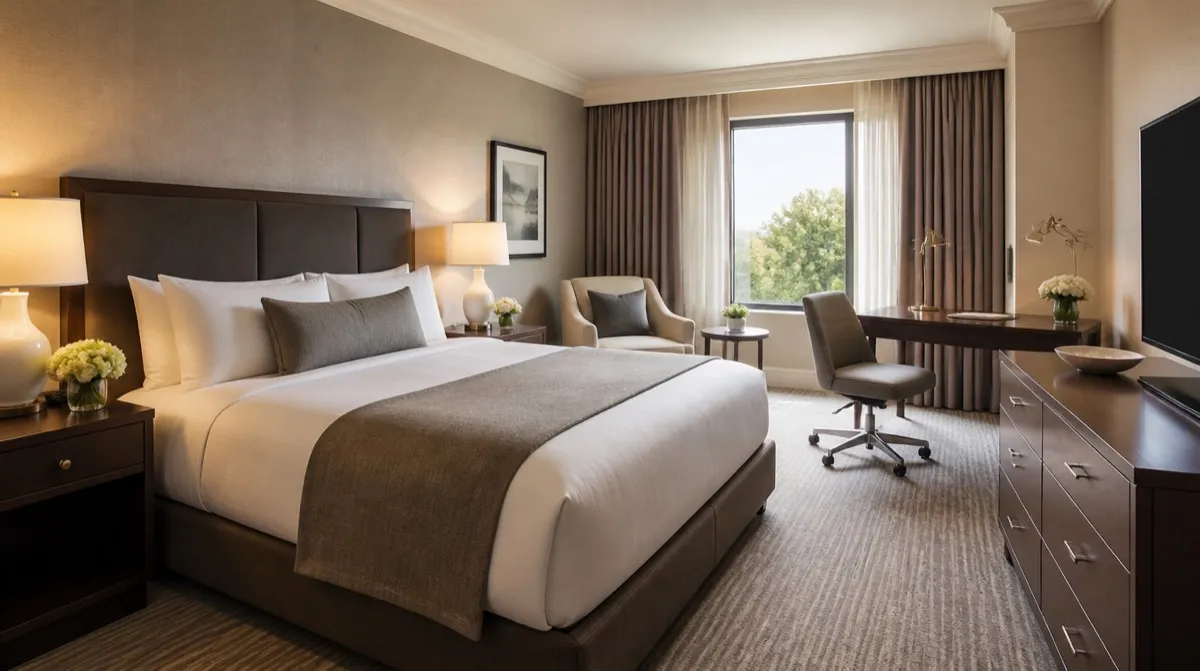
Look for engineered wood cores with a durable laminate or veneer finish rated for commercial contact, not a residential-grade wrap that chips at the corners. Drawer boxes should run on full-extension commercial slides rated for continuous cycling, not the friction-fit runners common in home furniture. Corners and edges should be eased or bullnosed, both for guest safety in a dark room and because sharp edges are the first thing to chip under cart contact.
Match the nightstand's grade to the headboard, dresser, and desk in the same room. A guestroom casegoods package should read as one coordinated set in finish, hardware, and construction standard, not a mix of pieces bought from different tiers to save on the smallest item in the room.
Sizing for the actual bed configuration
Match the nightstand to the actual mattress-top height of the approved bed, base and mattress assembly. The 24 to 26-inch nightstand and 16 to 18-inch depth figures are illustrative starting dimensions, not a universal hotel standard. Test reach, lamp/charging equipment, drawer operation and the intended bedside items in the mock-up room before approving the configuration.
Room configuration drives the count and footprint. A standard king room typically runs one or two nightstands depending on brand standard and whether the layout uses a single centered unit or a pair flanking the headboard. A double-double room needs a center nightstand sized to serve both beds, which usually means a wider unit than the single-bed version rather than two narrow pieces crowded against each other.
Run your full room mix, king counts, double-double counts, and any suite configurations, through the FFE budget calculator before finalizing quantities. Getting the nightstand count wrong on a large property means either a change order mid-project or unmatched furniture filling a gap later.
Ordering nightstands as part of the casegoods package
Put the nightstand on the coordinated headboard, dresser and wardrobe schedule. Ask whether the supplier can align approved finishes, production and delivery across the package; coordinated purchasing does not guarantee one run or arrival date. Track each approved component and finish sample separately.
Use 10 to 14 weeks only as a provisional planning window for custom casegoods. Confirm the exact model's finish availability, stock status, minimum quantity, approval milestones, production and delivery dates in writing. Coordinate the room set and retain finish samples or lot references so later pieces can be assessed for a match.
Browse nightstand concepts as style references. Submit a furniture request with the approved bed/mattress dimensions, room-type counts, power requirements, finishes and phase dates. Relevant independent suppliers may confirm actual models, mounting/electrical documentation and itemized delivery terms.