A headboard can be a prominent part of the guest-room design. Coordinate its appearance, cleaning and attachment with the bed, nightstands and wall assembly.
This guide turns that design decision into a brief covering surfaces, dimensions, installation and approvals, without assuming a fixed replacement year.
Upholstered versus wall-mount panel
Surface construction and mounting are separate decisions: an upholstered headboard can also be wall-mounted. Compare both aspects of the proposed design.
For fabric or vinyl over a padded panel, request the exact cover, foam and backing assembly, approved cleaners and repair options. Assess contact areas and any brand requirements. A performance-fabric or vinyl label does not promise a full seven to ten year renovation cycle.
For a decorative laminate or other hard-surface panel, confirm the surface and edge specification, care limits and mounting system. Compare repair and replacement costs for the actual design rather than assuming every panel is more durable, cheaper or quicker to clean than upholstery.
Fire-code fabric requirements
Confirm applicable fire and other project requirements with the project team and authority having jurisdiction, then obtain the required manufacturer documentation for the complete proposed assembly. CAL 133 must not be assumed to apply to every hotel or jurisdiction. Fabric and foam labels alone may not establish assembly compliance. Retain the exact reports and approval correspondence with the project records.
Sizing and bed configuration
Measure the actual bed and room configuration, including paired beds, nightstands and any integrated controls. King and queen bed labels do not establish a universal headboard width. Obtain dimensioned drawings for the proposed individual or continuous design.
Confirm wall construction, attachment details, required backing or rails and mounting height with the installer and manufacturer before ordering. The appropriate fixing depends on the design and substrate; coordinate any wall work with the renovation schedule.
Install at scale across a rolling renovation
If the renovation is phased, confirm quantities, packaging, batch deliveries and installation milestones against the room-block schedule. Ask about actual stock and custom approval times rather than assuming one type always arrives faster.
Obtain installation pricing for the actual mounting and headboard assembly, including access, protection and any wall work. A hard panel does not invariably install faster than an upholstered unit.
Coordinating the headboard with the rest of the case goods package
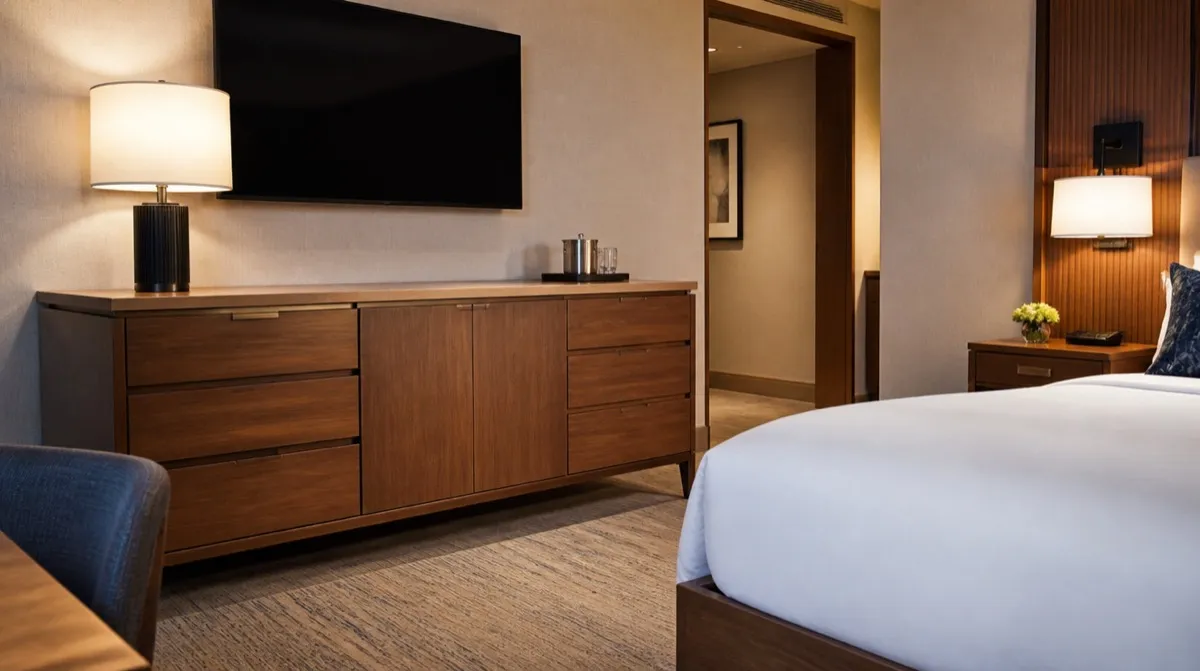
Compare physical samples for headboards, dressers, nightstands and bed bases together. A coordinated package or separately sourced pieces can work when dimensions, finishes and documentation are checked against the same room brief.
Use the FFE budget calculator for a planning scenario and request a quote for actual quantities, approvals and delivery terms. Browse headboards as inspiration; these concept images do not establish stock, fire compliance or physical specifications.