Identify whether the television is freestanding, wall-mounted or attached to a furniture panel. A console may provide storage, cable routing or a work or luggage surface, but those functions need separate documentation. Do not assume it supports a wall bracket unless the actual assembly is designed for that load.
Record those functions in the room brief before selecting the console.
Mount rating and wall coordination
Confirm the mount's permitted screen size, weight and attachment requirements with its manufacturer. Coordinate wall or panel support, fasteners and installation with the project team. Plywood blocking and drywall anchors cannot be selected from a generic blog description; use the documented assembly and substrate.
Confirm the console's cable pass-through lines up with where the mount and the in-wall power and cable box actually land. A console designed generically without your specific mount height and cable location in mind often needs field modification, which adds cost and time during install that a coordinated spec avoids entirely.
Cable management that actually gets used
Check cable routing, access and protection on the actual console and room drawings. A grommet, channel or other arrangement should support the intended connections and maintenance access without assuming one feature guarantees tidy cables.
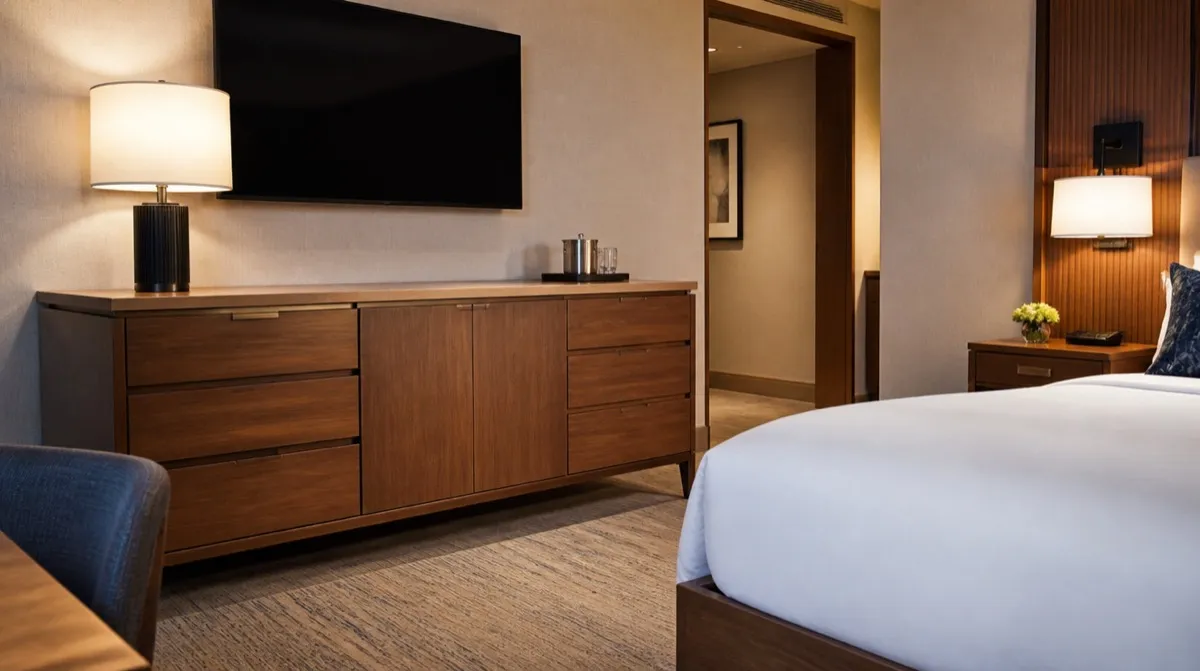
Look for a console with a routed channel or grommet system that keeps cables contained but still accessible, since a fully enclosed system that requires disassembly to access a cable is a maintenance headache for engineering staff over the life of the piece.
Doubling as a work or luggage surface
If the console must support work or luggage, specify the intended loads and tasks. Confirm usable surface, fit and manufacturer limits independently of the television mounting requirements.
Drawer and storage configuration
Where the proposed console includes drawers, request drawer loads, slides, applicable cycle testing, access and replacement parts. Full-extension ball-bearing construction is one option, not a universal qualification for commercial use.
Matching the casegoods set
Compare finish samples and dimensions with the room package. Our hotel dressers guide and hotel nightstands guide cover related pieces. The TV panels category offers design concepts; obtain actual product and coordination documents before ordering.
Open vs. enclosed storage design
Compare open shelves and enclosed drawers against guest storage, housekeeping access and the room brief. Trial the reset procedure rather than assuming open storage is always faster or that property tier determines drawer requirements.
Some properties mix the two, an open lower shelf for a bag or shoes plus one enclosed drawer for smaller items, which gives flexibility without adding the full footprint of a traditional dresser. Whichever configuration you choose, confirm it fits within the same footprint as the console it is replacing if this is a renovation rather than new construction, since guestroom floor plans rarely have spare inches to accommodate a larger piece.
Budgeting the renovation
Use the FF&E budget calculator for a package planning scenario. Obtain current quotes and separate approval, production, freight and installation dates; standard finishes have no universal ten to fourteen week delivery window.
Request a quote with the room drawings, television/mount details, storage needs and finish brief so independent suppliers can document a proposed console.