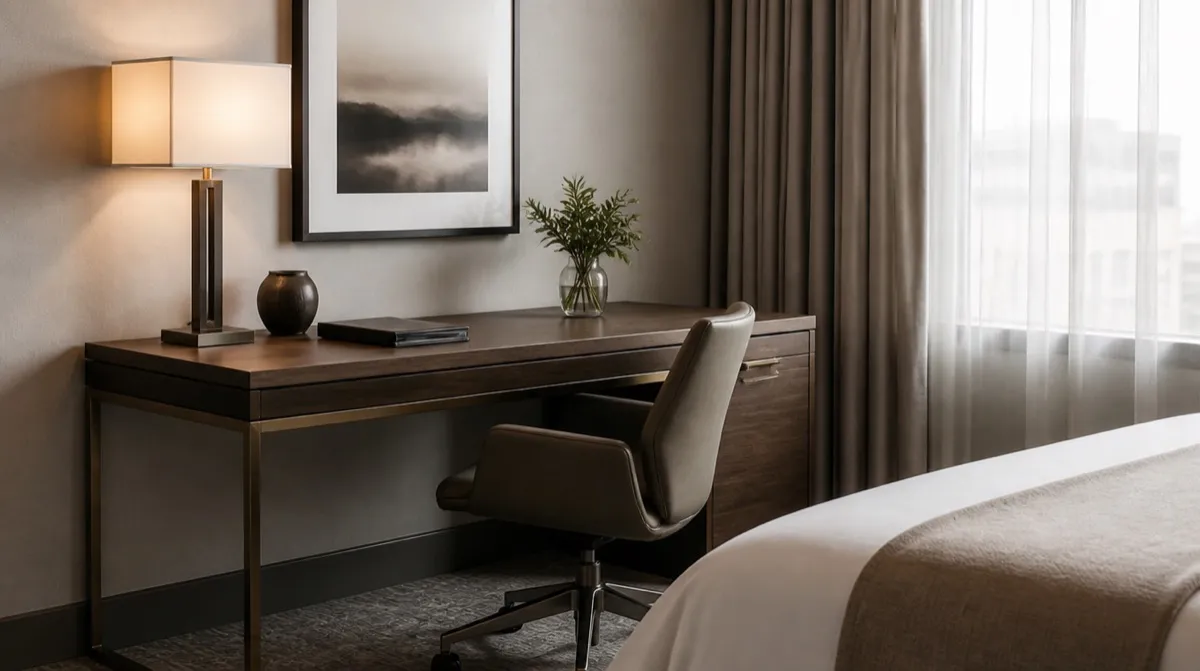
A guest-room desk may support laptop work, charging and everyday belongings. Plan the usable surface and chair together within the actual room layout rather than judging the desk only by its appearance.
This is a procurement guide to hotel desks: how to size them for real work, what specs separate a contract-grade desk from a residential one, how brand programs constrain your choices, and how the piece fits into the rest of the casegoods package. It is written for people furnishing new rooms or running a renovation, not for shopping a single desk.
Why the guest room desk matters more now
Guests who use a laptop need usable surface area, an appropriate chair and power access. Identify the tasks your room brief must support and trial a proposed desk-and-chair combination.
Check whether the chair pulls in, the work surface accommodates the intended equipment and the outlets are reachable. These are practical requirements to verify on drawings and in a mockup.
Sizing a hotel desk for real work
Use dimensioned drawings and a room mockup to check the proposed desk footprint and usable surface.
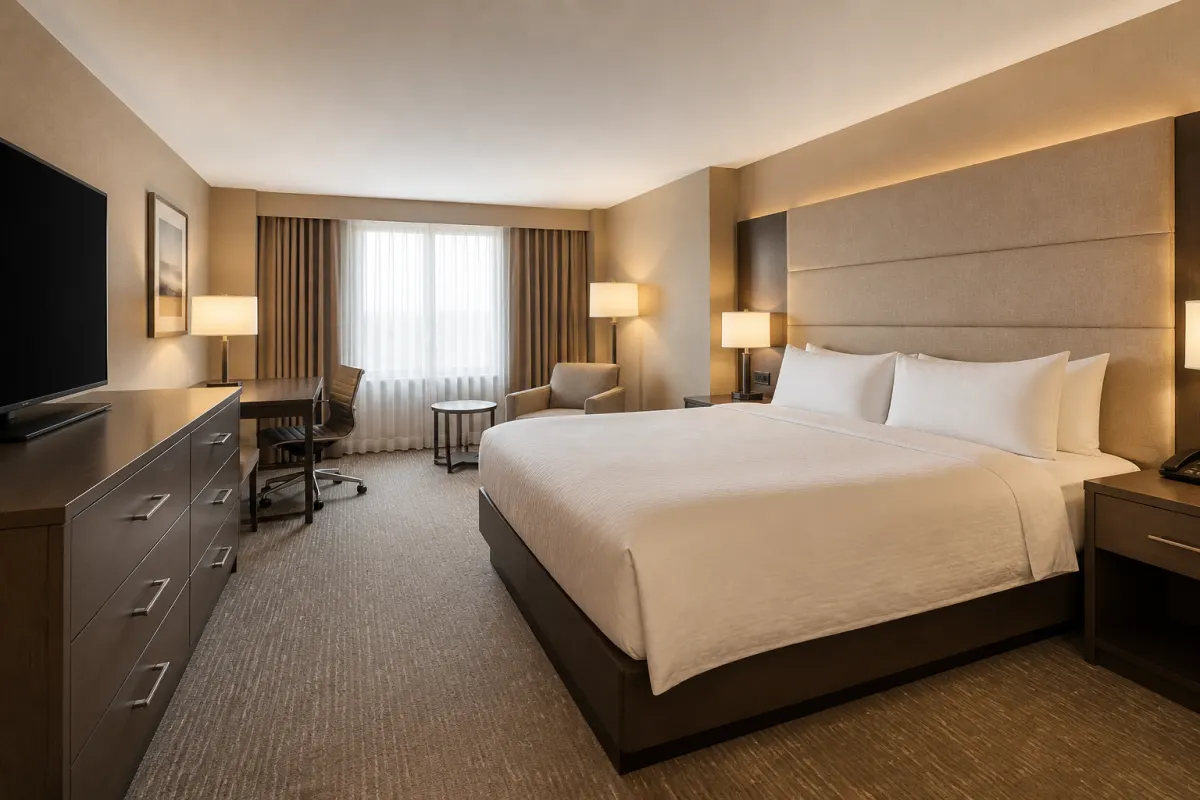
Check width and depth with the equipment and belongings described in the brief. The ranges below are planning examples, not universal brand requirements or proof of accessibility. For U.S. accessible dining and work surfaces where required, Sections 902 and 306 must be considered together with the applicable room requirements.
| Dimension | Planning example or referenced requirement | Why it matters |
|---|---|---|
| Height | 29 to 30 in planning example; applicable U.S. accessible work surfaces: 28 to 34 in | Coordinate surface and chair height; check the applicable standard |
| Width | 40 to 48 in planning example | Check the actual work zone and belongings |
| Depth | 22 to 24 in planning example | Trial laptop placement and usable surface |
| Knee clearance | Where Section 306 applies: 27 in minimum height and 30 in minimum width, with required depth profile | Check the full knee/toe clearance and approach, not just chair fit |
A dual-purpose or wall-mounted desk may help with a tight footprint. Check support, installation, access beneath the surface and housekeeping reach on the actual design. A floating design alone does not establish quicker cleaning or accessible use.
Specs that separate contract desks from residential
Include likely contact with drinks, luggage and housekeeping products in the desk brief. A contract-grade label alone does not establish the complete piece's performance.
Request the exact surface, substrate, edge treatment and approved cleaning instructions. Compare relevant test documentation for the actual assembly rather than assuming laminate always outperforms veneer or that a 3 mm edge is universally sufficient. For drawers, confirm loads, slide specification, applicable cycle testing and replacement parts.
Specify the outlet and charging needs in the room brief. Review reachable placement, cable routing, module documentation and installation requirements with the project team.
Compare physical finish samples with the other casegoods under room lighting. Color and sheen affect appearance; darker tones do not guarantee hidden wear.
Brand programs and property standards
If the hotel flies a flag, the desk choice is not fully yours. Brand programs set standards for guest room furniture, and those standards can dictate dimensions, finishes, durability ratings, and sometimes approved suppliers. A custom desk that ignores the program will not pass inspection, no matter how good it looks.
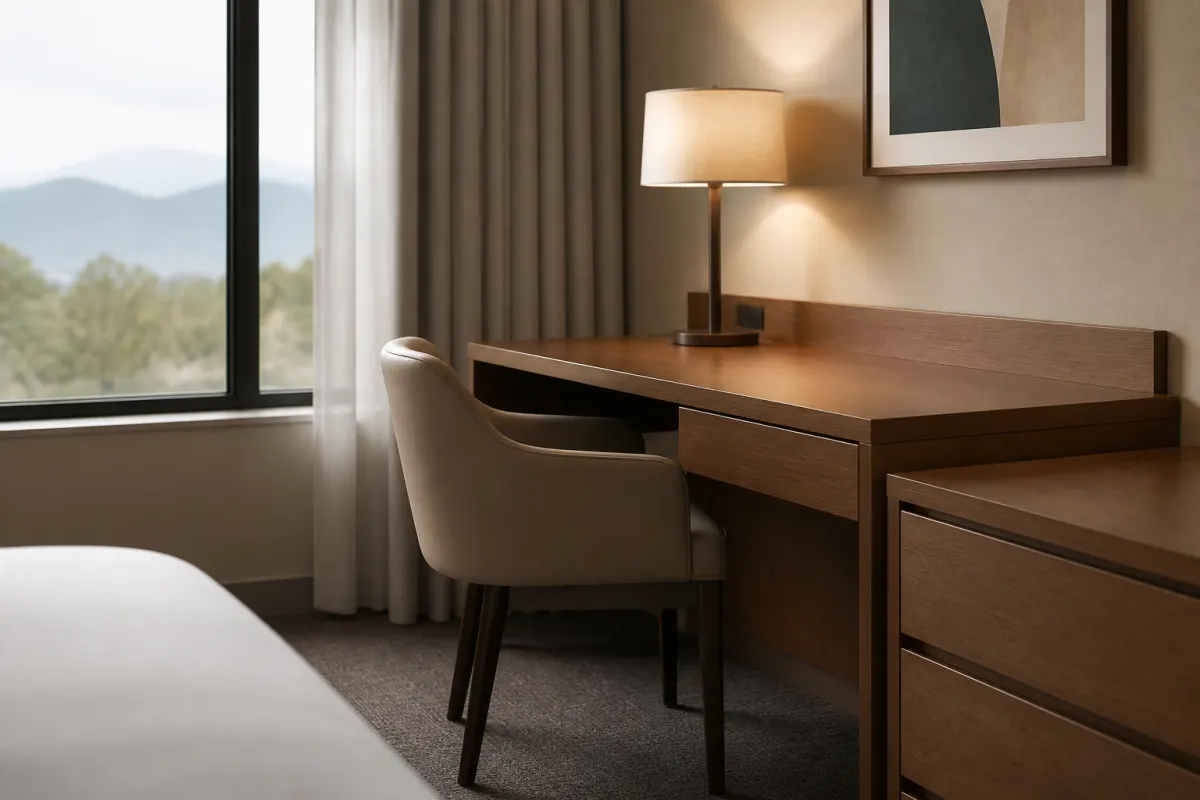
The practical move is to pull the brand's current FF&E standards before you spec anything and treat them as the constraint you design within. Independent and boutique properties have more freedom, and there the desk becomes a design decision that carries part of the room's character. Either way, consistency across the property matters. If you are renovating in phases, lock the finish and hardware specs at the start so rooms completed months apart still match. Our guide to how hotels source furniture explains how these programs and procurement paths fit together.
Budgeting and lead times
Coordinate desk procurement with the casegoods package. Confirm stock status, sample approvals, production, freight and installation for the proposed configuration; custom work has no universal 10 to 14 week window.
Plan backward from room handover, with named approval and delivery milestones. Obtain physical samples and written schedule assumptions. Request separate freight and installation prices rather than applying 14 to 26 percent as a general rule.
Use the FF&E budget calculator for a planning scenario and request a quote for actual quantities and delivery details. The desks, dressers and nightstands pages offer concept images for a design brief; they do not verify contract performance or current stock.
The short version
Check the work surface and chair in the room layout, confirm product documentation and any brand approval, coordinate power and obtain a delivery schedule before committing.
Related reading
Our take
Ask whether the power-and-data module can be replaced separately from the desk. Confirm compatible replacements, mounting, access and installation requirements. That gives the property a documented upgrade path if its charging needs change, without predicting when a particular connector will become obsolete.
Procurement check: Record the desk dimensions, chair fit, room and brand requirements, and the power-module replacement procedure in the same brief.