
Newark's hospitality market runs on a different engine than most cities its size, and that engine is Newark Liberty International Airport. Airport-adjacent select-service and extended-stay properties make up a huge share of the city's room inventory, and they turn rooms over at a pace few other markets can match. At the same time, downtown Newark has been rebuilding around the Prudential Center, NJPAC, and the office towers along Broad Street, pulling in corporate travelers and event crowds who expect a different tier of finish. Add the Ironbound District's dense restaurant and nightlife scene, a short PATH and rail ride from Manhattan that keeps demand steady, and a wave of new construction and adaptive reuse projects downtown, and you get a market that asks a lot from a furniture supply chain. If you are sourcing furniture for a hotel project anywhere in Newark, here is what that market actually requires.
What Makes Newark Different for Hotel Furniture Sourcing
Newark is a transit and logistics hub first, and that shapes guest behavior at nearly every property type. A select-service hotel a few minutes from Newark Liberty sees fast checkouts, early check-ins, and a guest who barely notices the room but absolutely notices when a chair wobbles or a headboard is scuffed. A corporate hotel downtown near the Prudential Center or NJPAC operates on a completely different rhythm, with longer stays tied to conferences, concerts, and Devils and Seton Hall games, and a guest who expects the room to look and feel current. Your furniture supplier needs to understand that split, not just quote you from a catalog built for one type of property.
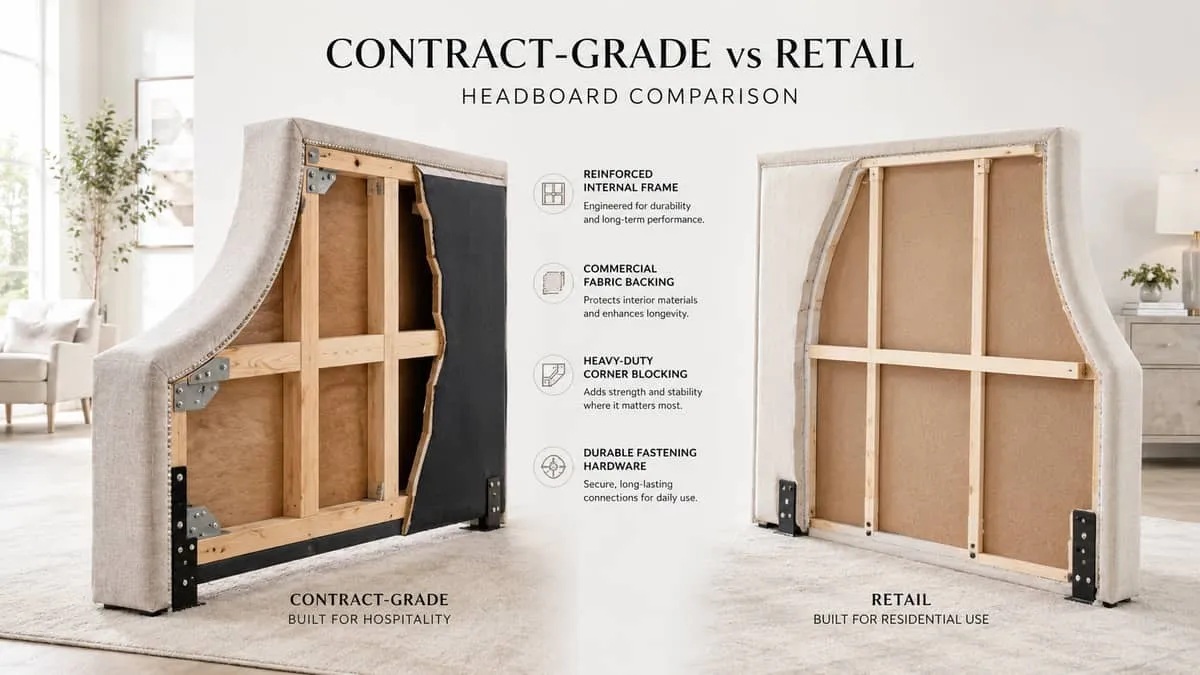
The airport corridor along Routes 1&9 and around Newark Liberty drives some of the highest turnover rates in the region. Rooms in that zone get cleaned, reset, and re-occupied on a schedule that leaves little margin for furniture that cannot hold up. Casegoods absorb more impact damage from rolling luggage in a single month near the airport than a suburban property sees in a year, and mattresses and upholstery see use cycles that residential-grade product was never built for. If you are sourcing for a property in that corridor, ask your supplier for real specification data, foam ILD ratings, fabric abrasion counts, and joinery documentation on casegoods. A supplier who cannot produce that paperwork is not the right partner for airport-tier volume.
Downtown Newark sits at the other end of that spec conversation. Properties near NJPAC and the Prudential Center, and the newer boutique and lifestyle hotels filling in around Military Park and the emerging residential towers downtown, are competing for a guest who could just as easily book something in Manhattan. Ownership groups downtown are increasingly design-conscious, and they are involved in fabric and finish decisions in a way airport-tier properties often are not. A hotel furniture supplier in Newark who only knows one tier of this market is going to leave gaps, whether you are spec'ing a high-turnover extended-stay property or a design-forward hotel near the arts district.
Why Contract Grade Matters in This Market
This is the conversation that saves money over time even when it costs more upfront. Retail furniture is built for residential use, light daily contact, careful handling, and the assumption that a piece gets replaced on its own timeline as a style choice. Hotel furniture in Newark lives in a completely different environment.
A lobby chair near NJPAC or the Prudential Center might see hundreds of sit-down cycles in a single event week. A guest room bed frame at an airport-corridor property gets moved and reset by housekeeping multiple times a day, every day of the year. Drawer hardware in a downtown business hotel goes through more open-close cycles in a month than residential hardware sees in a year. When retail furniture fails in that environment, and it fails faster than most owners expect, the cost is not just a replacement order. It is liability exposure, a blown maintenance budget, and a guest complaint that lands in a review before the guest has even checked out.
Contract-grade furniture from a qualified hotel furniture supplier meets BIFMA standards or an equivalent hospitality benchmark that retail products never have to clear. Frame construction is reinforced for commercial load cycles. Finishes are tested against institutional cleaning chemicals and daily wipe-downs. Foam density and fabric selection are chosen specifically for a use profile measured in years of heavy turnover, not seasons. The price gap between contract and retail product pays for itself before the first replacement cycle in almost every Newark hospitality application. Ask your supplier for documentation. Hesitation on that question tells you what you need to know.
Lead Times, Logistics, and Getting the Timeline Right
Newark hotel projects run on calendar pressure that shifts by property type. An airport-corridor renovation needs to move fast and finish clean, because those properties rarely get a slow season to hide construction behind. A downtown project near the Prudential Center or NJPAC is often racing a concert or convention calendar that will not move for anyone. A phased room refresh in an occupied building downtown has to work around guests, elevator schedules, and a general contractor who needs deliveries to land in a specific sequence.
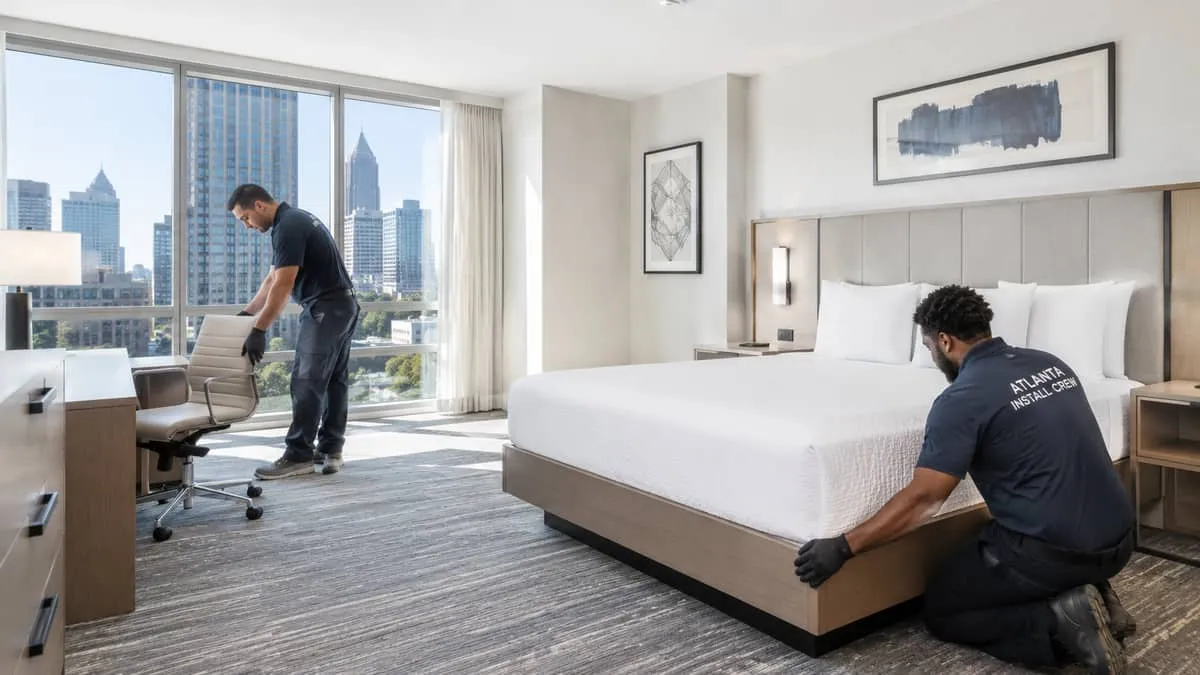
In every one of those situations, lead time is the variable that decides whether you hit your date. Standard lead times from contract furniture suppliers run 10 to 16 weeks for domestic production. Import orders stretch to 20 weeks or longer once shipping, customs clearance through the Port Newark-Elizabeth complex, and any downstream trucking delays are factored in. That math does not bend for a pre-opening booking horizon or a lender's draw schedule tied to substantial completion.
Lock your furniture specs at the same point you finalize interior design drawings, not weeks later. That is not a nice-to-have, it is the specific decision that separates Newark hotel projects that open on schedule from the ones that slip. A supplier worth hiring here will turn physical samples around fast enough to keep your design and ownership review moving, propose phased delivery sequencing for larger room counts, and flag lead time risk early enough that you can actually respond to it. They should be coordinating directly with your general contractor rather than waiting on you to relay information back and forth.
Minimum order quantities matter on Newark projects, especially for the independent and extended-stay properties that might be furnishing 60 to 100 rooms rather than 250. Most contract suppliers set MOQs at the piece level by category, with 20 to 50 units per SKU common for upholstered seating and more flexibility on casegoods. Custom fabrics and custom finish runs almost always push minimums higher. Get that conversation settled before you have invested weeks into sample selection.
How to Evaluate a Hotel Furniture Supplier in Newark
Start with actual project history in the New York metro and New Jersey hospitality market. A supplier with completed installations across Newark's property categories, airport-tier select-service, downtown business hotels, and boutique or lifestyle properties, understands both the operational demands and the design range this market covers. Ask for references from projects comparable to yours in scale and budget, then actually call them.
Logistics capability matters as much as product quality here. Newark is dense, and deliveries downtown near the Prudential Center or the Ironbound involve tight loading dock access, building management coordination, and general contractor schedules that do not leave room for error. A supplier with in-house white-glove delivery and installation experience in commercial environments has already solved those constraints before the truck leaves the warehouse. A supplier who ships freight and hands the final mile to a third party has not, and that gap shows up on installation day.
Ask how a supplier works within your broader project team. Most Newark hotel renovations run through an interior design firm or a dedicated FF+E project manager, and a supplier with established relationships in that local design and PM community keeps projects on spec and on schedule. Communication breakdowns between the supplier, the design team, and the GC are how weeks get lost. A supplier embedded in that process prevents it.
The right hotel furniture supplier in Newark is not a vendor you use once and move past. In a market this active, where the airport corridor, the downtown business and events district, and the emerging boutique segment are all demanding different things at the same time, they are a project partner. Evaluate them that way before you sign a purchase order.
If you are sourcing hotel furniture for your Newark property, the fastest way to real numbers is to tell us what you need. Request a quote with your quantities and timeline.
Related reading
- Commercial hotel furniture: a sourcing guide for every space
- Boutique hotel furniture: specifying a distinctive, durable look
- What is contract furniture
- Commercial furniture vs retail
- Hospitality furniture supplier guide
- Hotel lounge chairs
- Hotel headboards
- Browse full catalog
- Commercial furniture in New Jersey