Food service FF&E covers the furniture inside a corporate cafeteria, a campus dining hall, a hospital dining program, or a catering and banquet kitchen's front-of-house space. It is easy to assume this is restaurant FF&E under a different name, but the buyer, the use pattern, and the durability math are all different. A restaurant furnishes one dining room for a single operator turning covers at a set pace. Institutional food service furnishes a space that a facility, a district, or a health system owns, that runs on a fixed meal-period schedule, and that often has to double as something else (a study hall, a family waiting area, an overflow meeting space) outside those windows.
How is food service FF&E different from restaurant FF&E?
The difference is who sits down and how long they stay. Restaurant seating is designed around a controlled cover pace and a hospitality experience the operator curates. Institutional dining seating is designed around throughput at a fixed hour: for example, a cafeteria feeding a shift change in a 40-minute window, a dining hall clearing and resetting for the next meal period, a hospital tray line moving patients' families and staff through in bursts. That changes the spec. Chairs and stools need to stack or nest for fast reset and off-hour storage. Table tops need a surface that survives tray impact and heavy wipe-down cycles rather than a finish chosen primarily for atmosphere. Plan seating from peak-period headcount as well as daily use. Compare the busiest measured interval with seating, reset time, and service-line capacity rather than assuming one universal fifteen-minute peak.
Scoping by zone
Corporate cafeteria. Usually the smallest footprint of the group but the most schedule-compressed, since a single building's population eats in one or two windows. Seating mixes four-tops, communal tables for larger groups, and a smaller counter-height zone near coffee and grab-and-go for employees eating fast between meetings. Durability standard is closer to office-adjacent than restaurant-grade, since the abuse is spills and daily use rather than bar-level volume.
Campus dining hall. The highest-turnover zone in this category. A dining hall resets multiple times a day across breakfast, lunch, and dinner, and the furniture often has to support the room functioning as study space in the hours between meals. Durable, stackable seating and tables that can be reconfigured or cleared to open floor space matter more here than anywhere else in institutional food service. Finish and cleanability standards need to hold up to a population that treats the space casually, spills, backpacks, and long occupancy at single tables during off-peak hours.
Healthcare dining. Splits into two very different sub-zones that get confused constantly. Staff and visitor cafeterias run like a corporate cafeteria: fixed meal windows, throughput-focused seating, easy-clean surfaces. Patient and family dining areas near a unit or a pediatric wing run on a completely different clock, low turnover, longer dwell time, and a specification that leans softer and more residential to support a calmer environment, closer in spirit to a waiting room than a cafeteria line.
Catering halls and banquet kitchen fronts. The front-of-house furniture supporting an in-house catering or banquet operation needs to flex between a plated sit-down event and a buffet-style reception, which usually means round or rectangular banquet tables paired with stacking or banquet chairs rather than fixed seating. This overlaps heavily with event furniture programs, and if your facility runs banquet service alongside daily cafeteria service, plan the two as related but separate line items since the durability and reconfiguration requirements diverge.
Durability and cleanability specs that actually matter
Use the actual service calendar, meal-period peaks, off-hour activities, and cleaning frequency to set the specification. A 300-service-day campus scenario is one illustrative workload assumption; it does not establish that every institutional dining room gets more use than a restaurant. That argues for commercial-grade frames rated for continuous stacking and moving, table tops with a wipeable, chemical-resistant surface rather than a softer finish, and seating that tolerates repeated cart and cleaning-equipment contact along baseboards and table legs. Health-code-adjacent cleanability, smooth surfaces without seams that trap debris, matters more here than in most FF&E categories, so confirm any laminate or solid-surface top spec meets your facility's cleaning protocol before finalizing the order.
What counts as FF&E versus kitchen equipment here
This guide focuses on dining furniture: tables, chairs, stools, and adjacent front-of-house pieces such as condiment-station bases. Schedule serving lines, tray conveyors, walk-ins, and dish-room equipment separately with the responsible foodservice and construction teams. Whether a piece is carried in the FF&E budget or another project package depends on the agreed scope; identify its owner and installation requirements rather than relying on the acronym alone. Our FF&E versus OS&E guide breaks down that boundary in more detail if your project is drawing budget lines for the first time.
Phasing installs around live meal service
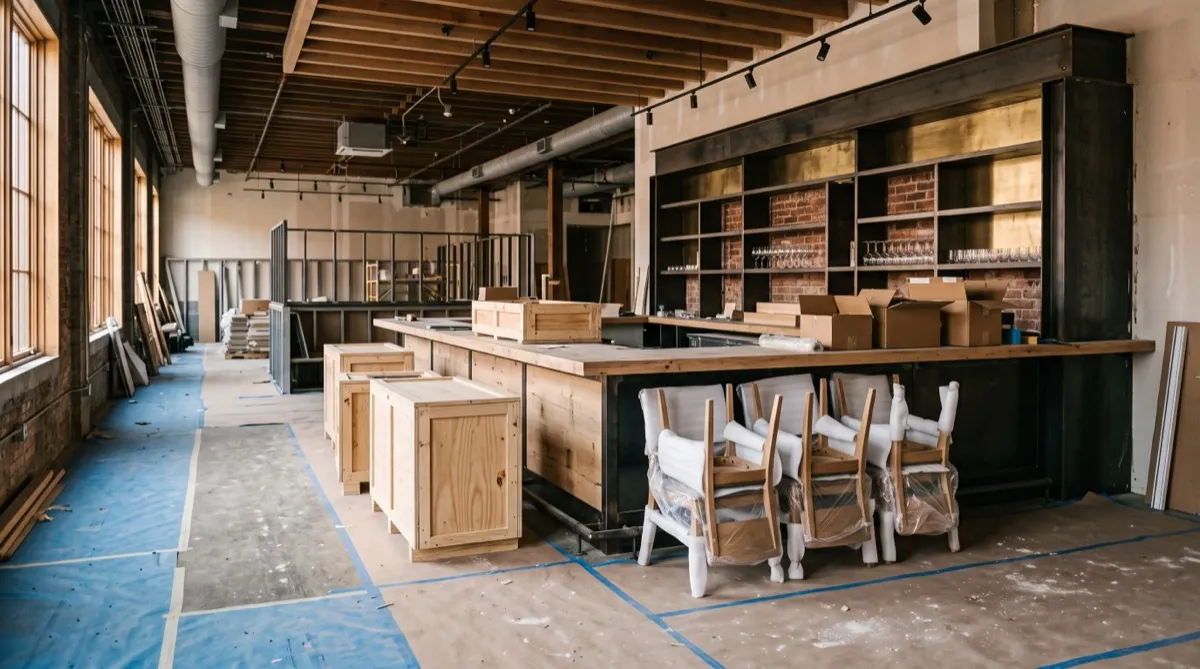
If the facility must remain open during the work, make live meal-service continuity an explicit constraint in the delivery and installation plan. A campus dining hall or hospital cafeteria has to keep serving through a renovation or refresh, which means furniture delivery and install get phased zone by zone and scheduled around service windows rather than delivered all at once. A typical approach installs half the room overnight or during a low-traffic period, holds a service line open on the completed half, then flips to the remaining half once the first is functional. This takes more install coordination than a from-scratch restaurant build where the whole space sits empty until opening day, so build extra lead time into your schedule for staged delivery and confirm with your supplier that partial shipments can be sequenced to match your phasing plan rather than arriving as one combined load.
Determine seat counts by zone from peak-period demand and the measured layout, then price the item schedule. The FF&E budget calculator uses hotel keys, property tier, and renovation or new-build assumptions; it does not calculate institutional dining seats. For the full procurement sequence, spec to install, see our FF&E procurement guide, or start from the FF&E procurement hub if you want the whole process mapped stage by stage on one page.
Getting a quote for a food service program
Institutional food service programs often span multiple zones and multiple durability tiers in a single order, cafeteria seating here, patient dining seating there, banquet tables for the catering side. Bundling all of it into one request a quote submission with zone-by-zone counts lets bidders price the complete program and state whether they can meet the required delivery phases. Confirm any quantity pricing, partial-shipment charges, and installation scope in the proposal.
Browse commercial dining and banquet tables sized and finished for continuous institutional service to see what a zone-appropriate spec looks like before you build your item list.