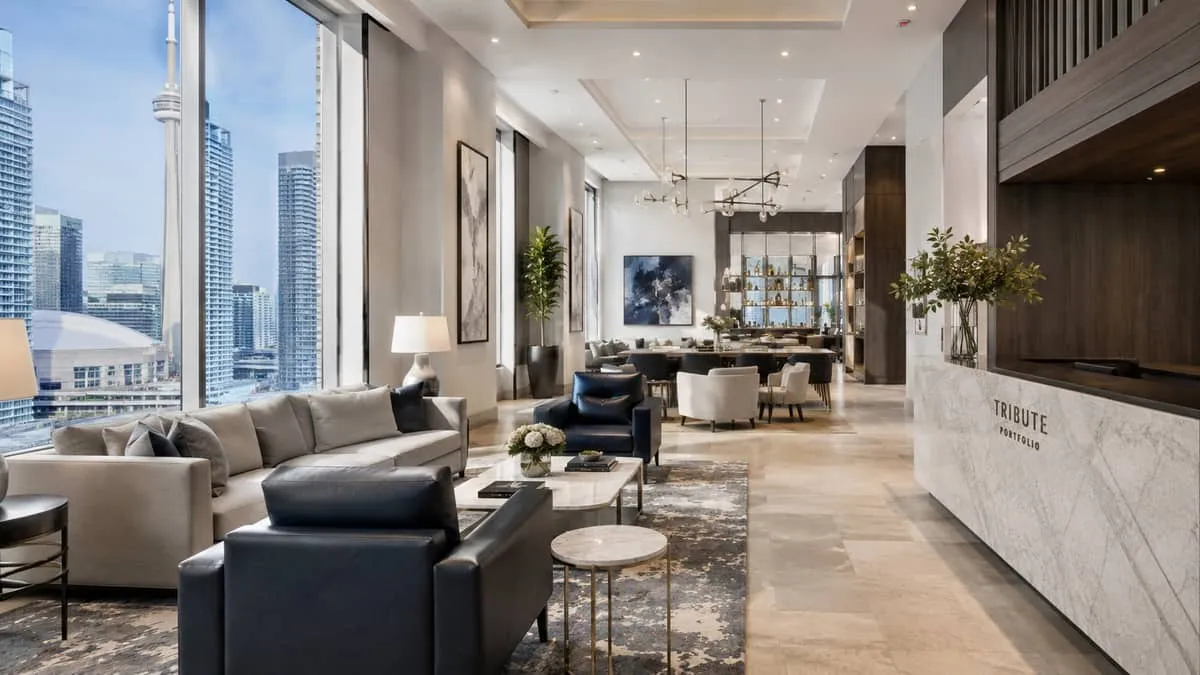
Toronto is running one of the most active hotel development pipelines in North America. At any given moment, the city has between 20 and 30 hotel projects in various stages of development: flag properties going vertical near the Metro Toronto Convention Centre, boutique conversions carving guest rooms out of heritage buildings in the Distillery District, lifestyle hotels targeting the King West and Queen West corridor, and extended-stay properties chasing the tech and finance workforce in the Financial District. Each of those projects goes through FF&E procurement, and in a market this size, with design expectations this high and construction timelines this unpredictable, the process looks meaningfully different from smaller Canadian markets.
If you are an owner, developer, or operator working on a Toronto hospitality project, this is what FF&E procurement actually looks like here, not in a generic sense, but in the specific context of this city.
FF&E and OS&E: What the Categories Actually Cover
The terms get used interchangeably and imprecisely, which causes real problems when budgets are being assembled.
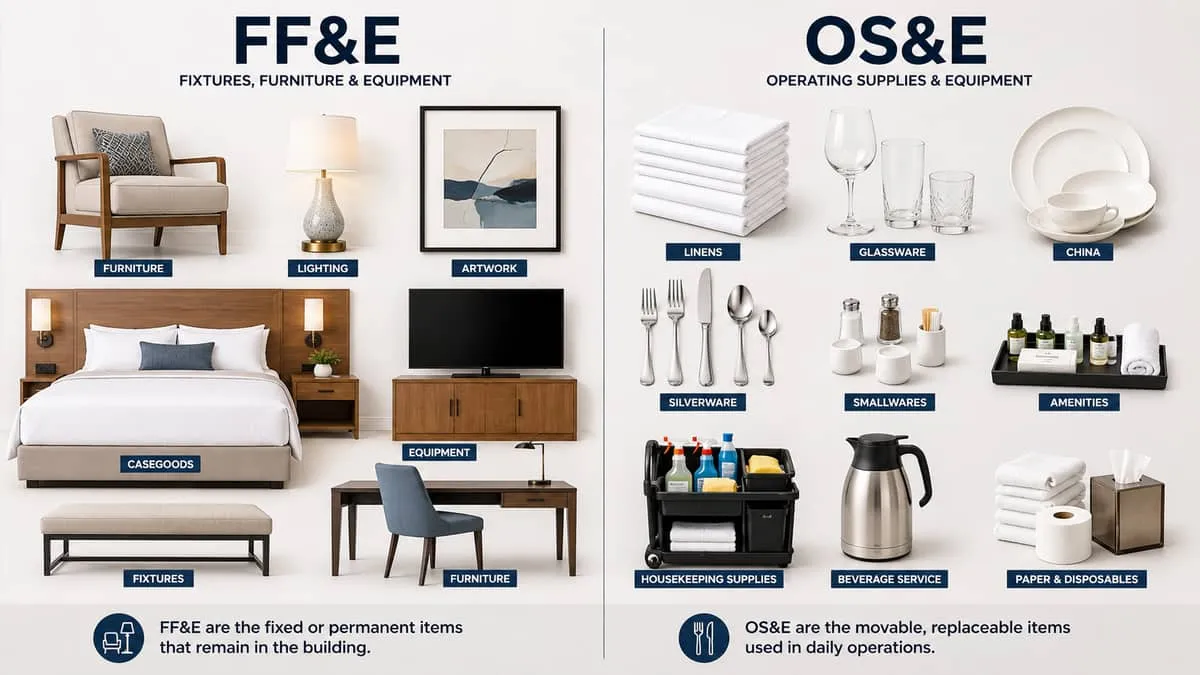
FF&E covers furniture, fixtures, and equipment: guest room case goods and beds, lobby seating, restaurant dining chairs, bar stools, lounge furniture, artwork, decorative lighting, and anything else that is movable but not structurally part of the building.
OS&E (operating supplies and equipment) covers what is needed to run the operation once the furniture is in: linens, glassware, kitchen smallwares, housekeeping carts, uniforms, and similar items.
Both categories require their own procurement timelines and vendor relationships. A common and expensive mistake in Toronto hospitality projects is treating OS&E as a cleanup item to handle after the FF&E is sorted. It is not. A Yorkville luxury hotel that defers OS&E sourcing until eight weeks before opening will find itself scrambling for linens and serviceware while the custom lobby furniture arrives on schedule. The furniture photos make it into the press release. The missing glassware shows up on opening weekend.
Toronto's Hotel Pipeline and What It Demands from Procurement
The scale of Toronto's development pipeline creates procurement conditions that do not apply in smaller markets. Order quantities are larger. Design firms working on flagship properties in Yorkville or the Financial District are specifying at a higher level than most hospitality designers in Canada. And the construction environment in downtown Toronto is one of the most congested and delay-prone in the country.
Heritage conversion projects in the Distillery District and King West create their own complications. Victorian and Edwardian building envelopes are not designed around modern loading docks. Elevator capacities are limited. Floor loading restrictions affect what can be specified for upper floors. Custom pieces that would drop into a standard hotel corridor without issue require advance measurement, sequenced delivery, and sometimes furniture that is designed to be assembled in place rather than brought in finished.
New-build flag properties near the convention centre are working at the opposite extreme: 300 to 500 rooms means order quantities that require factory allocation months in advance, freight consolidation across multiple manufacturers, and warehousing that can handle phased delivery as floors are completed. A supplier relationship that works for a 60-room boutique in the Annex is not automatically equipped for a 400-room Marriott product.
Understanding which category your project falls into, and sourcing accordingly, is the first decision that shapes everything else.
The Realistic Procurement Timeline for a Toronto Project
Toronto's construction sector has chronic delay exposure. Projects that open on schedule are the exception. A procurement timeline built around a fixed opening date with no buffer for site delays is a procurement timeline that will fail.
For a mid-scale to upscale Toronto property, FF&E procurement should begin 14 to 18 months before the target opening date. Convention-scale and luxury projects often start earlier. Here is what that window looks like in practice:
Months 14 to 10 before opening: The design team finalizes FF&E specifications. Product selections are confirmed, samples are reviewed, and custom fabrication orders are placed. Custom upholstered pieces from contract manufacturers typically carry 16 to 24 week lead times. Anything coming from European suppliers adds freight time on top of that. For a property trying to capture TIFF business in September, starting custom seating orders the previous November is not aggressive, it is appropriate.
Months 10 to 6: Purchase orders are issued. Freight and logistics arrangements are confirmed. If the project is using a purchasing agent or FF&E procurement firm, this is when their coordination role becomes most active. Currency exposure on US or European purchases needs to be managed here, not after delivery.
Months 6 to 3: Production is monitored. Factory inspections are scheduled for large custom orders. Supply chain substitutions, when they happen, get resolved in this window. Resolving them at month one is emergency procurement. Resolving them at month five is normal project management.
Final 3 months: Warehousing, phased delivery coordination, and installation sequencing. In downtown Toronto, loading dock access at sites near the Financial District or the convention centre requires scheduling well in advance. Elevator time in a building still under construction is a shared and often contentious resource. The furniture supplier or procurement agent who has done this in Toronto before knows to book access early and build contingency into the sequencing.
Working with Toronto's Interior Design Community
Toronto has a sophisticated hospitality design community, and the firms working on significant projects here are specifying at a level that demands equally sophisticated procurement support.
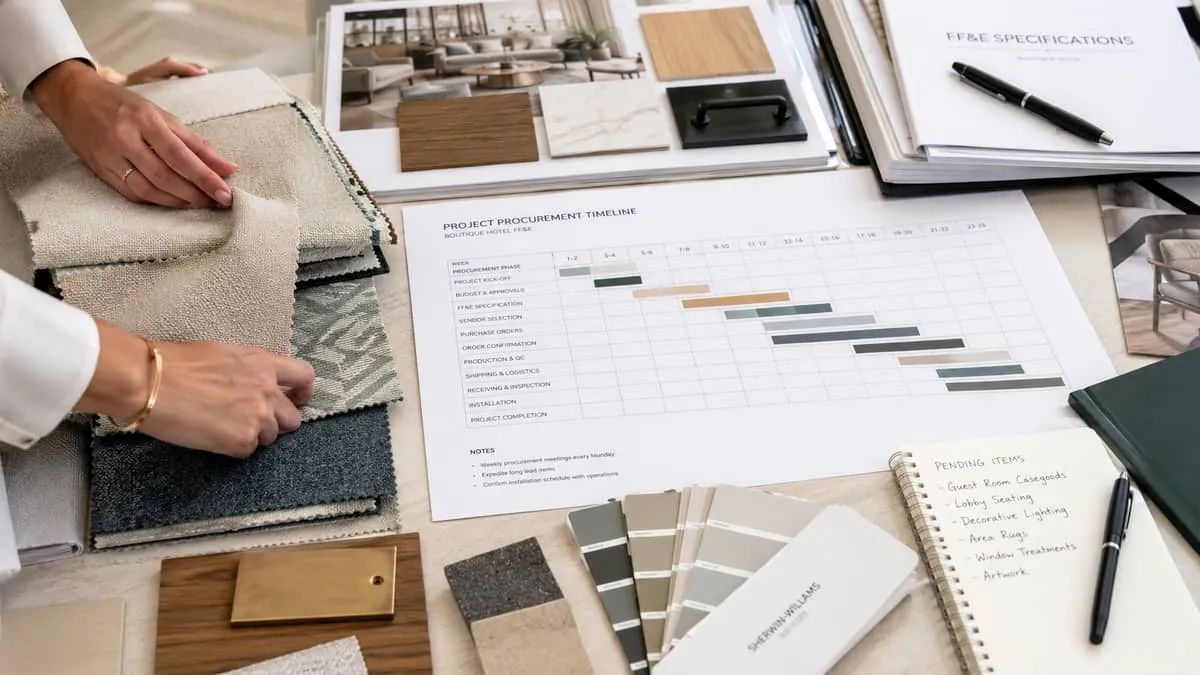
The studios involved in properties like the Four Seasons Yorkville renovations, Soho House projects, Ace Hotel, and the crop of boutique properties coming into the Distillery District and the St. Lawrence Market area are not working from catalog selections. They are developing custom upholstery programs, specifying tight finish tolerances, and coordinating closely with architects on built-in and loose furniture integration. A furniture supplier operating in this environment needs to be able to receive detailed specification packages, confirm compliance, manage sample submittals efficiently, and flag lead time issues early rather than at delivery.
For owners who are new to the Toronto market, the relationship between the designer and the purchasing function can be unclear. Most projects above a certain scale separate the two, even when the same firm nominally handles both. The interior designer specifies what is required: manufacturer, finish, fabric, dimensions, and custom requirements. The purchasing agent or procurement company manages the actual transaction: pricing, purchase orders, freight coordination, warehousing, and installation scheduling. This separation is not redundant overhead. A purchasing specialist handling volume across multiple projects negotiates better pricing, has freight relationships that reduce logistics costs, and has visibility into which suppliers are running on time and which are consistently late.
At the boutique scale, a 40-room hotel in Kensington Market or a restaurant group opening a second location in King West, the designer may take on more of the purchasing coordination directly. That works when the designer has the systems and vendor relationships to support it. Confirming the scope explicitly before the project is underway is worth the conversation.
Budget Realities in a High-Cost Market
Toronto hospitality owners, particularly those developing their first property, consistently underestimate FF&E budgets. The furniture line item is visible and easy to cost. The surrounding costs are not, and they add up quickly.
A realistic benchmark for a full-service hotel in Toronto's mid-scale to upscale segment is between $18,000 and $40,000 CAD per key, depending on segment, brand standards, and the degree of customization the design calls for. Luxury properties in Yorkville or the Financial District corridor frequently exceed that range. Restaurant fit-outs for a mid to upper-scale concept typically run $175 to $450 per square foot for full furniture and fixture installation, with higher-end food and beverage concepts in Queen West or the Harbourfront area sitting toward the top of that range.
What the total budget needs to account for, beyond the furniture itself:
Freight costs have risen substantially and remain elevated. Importing from US manufacturers involves cross-border logistics and currency exposure. European goods add ocean freight, port handling, and customs brokerage. Duties on upholstered goods and case goods vary by country of origin and material composition, and they need to be calculated during the budgeting phase, not after the purchase orders go out.

Warehousing in the Greater Toronto Area is expensive. Holding furniture in a climate-controlled facility while a construction project runs behind schedule is a real cost that needs a budget line.
Installation labor in Toronto reflects local wage rates and union considerations on certain project types. Sequenced installation on a multi-floor hotel, coordinated with active construction on other floors, is more complex and more expensive than a straightforward single-day delivery.
Toronto also has strong regional suppliers for custom seating and case goods, particularly in the manufacturing corridor west of the city, that can reduce both lead times and landed costs for projects that would otherwise source exclusively from the US or overseas. A procurement partner with established relationships in that network is a material advantage.
Construction Delays and Procurement Flex
Toronto's construction sector is notorious for schedule slippage. Permitting backlogs, trade availability, and the sheer volume of concurrent activity in the downtown core all contribute to projects running behind their original opening targets. This is not a contingency scenario, it is the baseline expectation for most projects.
FF&E procurement in this environment needs to be structured with explicit flexibility. That means warehousing arrangements that can extend without penalty, purchase order terms that allow phased delivery rather than a single drop, and a supplier relationship that can hold finished goods without degrading quality or service.
The properties that manage this well plan for a range of opening scenarios from the beginning. They do not build their procurement timeline around an optimistic opening date and hope the construction schedule holds. They build it around a realistic range, communicate that range clearly to their procurement partners, and structure their contracts accordingly. Furniture held in a warehouse for two months costs money. Furniture that arrives on schedule for a hotel that is not ready to receive it costs significantly more, in storage, in re-delivery, and in the stress on every relationship involved.
Specific Segments, Specific Demands
Toronto's hospitality market is not uniform. The procurement context for a Financial District business hotel serving Bay Street professionals and convention delegates is different from a boutique property in the Distillery District drawing leisure travelers and TIFF guests, and both are different from a King West food and beverage concept built around late-night volume and heavy daily use.
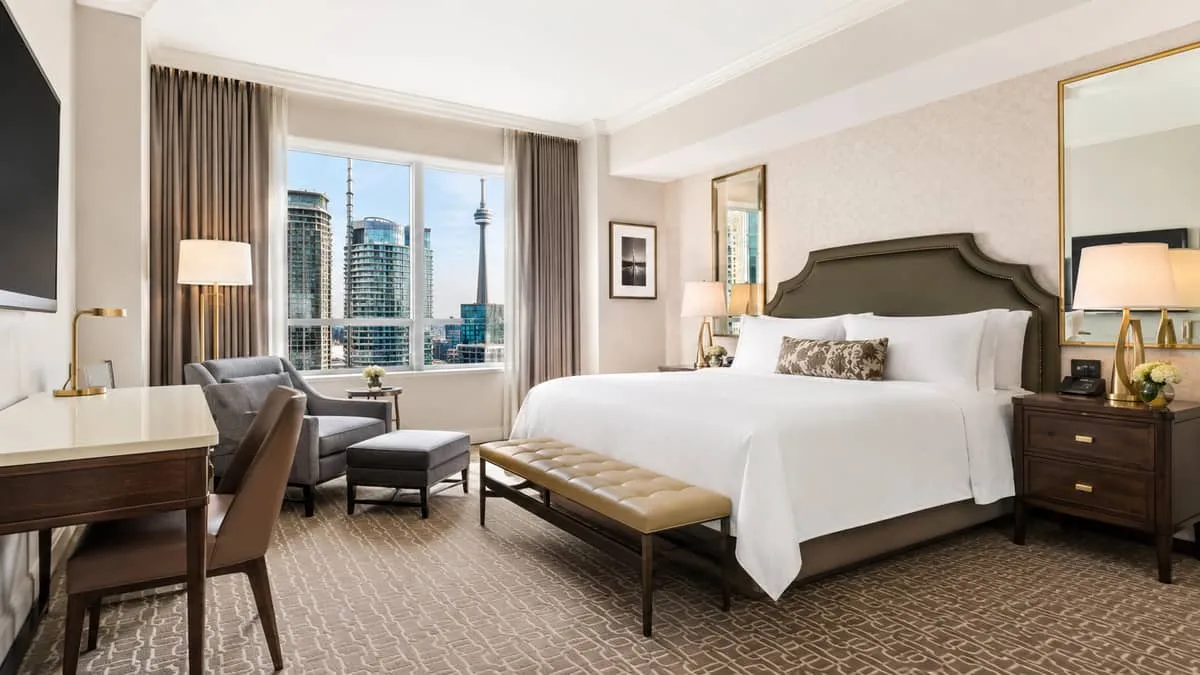
Business hotels near the convention centre are specifying for durability and brand compliance. Guest room furniture needs to meet brand standard specifications for a major flag, which means documented testing data, approved manufacturer lists in some cases, and procurement that can support a large rollout with consistent quality across hundreds of identical rooms. The lobby and food and beverage spaces face the intensive daily use that convention and meeting business generates.
Boutique and lifestyle hotels in the Distillery District, Yorkville, and King West are specifying for aesthetic distinctiveness. These projects are often the ones where custom fabrication, unique upholstery programs, and locally sourced or locally designed pieces are part of the brand proposition. Lead times for custom work need to be built into the schedule from the beginning, not treated as an upgrade to the standard timeline.
Food and beverage operations across Toronto's dense restaurant landscape, from the St. Lawrence Market area through to Harbourfront and the Queen West strip, face a procurement reality centered on durability and replenishment. Contract-grade seating for a high-volume restaurant handles daily punishment that residential furniture cannot sustain. The initial procurement decision has a direct line to maintenance costs and replacement cycles over the life of the operation.
Starting the Procurement Conversation at the Right Time
The single most consistent predictor of a smooth FF&E procurement process in Toronto is how early the conversation starts. Projects that lock in design direction early, engage procurement support before the timeline is under pressure, and treat OS&E with the same discipline as furniture routinely outperform those that treat procurement as a downstream task.
The lead times are real. A 20-week lead time on custom upholstery ordered at month eight before opening becomes a crisis at month six when the construction schedule slips. A 12-week lead time ordered at month ten is a buffer. The difference between those outcomes is almost entirely about when the first conversation happened.
Toronto's hospitality market rewards operators who understand how the city works: the density and logistics friction of downtown delivery, the design expectations of a sophisticated local design community, the construction realities of one of Canada's most active development markets, and the seasonal demand patterns driven by TIFF, convention season, and a year-round urban hospitality economy. Working with a furniture supplier and procurement partner who has navigated this market across multiple project types gives you a cleaner path through a process that can be genuinely complex when it goes wrong.
Planning FF&E for your Toronto project? Share your specs and quantities and we will build pricing around your actual program. Request a quote to get numbers for your space.