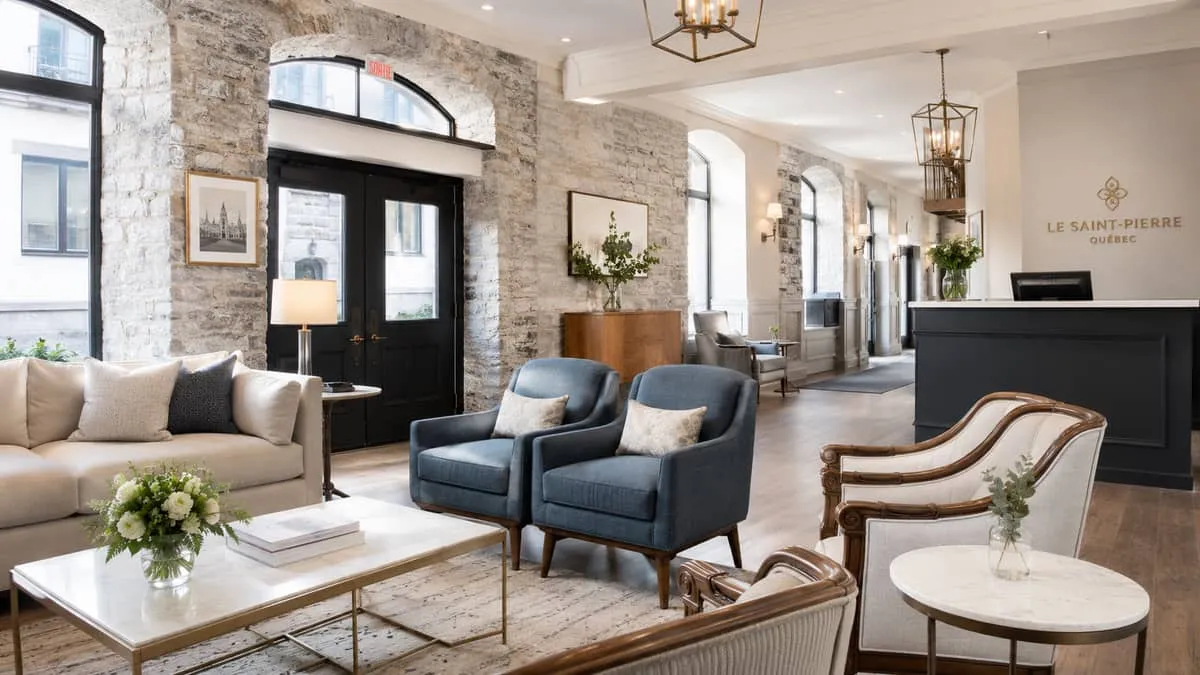
Quebec City has fewer than 600,000 residents, but it hosts a concentration of boutique hotels that would be remarkable for a city three times the size. Auberge Saint-Antoine in Basse-Ville regularly draws guests who compare it to Relais and Chateaux properties in Burgundy and Provence. The Fairmont Le Château Frontenac sets the visual tone for the entire destination. Properties along Rue Saint-Louis and tucked into the stone corridors of Haute-Ville operate in permanent competition with European hospitality standards, not because they are trying to copy Europe, but because that is the guest profile walking through their doors.
FF&E procurement Quebec City is shaped entirely by this reality. Operators are not sourcing furniture for a commodity hotel market. They are sourcing for properties where the physical environment is a core part of the reason guests chose Quebec City over Paris or Bruges in the first place.
Heritage Regulations and What They Actually Restrict
Old Quebec, covering both Haute-Ville and Basse-Ville, carries UNESCO World Heritage Site status that translates into tangible procurement constraints. The city's heritage office reviews anything that alters the character of a protected building, and the scope of that review is broader than most operators from outside Quebec expect.
Loose furniture, including guest room case goods, restaurant seating, and lobby upholstered pieces, typically does not trigger heritage review. But lighting installations that require penetrating stone walls, custom millwork that becomes a fixed element of the space, and exterior fixtures all require advance consultation. On a heritage property renovation in Vieux-Quebec, the safe assumption is that anything bolted to a surface needs to be reviewed before you order.
This creates a sequencing challenge. Interior designers working on properties like Hotel du Vieux-Quebec need to complete their specification work far enough in advance that heritage approvals can be secured before purchase orders are placed. The operators who handle this well treat heritage review as a parallel track to design development, not a gate that comes after design is finalized.

A Fully French Procurement Environment
Quebec City is not bilingual in the way that Montreal operates. The market is overwhelmingly francophone, and the hospitality operators, trades, and suppliers serving it work in French as their default. This extends into every stage of FF&E procurement.
Specification sheets from contract furniture manufacturers need to be available in French for review by local project managers and installation crews. Supplier proposals, delivery documentation, and deficiency reports all move through French-language channels. If you are coordinating a receiving and installation schedule with a Vieux-Quebec property's facilities team, that coordination happens in French.
For operators who source internationally, this creates a real friction point. A contract furniture supplier based in North Carolina or Portugal may not have French-language technical documentation, and the gap between what a francophone installation coordinator understands and what an anglophone supplier's specification sheet says creates field errors. Misread mounting instructions for custom lighting fixtures or incorrectly interpreted fabric specifications on upholstered pieces are exactly the kind of deficiencies that cost money and time to resolve.
Working with a procurement consultant who is fluent in both the French regulatory environment and the English-language supplier ecosystem is not a luxury in Quebec City. It is how the project stays on track. A good consultant translates not just language but context: explaining Quebec's labour practices and union expectations to a supplier's installation team, and explaining lead time realities to a hotel operator who has a firm opening date tied to a Summer Festival week.
The Office québécois de la langue française sets the standards for workplace language in Quebec, and any supplier with a permanent presence in the province operates under those rules. For out-of-province suppliers shipping into Quebec City projects, the immediate practical implication is documentation. Get your French-language product sheets, installation guides, and warranty documents in order before the first delivery arrives on site.
How the Tourism Calendar Shapes Renovation Windows
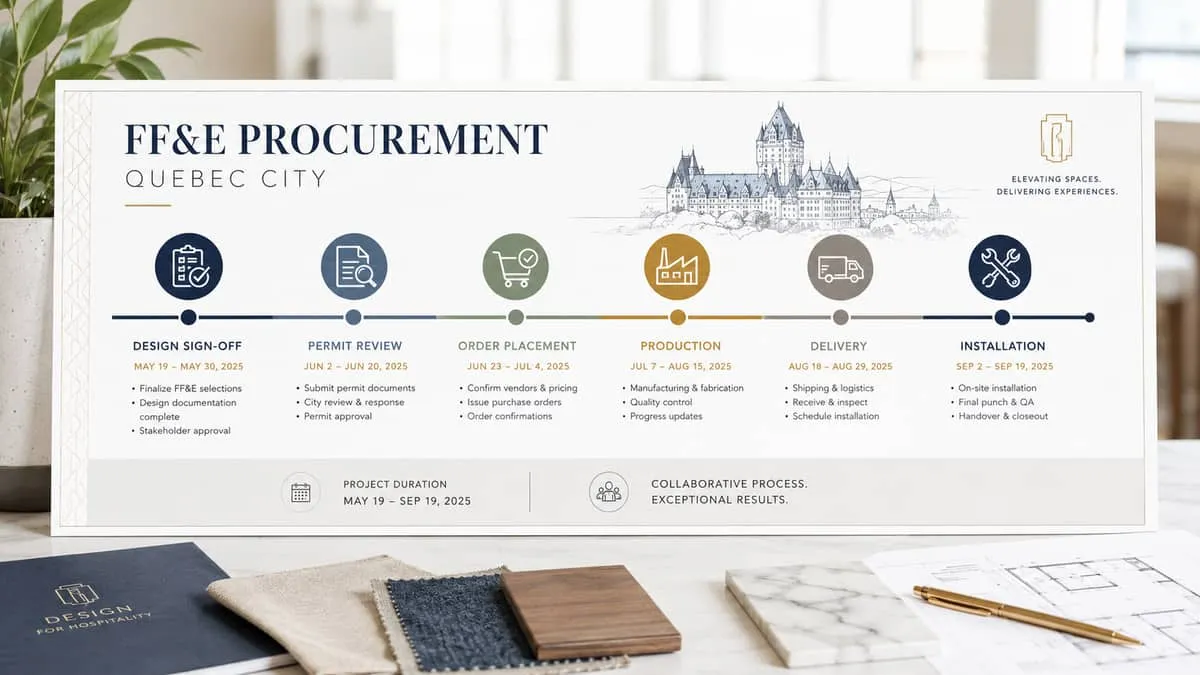
Quebec City's hospitality economy runs on two peaks and two valleys. Summer, from late June through Labour Day, fills every quality property in the city. Winter Carnival, held in late January and February, drives a second peak that is unlike anything in most North American cities. The Carnaval de Québec is not a quiet event: it brings hundreds of thousands of visitors to a city that is already covered in snow, and operators who are not ready take a commercial hit that takes months to recover from.
That leaves two realistic renovation windows. The first runs from mid-September through mid-November, when summer volume has dropped but winter demand has not yet built. The second is the brief lull in March, after Carnival but before the spring shoulder season begins. Both windows are short, typically eight to twelve weeks, and neither is forgiving of procurement delays.
Contract furniture lead times do not care about your renovation window. Custom upholstered pieces from European manufacturers, which are common in boutique Vieux-Quebec properties that want textiles and silhouettes with a French or Flemish sensibility, run 14 to 20 weeks from confirmed order. Domestic Canadian suppliers, particularly those in Quebec or Ontario who understand the market, can sometimes move in 10 to 14 weeks, but that still requires orders to be placed well before permits are finalized on many projects.
The practical solution that experienced operators use is conditional purchase orders. You lock a production slot with a supplier before your permits are fully approved, accepting a defined cancellation cost in exchange for protecting your delivery date. It is a calculated exposure, but it is far less expensive than missing a renovation window and pushing your reopening into peak season.
What a Full FF&E Scope Looks Like for a Boutique Heritage Property
For a 35-to-50 key boutique property in Haute-Ville or Basse-Ville, a complete FF&E scope covers considerably more than the obvious pieces. Guest room case goods, beds, seating, and desks account for the largest budget share, but the lobby, common corridors, and any food and beverage spaces on the property are part of the same procurement exercise.
Heritage properties in Vieux-Quebec typically need upholstered pieces that read as period-appropriate without being costumed replicas. A property competing for guests who compare it to European boutique hotels needs upholstery fabric weights and finishes that hold up to five to seven years of hard use while looking like they belong to the building. That means commercial-grade fabrics with a minimum 50,000 double rub rating specified across all seating, and wood frames built to contract tolerances rather than residential standards.
Stone walls and wooden beam ceilings are common architectural features in heritage Old City buildings, and they dictate lighting placement and furniture scale in ways that a generic specification cannot anticipate. Beds and case goods sized for a standard North American hotel room may look out of proportion in a room with a 10-foot vaulted ceiling. Good specification work accounts for the actual room geometry, not category defaults.
Budget benchmarks for this category of property run from $12,000 to $18,000 per key for FF&E, fully loaded with freight and installation. A 40-key property is looking at $480,000 to $720,000. Within that number, you need to account for freight costs that are higher than operators in Montreal or Toronto typically experience, because Quebec City's location and the access constraints of the Old City mean delivery is more complex and more expensive. White-glove delivery crews navigating stone stairwells in Basse-Ville charge accordingly.
Rue Saint-Jean and Grande-Allée: Restaurant Procurement at Street Level
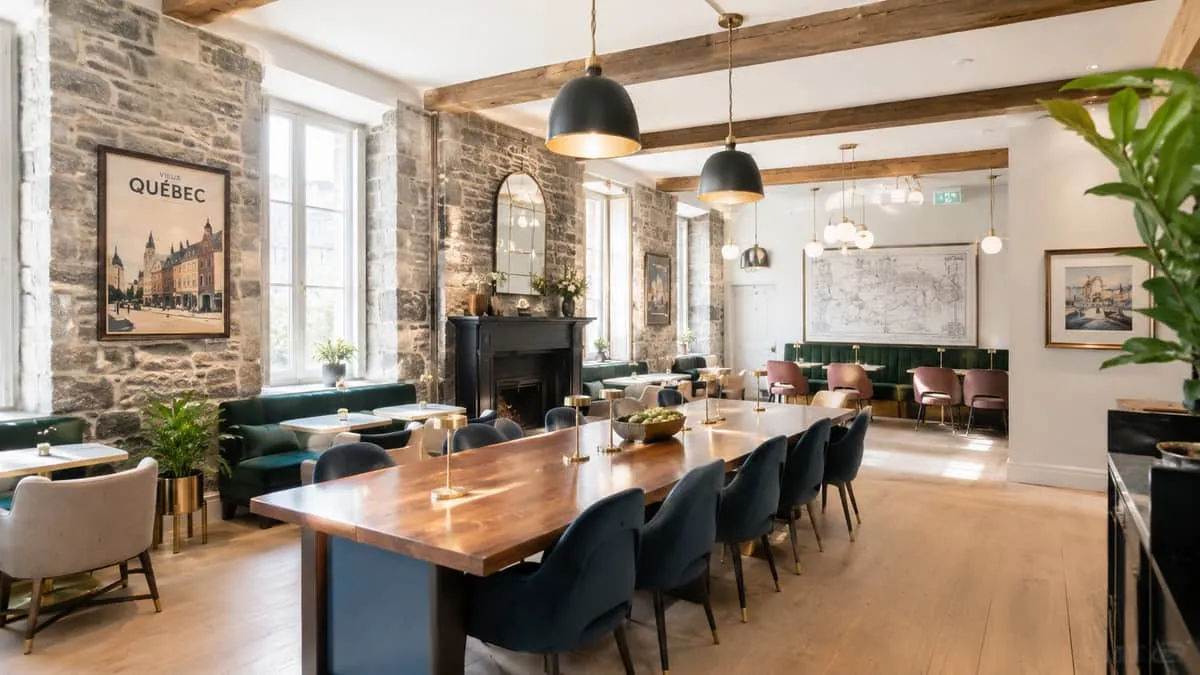
The Rue Saint-Jean corridor, running from the Old City west through the Saint-Jean-Baptiste neighbourhood, concentrates a density of bistros, brasseries, and destination restaurants that shape what Quebec City food culture actually looks like at ground level. Grande-Allée, which picks up a more celebratory and terrace-forward character, adds another layer of restaurant volume. These operators are not sourcing for 25-year-old institutions. Many are independent operators running 50 to 80 covers with tight margins and genuine design ambitions.
Restaurant FF&E on these corridors involves a specific durability calculation that Quebec City's climate makes non-negotiable. Operators who maintain outdoor terraces on Grande-Allée or along the sidewalks of Rue Saint-Jean are running those terraces from May through October, but the furniture has to survive being stored through winters that routinely see minus 20 degrees Celsius. Patio furniture specified for a Quebec City restaurant is not the same category as patio furniture for a Vancouver or Toronto terrace.
For indoor covers, the durability math is different but equally important. A restaurant on Rue Saint-Jean that does 200 covers on a Saturday night in July and the same volume during a Carnaval weekend needs chairs and tables built to contract standards. The floor-level wear patterns in high-volume Quebec City restaurants are aggressive. Metal base legs on chairs and tables need glide feet that are replaceable, not welded-on felt pads that fail after six months.
For these operators, FF&E budgets for a full restaurant build-out run from $90,000 to $200,000 depending on cover count and finish ambitions. A neighbourhood bistro in Saint-Jean-Baptiste will sit at the lower end with clean, honest materials. A destination dining room targeting the fine dining clientele that flows through Place Royale and Quartier Petit Champlain will push toward the top.
Sourcing Decisions in a Tourism-Driven Economy
Quebec City's economy is built on tourism in a way that provincial capitals rarely are. The provincial government provides stable institutional employment, Université Laval anchors an academic population, and technology and insurance sectors add some diversification. But the physical character of the city, and the commercial decisions that shape it, are driven by hospitality.
That tourism orientation creates a procurement logic that is different from corporate-driven markets like Calgary or Ottawa. Quebec City operators are not buying furniture for the average business traveller who values functionality above everything else. They are buying for guests who chose Quebec City precisely because it is not a corporate hotel market. Those guests notice when the upholstery fabric looks cheap. They notice when the case goods feel hollow. They notice when the lighting pendants in the restaurant could have come from a big-box supplier.
This guest sensitivity is not snobbery. It is the natural consequence of a city whose tourism appeal rests on authenticity and quality of place. A guest who has stayed at Auberge Saint-Antoine and is booking a first visit to a newer Basse-Ville property is making a comparison. The FF&E in that newer property has to hold up to that comparison without looking like it is trying too hard.
The sourcing implication is that Quebec City operators tend to pay more attention to provenance than operators in most North American markets. A chair made in Quebec, or imported from France or Belgium, carries a different narrative weight than the same chair made in a generic contract furniture factory. That is not always a rational purchasing decision, but it is a real one, and operators who ignore it are often surprised by how much it matters to their guests.

Coordinating Delivery and Installation in the Old City
The physical constraints of Vieux-Quebec create logistics challenges that add cost and time to every FF&E installation. Narrow streets, restricted vehicle access zones, and buildings without freight elevators are standard conditions in Haute-Ville and Basse-Ville. A supplier who ships regularly to suburban hotel projects in Quebec's secondary markets will not automatically know how to handle a delivery to a four-story heritage property on Rue des Remparts.
Installation coordination for heritage property projects in Old Quebec needs to happen in French. The tradesperson adjusting a bed frame, the millworker hanging custom shelving, the electrician connecting pendant fixtures: all of them are working in French, reading French-language installation documents, and communicating with the property's facilities team in French. Suppliers who do not have French-language installation documentation create friction that slows the installation schedule and increases the risk of field errors.
Access windows in the Old City are often restricted to early morning hours to avoid conflicts with pedestrian and tourist traffic. That constraint affects how many pieces an installation crew can move in a single day, which affects your overall installation schedule. A 40-key hotel renovation that would take three weeks of installation in a suburban property might take four to five weeks in Vieux-Quebec.
Budget for this. The operators who are surprised by installation costs in Quebec City are almost always operators who used a suburban or out-of-province benchmark to estimate their installation line items.
Getting Specification Right Before You Go to Market
The consistent pattern across FF&E procurement Quebec City projects that finish on time and on budget is specification discipline. Operators who complete a full FF&E specification before going to suppliers, covering every piece in every room type with dimensions, material requirements, finish specifications, and commercial durability standards, have dramatically better outcomes than operators who specify as they go.
Changing upholstery fabric after an order is placed costs money. Changing the model entirely costs more. Changing the model on 40 chairs after you have already received 10 of them costs the most, and it happens more often than it should.
The specification process for a Quebec City boutique property also needs to account for the French-language environment. If your specification document will be reviewed by a Quebec-based procurement consultant, a heritage office reviewer, or a local trades coordinator, it needs to be in French or have a complete French translation. An anglophone designer producing specifications for a Vieux-Quebec property should plan for translation as a line item, not an afterthought.
If you are planning a renovation in Vieux-Quebec, a new restaurant on Rue Saint-Jean, or a property refresh anywhere in the Quebec City market, the contact form is the fastest way to reach us. We work with French-language documentation and understand the access and timeline constraints that make Quebec City different from every other hospitality market in Canada.
Every Quebec City venue has its own volume, layout, and turnaround demands, and FF&E pricing follows from those specifics. Request a quote and we will scope it to your project.