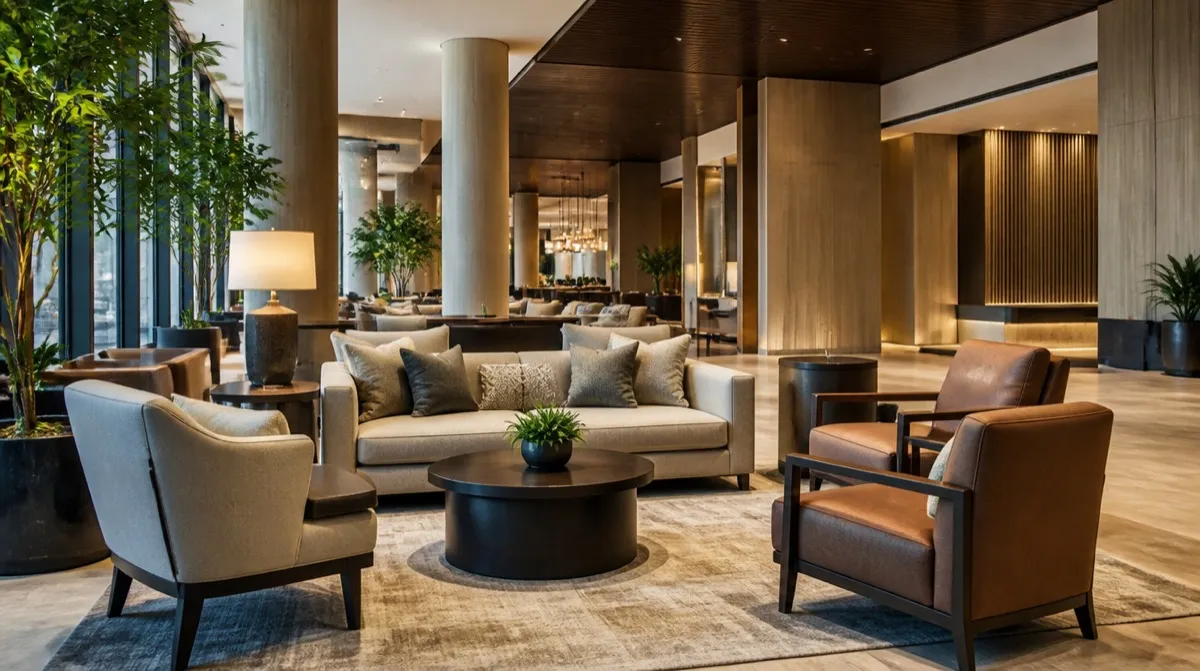
Record the lobby sofa's actual occupancy, guest handling and cleaning routine. Cover selection matters alongside seams, support and care; this guide has no evidence that leather lobbies fail faster than almost every other upholstered piece.
Top-grain, full-grain, and bonded: what the terms actually mean
Full-grain refers to the natural grain surface, not a guarantee about full hide thickness, price or longest life. Request the actual leather and finish specification and a sample.
Ask the supplier to define top-grain for the proposed cover, including grain correction and finish. The label alone does not establish sanding, affordability or suitability for every commercial lobby.
Ask for bonded material's actual composition, cover construction and intended-use documentation. Compare the actual alternatives; this guide has no verified one-to-two-year peeling deadline for all bonded products.
Compare vinyl using its actual specification, approved cleaners and relevant performance evidence. 100,000 Wyzenbeek rubs does not establish puncture resistance, disinfectant compatibility or longer life. ACT explains the limits of abrasion results.
Seam construction is where lobby sofas actually fail
Ask how the proposed sofa's seams and cover attachments are constructed and tested for its intended use. Double stitching or a thread label alone cannot establish where all sofas fail first.
Review seat-deck support and attachment as part of the complete assembly. Request repair options and relevant evidence rather than predicting a single-seam failure within a year.
Inspect piping and decorative seams on the actual sample and ask about reinforcement, repair and cleaning. No decorative feature is automatically the first failure point.
Frame and cushion core: what supports the leather
Review the complete frame, joints and support documentation separately from the cover. A frame material or corner-blocking feature alone cannot establish three versus ten years of life.
Request cushion density with mass-per-volume units, firmness and fatigue results, plus suspension specification and replacement options. A 1.8 to 2.5 pound figure without units or a named spring system does not establish longevity.
Cleanability and finish for a real lobby
Obtain care instructions for the exact leather finish and the property's cleaning products. Grain terminology does not establish an aniline, semi-aniline or pigmented finish or its stain resistance.
Compare physical samples under lobby lighting and follow documented sample-care trials. Darker colors or matte finishes do not invariably hide all scuffs and water marks better than pale leather.
Confirm the current applicable upholstery requirements, including any TB 117-2013 reference, with the project authority. Obtain the required report for the actual assembly; a spec-sheet label alone does not establish compliance.
Where leather sofas fit in the overall lobby plan
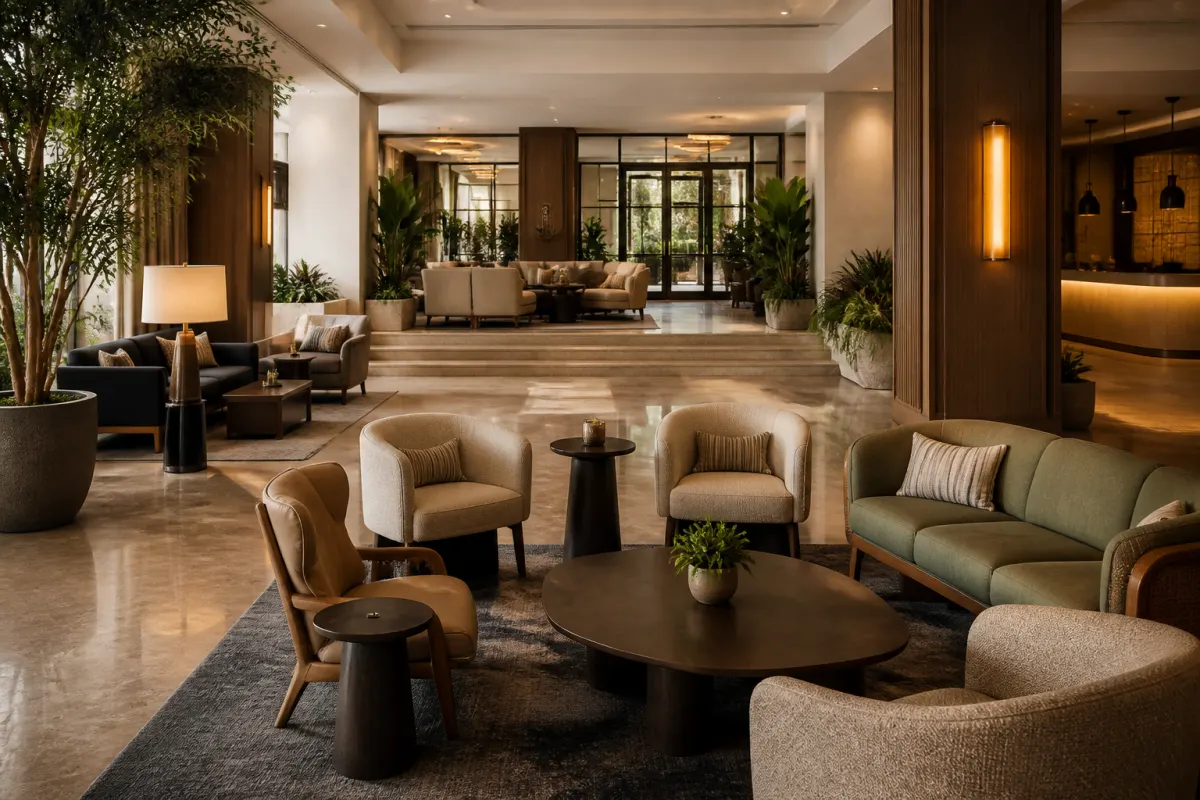
A leather sofa rarely sits alone. It anchors a seating group with accent chairs, a low table, and often a runner rug that defines the zone within an open lobby. For the fuller picture on how these pieces work together as a floor plan, our hotel lobby furniture guide covers zoning, traffic flow, and the full furniture list for a lobby buildout, not just the sofa.
Use the fabric durability checker for a planning comparison and request the exact leather, vinyl or fabric documentation. The tool does not replace product-specific testing or cleaning instructions.
Ordering at volume
Leather lobby sofas are typically ordered in matched sets rather than as single pieces, since most lobby seating groups repeat the same sofa in two or three configurations around the space. Confirm hide-to-hide color matching across the order before production if you are ordering more than a handful of units, since natural leather has more batch variation than vinyl or fabric and a mismatched set is obvious the moment it is installed side by side.
Confirm approval, production, stock allocation and freight dates for the exact cover and sofa. Leather is not universally slower than every fabric or vinyl option.
Request a quote with the lobby use, cover requirements, cleaning products and quantities so independent suppliers can document proposed seating.