
Toronto doesn't slow down. TIFF floods Yorkville in September. The Metro Toronto Convention Centre runs back-to-back delegate events most weekends from March through November. Soho House King West is at capacity by 9 PM on a Tuesday. The Distillery District fills with private events every Friday and Saturday from May through October, while the Financial District hotel corridor turns rooms at some of the highest ADRs in the country outside Vancouver's luxury tier. Operators in this city are managing volume, pace, and guest expectation simultaneously, and they don't have room for a furniture program that can't keep up. That's what makes choosing a commercial furniture supplier Toronto hospitality teams can actually rely on one of the most important vendor decisions you'll make before opening day.
Why Toronto's Scale Changes the Supplier Conversation
Most commercial furniture buyers outside Toronto's tier are thinking about one venue at a time. A 60-seat restaurant in a smaller Ontario city. A 40-room boutique inn. A patio refresh for a neighbourhood bar. Those are real projects that require real expertise, but the supplier relationship looks very different than what Toronto operators are navigating.
When the Four Seasons Yorkville undertakes a phased room refresh, they're not ordering 20 chairs. When a new King West cocktail bar opens in a converted heritage space, the design brief is arriving from an interior design firm that regularly works at international standards, not a regional decorator. When a Harbourfront hotel adds patio seating for summer, the owner needs delivery to coordinate with a construction schedule that was set months ago by a general contractor managing multiple projects across the city.
Toronto operators are routinely placing orders in the hundreds of units, working against compressed timelines, and holding their suppliers to design specs set by some of the most demanding ID firms in the country. If your furniture supplier can't absorb that complexity without stumbling, you'll feel it in delays, substitutions, or quality inconsistencies that your guests will notice before your next review cycle.
This is why the Toronto hospitality market rewards national commercial suppliers over local boutique options. A national supplier with real production capacity and logistics infrastructure can fill a 300-unit order without pushing your timeline. A local operation with strong showroom presence but limited factory access can't.
Contract Grade Is Not a Marketing Term
The difference between contract-grade furniture and retail furniture is structural, documented, and consequential at commercial scale. It is not a positioning phrase.
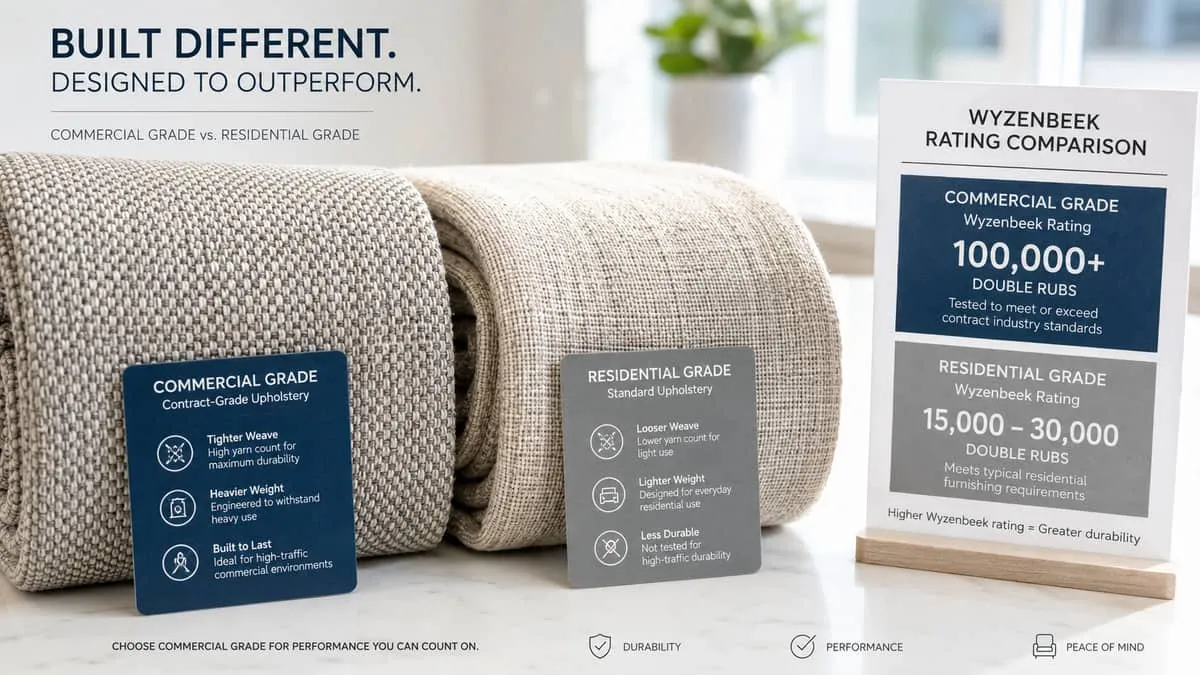
Contract furniture is engineered for commercial environments: frame construction rated for repeated daily use by people across a wide weight range, foam densities that retain their form after thousands of compressions, and fabrics tested to tens of thousands of double rubs under Wyzenbeek or Martindale methods. A residential sofa might carry a 15,000 double rub rating. A contract-grade lounge chair for a Distillery District boutique hotel lobby starts around 50,000 and commonly runs higher depending on the application.
A qualified commercial furniture supplier Toronto operators source from will provide documentation on all of this without being asked: flame retardancy certifications to relevant Canadian standards, structural load ratings, warranty terms written specifically for commercial use. If a supplier hesitates on documentation, that's your exit signal. Retail warranties almost universally exclude commercial environments, which means the moment you file a claim after a guest damages a piece, you're unprotected.
For Toronto's higher-end corridors, this matters at a second level as well. Yorkville guests and Financial District business travelers are staying at properties that compete internationally. When those guests sit in a lobby chair or eat at a restaurant table, they're comparing the feel against properties they've visited in London, New York, and Dubai. Contract-grade construction at the right spec level is what allows Toronto's top-tier properties to hold that comparison.
The Design Expectation Gap Toronto Creates
Toronto has one of the most sophisticated interior design communities in North America. The firms working on Ace Hotel buildouts, Soho House renovations, and new boutique openings in the St. Lawrence Market area are producing work that competes with New York and London-based studios. They are not specifying generic commercial furniture from a catalogue.
What this means for operators is that your furniture supplier needs to function as an execution partner for complex specifications, not just a vendor filling SKUs. When a Toronto ID firm specifies a particular upholstery grade, a custom stain on a wood frame, or a non-standard table height to match banquette seating in a heritage building with irregular floor elevations, the supplier's job is to execute that spec without pushing back with substitutions because the custom option adds production complexity.
National commercial suppliers with real manufacturing relationships can accommodate custom fabric specifications, modified dimensions, and finish matching across mixed product categories. The same production infrastructure that allows them to handle 300-unit hotel orders also allows them to handle complex customization, because both require factory-level coordination rather than simple catalogue fulfillment.
Toronto operators who have tried to source through smaller local suppliers and run into spec limitations mid-project understand this trade-off viscerally. The cost of a substitution at the eleventh hour, when your design team needs to rework drawings and your GC is waiting on furniture dimensions to finish millwork, is never small.
Timelines in an Overheated Development Market
Toronto's construction sector is one of the most active in North America, and that has downstream effects on hospitality project timelines that operators in quieter markets don't face.
General contractors managing hotel renovations and restaurant buildouts in Toronto are juggling subcontractor schedules, permit timelines, and material lead times across multiple simultaneous projects. When your GC gives you a furniture delivery window, it's embedded in a construction sequence that has no flexibility. Furniture arriving two weeks late doesn't mean you push the opening. It means you open without furniture, or you scramble for temporary pieces that your guests will notice.
Standard contract furniture runs 8 to 14 weeks from order confirmation to delivery under normal production conditions. Custom specifications, custom fabrics, and dimensional modifications add time. For Toronto hospitality projects, the practical rule is to confirm furniture orders no later than 16 weeks before your target delivery date, and to front-load your customization decisions so they don't eat into that buffer.
The Toronto market's project velocity means production queues at capable suppliers fill faster than operators expect. A supplier who can deliver in 10 weeks in February may be running 14-week lead times by April, when spring project starts flood in simultaneously. Getting your order confirmed early and locked into a production slot is not just good practice; it is the specific hedge against the construction market conditions this city creates.
Communicate hard delivery dates in writing before you sign a purchase agreement. Ask explicitly whether your order will share a production run with other large projects and how that affects your queue position. A supplier who can answer those questions with specifics is a supplier with actual production visibility. One who gives vague reassurances is one who will call you at week 12 with a delay notice.
Managing Scale: 300-Room Renovations While the Hotel Stays Open
The operational complexity of a phased hotel renovation in Toronto deserves its own section, because it is genuinely different from what operators in smaller markets face.
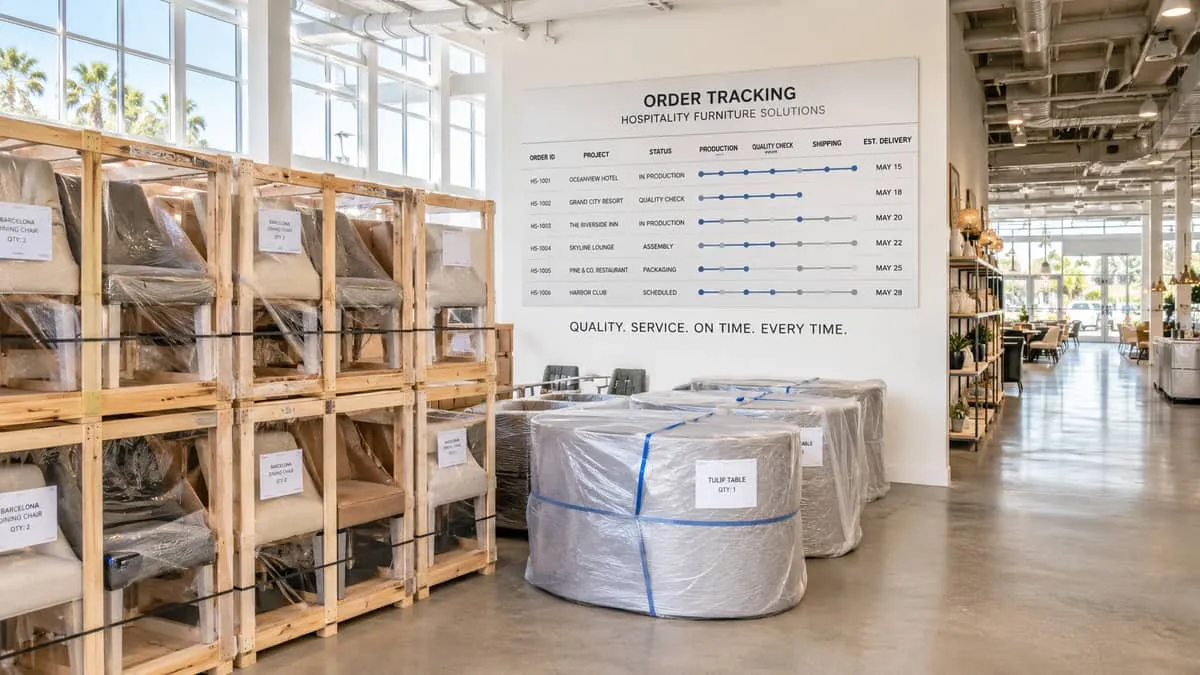
A 300-room property in the Financial District or near the convention centre can't close for a full renovation. The revenue loss is prohibitive, and the market is too competitive to cede that many months of room nights. So renovations run in phases: floors are blocked, rooms are taken out of rotation in segments, and the furniture program has to deliver in coordinated batches that match the construction sequence, not in a single shipment.
This requires a furniture supplier with warehousing capacity and logistics coordination, not just a vendor who ships from a manufacturer. Phased delivery against a rolling construction schedule means your supplier needs to hold product that's been produced, stage it appropriately, and release it to site on your GC's schedule. Suppliers who work primarily on one-time residential-style deliveries don't have these logistics systems in place.
For Toronto operators managing this kind of renovation, confirming your supplier's warehousing capabilities and phased delivery experience before you sign is non-negotiable. Ask for references from comparable hotel renovation projects, specifically phased projects where delivery had to match a construction sequence. If a supplier can't produce those references, they're not the right fit for a project of this complexity.
The same logistics consideration applies to large restaurant openings in Toronto's competitive hospitality corridors. When a 200-seat King West venue opens, the furniture program often has to coordinate with a build-out that's finishing days before opening, with multiple contractors still on-site during final furniture placement. Suppliers who understand how to work within that environment, with proper site coordination and clear communication with the GC, are the ones who don't create problems on opening week.
Volume Quality Control: Why Consistency Matters More at Scale
Buying 200 restaurant chairs is not the same risk profile as buying 10. When you're placing a large order, small quality inconsistencies become significant problems at scale.
Request physical samples before committing to any large order. Sit in the chairs. Run your hand along the joinery. Check that the finish is consistent across multiple pieces from the same sample batch. Inconsistency in samples is a reliable predictor of what you'll receive at full production volume.
Ask about dimensional tolerances. This matters particularly in Toronto's older hospitality spaces, the heritage buildings in the Distillery District and around St. Lawrence Market that operators have converted into restaurants and event venues, where floor plans are fixed by the building's bones. A two-centimeter variation across your table bases can throw off an entire dining room layout in a space where you have no flexibility to compensate.
For Yorkville and other luxury-tier applications, also ask for QC documentation on finish consistency across production runs. Guests in these environments are acutely sensitive to a room that reads as slightly mismatched, and a furniture order where 10 percent of the pieces came off a different production run with a slightly different stain tone will register as a quality problem even if it doesn't register as a furniture problem.
The right commercial supplier Toronto operators source from at volume will have QC systems that address all of this, and they'll be able to explain those systems without hesitation. Suppliers who can't describe their QC process clearly are suppliers who don't have one.

Why National Suppliers Serve Toronto Better Than Local Options
Toronto's hospitality operators have access to local commercial furniture suppliers, and some of those operations are well-run. But the structural advantages of a national supplier with real production capacity are significant enough that they're worth being explicit about.
Production capacity is the first advantage. A national supplier with factory relationships and volume purchasing power can absorb a 300-unit order without disrupting their production schedule or deprioritizing your project. A local supplier with limited factory access will often move a large order to a manufacturer they haven't worked with extensively, which introduces quality and timeline risk at exactly the point where you need certainty.
Logistics infrastructure is the second. A national operation that regularly ships to hotel properties and restaurant groups across Canada has freight relationships, warehousing capacity, and delivery coordination systems that a local boutique cannot replicate. When your renovation is delivering furniture to a Financial District property where loading dock access is restricted to specific hours and the building management requires 48-hour notice for freight lifts, you need a supplier whose logistics team handles those constraints as a matter of routine.
Inventory depth is the third. Operators who need to reorder 15 chairs three years after their original purchase, because a section of their patio was damaged or a private dining room was expanded, can source matching pieces from a national supplier with maintained inventory lines. Local suppliers who sourced from a manufacturer on a one-time run can't guarantee a match, which means your reorder creates a visible inconsistency in your space.
None of this means a national supplier is impersonal. The best operators in this market have long-term relationships with their furniture supplier reps, built over multiple projects and years of repeat business. Those relationships function at the account level and don't require sacrificing the production, logistics, and inventory depth that only national operations provide.
The Due Diligence Process Before You Commit
For any Toronto hospitality project of meaningful scale, the evaluation process for a commercial furniture supplier should include the following before you sign a purchase agreement.
Request documentation on contract-grade specifications for every category you're sourcing: upholstery double rub ratings, flame retardancy certifications, structural load ratings, and warranty terms that explicitly cover commercial use. Review these documents, not just the sales representations about them.
Ask for references from comparable Toronto projects, specifically from operators who placed orders of similar size and complexity. Call those references and ask direct questions: Did delivery arrive on schedule? Were there quality inconsistencies and how were they resolved? Did the supplier coordinate effectively with the GC or site manager? Would you use them again for a larger project?
Confirm the full cost structure in your quote before you approve it. Freight, installation, packing removal, and white-glove delivery fees are sometimes excluded from base pricing in ways that aren't obvious until invoice. Know what you're paying before you make a deposit.
Understand your inspection rights. You should have the ability to flag defects and receive remediation before signing off on final payment. A supplier who resists this is a supplier whose product you should not be trusting with a large order.
Toronto's hospitality market is competitive, fast-moving, and held to international design standards by guests who have options. The furniture program you build for your property will be part of your guest experience for the next 10 to 15 years. The supplier you choose to execute it is not a commodity decision.
Every Toronto venue has its own volume, layout, and turnaround demands, and commercial furniture pricing follows from those specifics. Request a quote and we will scope it to your project.