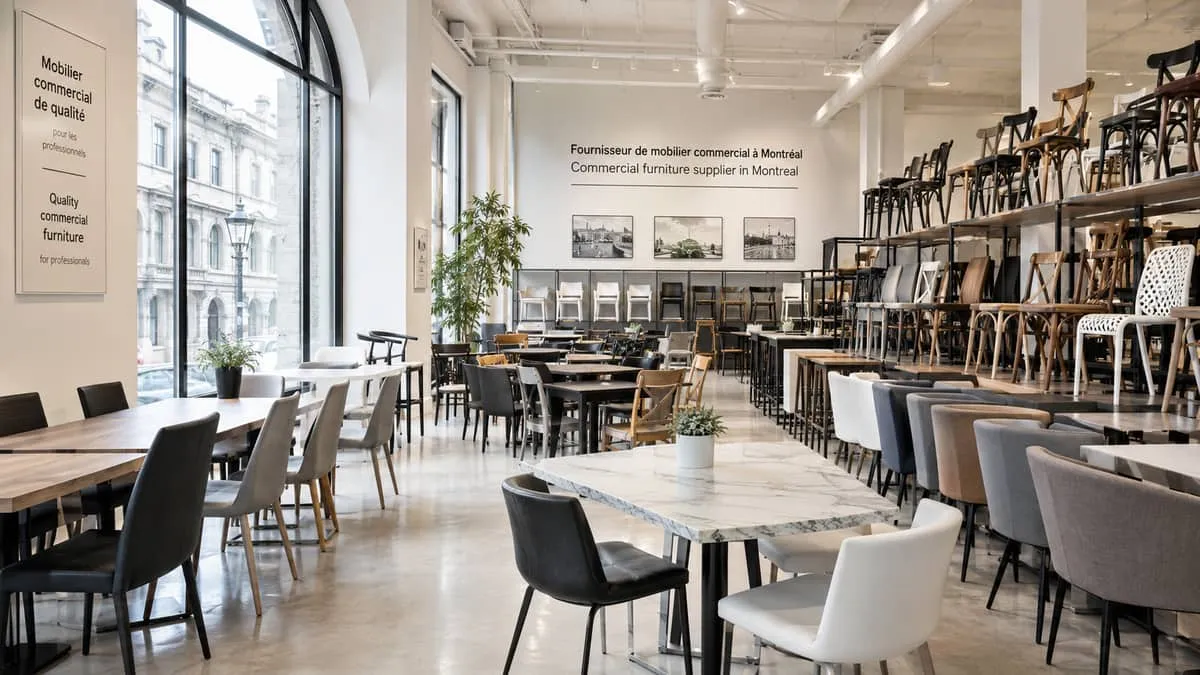
Montreal operators are not a forgiving audience. The city has arguably the most design-literate dining and hotel culture in Canada, shaped by a French heritage, a deep connection to European aesthetics, and a local restaurant scene that competes on atmosphere as seriously as on food. When a guest walks into Hotel Nelligan in Old Montreal or settles into a booth at a Plateau bistro, they are bringing a standard of comparison that was calibrated in Paris, Lyon, and Brussels, not just Toronto and Calgary. That standard lands directly on your furniture choices.
If you are outfitting a hospitality space in Montreal, the commercial furniture supplier you choose matters more here than in most other Canadian markets. This is not a city where contract-grade seating is enough on its own. It needs to be contract-grade and credible. And the supplier relationship needs to function in French, navigate Old Montreal's heritage building constraints, and hold up under Grand Prix weekend load factors that would stress-test any piece not built to genuine commercial specification.
Why Montreal Measures Furniture Against a European Reference Point
The terrasse culture on St-Denis and Laurier is not seasonal decoration. From May through September, outdoor seating is a serious revenue driver and a statement of identity for any restaurant worth its prix fixe. Operators in the Plateau and Mile End invest in terrasse furniture with the same intentionality they bring to interior design, because their clientele expect it.
That clientele has absorbed European dining norms for generations. Montreal's French-speaking majority maintains cultural and culinary ties to France that shape expectations around atmosphere, proportion, and material. A bistro chair that reads as generic in another city reads as a missed opportunity here. Operators know this. The ones who have been open long enough have already learned it the hard way.
The result is a purchasing mindset that is more discerning at the selection stage than almost anywhere else in Canada. Montreal restaurateurs and hotel buyers will ask about provenance, finish options, and custom upholstery in the same conversation where they are asking about BIFMA certification and lead times. They expect a commercial furniture supplier to be able to answer all of it.
The Bilingual Requirement Is Not Optional
Montreal operates in French first. The Office québécois de la langue française enforces language requirements in commercial contexts, and beyond the regulatory dimension, conducting a supplier relationship in French is simply the professional standard for most Montreal-based operators, particularly those running francophone-owned independent businesses in the Plateau, Little Italy, or Griffintown.
This eliminates a meaningful share of otherwise-qualified commercial furniture suppliers. An Ontario-based supplier with no French-language capacity, no Quebec sales representative, and no familiarity with local permitting and building code nuances is not genuinely set up to serve this market. They may be able to process a transaction, but they are not a partner for the kind of project where details matter.
What to look for: a supplier with a dedicated Quebec contact who can hold a technical conversation in French about finish specifications, lead times, and damage claims. Not a translated catalog. An actual human point of contact who understands the market.
Heritage Buildings in Old Montreal Change the Furniture Brief
Old Montreal's concentration of nineteenth-century stone buildings, many of them now operating as boutique hotels like Auberge du Vieux-Port or event-driven venues, creates a specific set of furniture logistics challenges that suppliers from outside the market often underestimate.
Elevators are narrow or absent. Stairwells have tight turns. Floors are original hardwood or reclaimed stone that cannot be scratched during delivery. Ceilings are lower than modern construction, which affects the visual scale of furniture pieces that might work in a Griffintown hotel with industrial-height ceilings but read as heavy and cramped in a heritage suite on Rue Saint-Paul.
A commercial furniture supplier with genuine Montreal experience will know to ask about the building before quoting. They will flag whether a piece requires full assembly on-site versus arriving in a configuration that fits through a heritage doorframe. They will coordinate delivery with your contractor so nothing is dragged across new floors on opening week. These are not small considerations. For Old Montreal operators especially, they are often the difference between a smooth installation and a costly delay.
For Griffintown projects, the brief is different but equally specific. The neighbourhood's rapid condo and boutique hotel development has created demand for furniture that works in modern high-rise contexts, often with large windows, polished concrete, and a more contemporary aesthetic palette than the Vieux-Port. Suppliers who can only speak to one Montreal aesthetic register are limiting your options before the conversation starts.
What Contract Grade Actually Means at Montreal Load Factors
Jazz Festival runs for eleven days in late June and early July and draws over two million attendees. The Grand Prix weekend in early June pushes Old Montreal hotel occupancy to near-capacity for four consecutive days. These are not casual peaks. They are stress tests on every piece of furniture in a space.
A barstool rated for residential use will show meaningful wear within a season of Jazz Fest volume. A dining chair with a poorly welded frame will develop wobble after the thousandth cover. This is not abstract. Montreal operators who have replaced retail furniture after a single peak season understand the math differently than operators in markets without comparable event density.
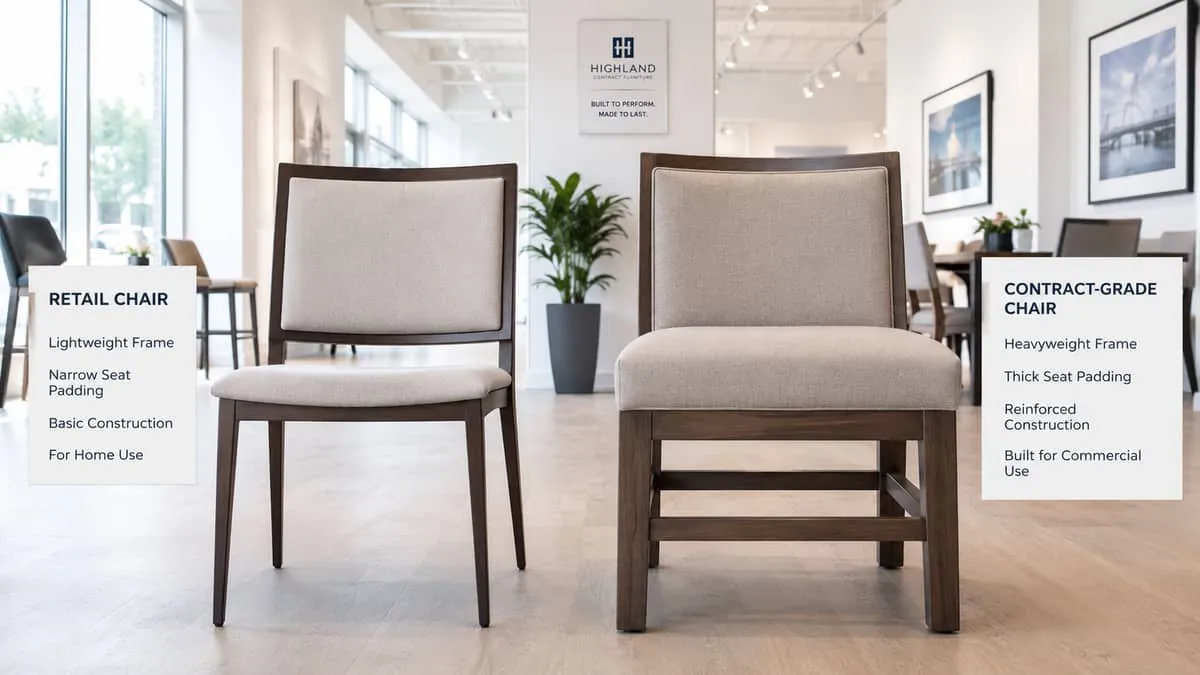
Contract-grade specification means, at minimum, seating that meets BIFMA x5.1 cycle testing for seating durability, foam density appropriate for commercial volume, frames with welded or bolted connections rather than glued wood joinery, and finishes that can withstand daily sanitizer application without degrading. These standards exist because the research on commercial use patterns shows that residential construction fails faster under hospitality load factors, often dramatically so.
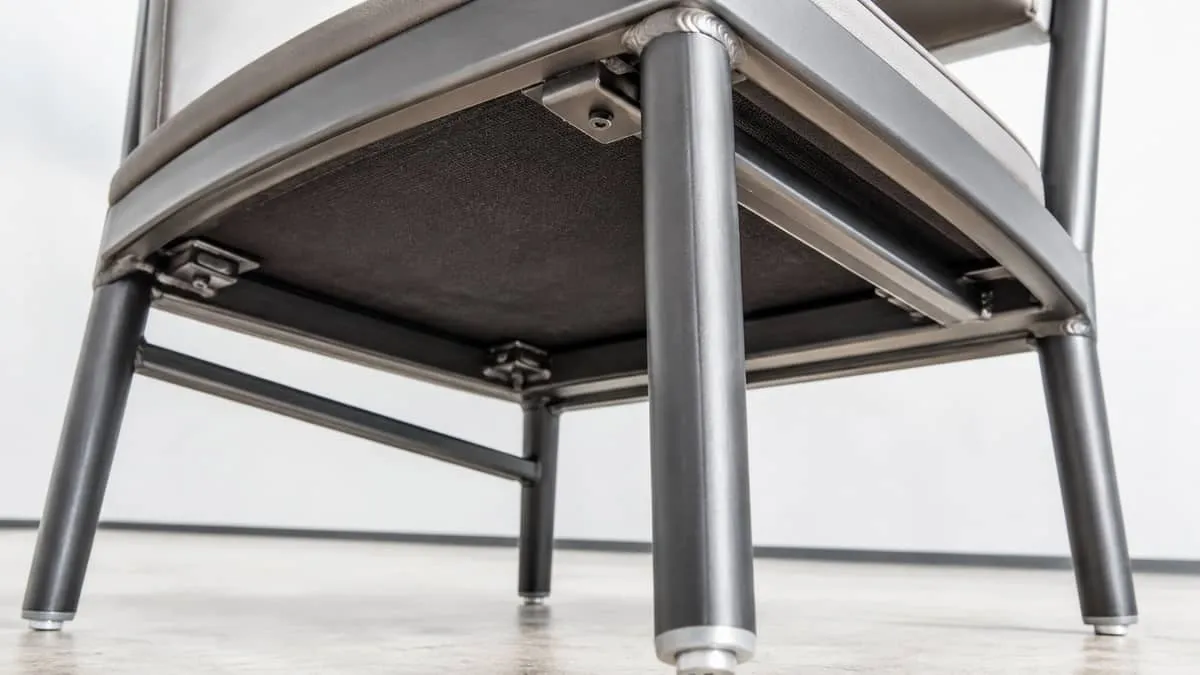
When evaluating a supplier, ask for third-party test documentation, not just a claim of commercial grade. Any supplier worth working with in this market can produce it.
Design Credibility: The Criterion That Filters Out Half the Field
Montreal restaurant buyers evaluate furniture aesthetics seriously. The Mile End coffee shop scene, the Plateau's natural wine bars, Little Italy's trattorias along Dante and Saint-Laurent, and the boutique hotel builds in Griffintown all have distinct design identities. A furniture supplier who offers three finish options and two frame colors is not going to be useful to an operator building a 45-seat room with a specific visual reference point.
What credible design support looks like in practice: a supplier who can discuss proportion and scale in the context of a specific room, who offers genuine custom upholstery options including COM (customer-supplied material) programs, who can produce samples before full order commitment, and whose catalog reflects awareness of what is happening in contemporary hospitality design rather than defaulting to a decade-old product line.
This matters especially for projects where an interior designer is already engaged. Designers working on Montreal hospitality projects, particularly on the higher end, are specifying furniture that reflects a precise aesthetic vision. A supplier who can work collaboratively with that process, provide accurate technical drawings, and hit finish specifications consistently is a partner. A supplier who is just fulfilling an order is a risk.
Le Mount Stephen, the W Montreal, and the independent boutique properties that have opened in Griffintown over the past several years all represent cases where furniture specification was as much a design decision as a procurement decision. The suppliers who participated in those projects understood that distinction going in.
Terrasse Season and the Outdoor Furniture Equation
Montreal's patio season is short, roughly May through September, and operators treat it as a primary revenue period rather than a bonus. This means outdoor furniture is not an afterthought. It is a capital investment with a specific durability requirement: genuine weather resistance through freeze-thaw cycles, UV stability for summer sun exposure, and stacking or storage capacity for the off-season.
The materials that hold up are powder-coated aluminum, commercial-grade teak (correctly sourced and maintained), and resin weave over aluminum frames. Steel requires marine-grade coating at minimum to survive Montreal winters without surface rust. Wrought iron is heavy enough to be appropriate for a fixed terrasse setup but not practical for seasonal storage and reinstallation.
A supplier with no Montreal outdoor furniture track record may not think about freeze-thaw performance or the logistics of off-season storage in a dense urban restaurant setting. Ask explicitly: what outdoor products have they placed in Montreal, how have those pieces performed across multiple seasons, and can they provide references from operators who have been using the product for at least two years.
Questions That Separate a Real Montreal Partner From a Generic Account
When you are evaluating commercial furniture suppliers for a Montreal project, the following questions move the conversation past the sales pitch and into the specifics where real qualification happens.
Do you have a French-speaking sales or project contact based in Quebec? If the answer is no, or if the answer is "we have a bilingual person in Toronto who handles Quebec accounts occasionally," that is a meaningful gap for a Montreal project.
Have you delivered into Old Montreal heritage buildings before? Ask for specifics. If they have done it, they will know immediately what you are asking about and will have a process to describe.
What is your lead time from a Montreal warehouse versus a Toronto or Vancouver warehouse? Freight from outside Quebec adds cost and time. Local stock or a Quebec distribution partner is a real advantage for projects with tight windows, particularly anything opening around a major event season.
Can you provide references from Montreal operators who have been using your product for more than one season? Not from the launch. From after the first Jazz Fest or Grand Prix.
What does your replacement parts program look like? If you lose a glide foot, crack a stretcher rail, or need to reorder six chairs two years after opening, what is that process? A supplier with genuine Montreal market commitment has thought about this. A supplier treating you as a one-time transaction has not.
The True Cost of Getting This Wrong
A forty-seat room furnished with retail seating at two hundred dollars per chair costs roughly the same at purchase as one furnished with entry-level contract pieces. Over three years of Montreal hospitality volume, the retail option will typically require replacement or significant repair. The contract option should still be in serviceable condition. The cost difference over a five-year horizon is not close.
Beyond durability, there is the question of liability. Retail furniture is not rated or insured for commercial public occupancy. If a chair fails under a guest and results in a claim, your insurance coverage may be affected by the fact that you were not using furniture rated for commercial use. This is not theoretical. It is a clause that commercial insurers check.
The commercial furniture supplier relationship in Montreal, when it is working correctly, is less transactional than it sounds. You are choosing a partner for the life of the project, one who can supply the reorder when you expand, troubleshoot a warranty claim when something arrives damaged, and have the conversation in the language your team works in. In a market as demanding and as design-literate as Montreal, that relationship is part of the infrastructure of a hospitality business, not just a line item in the opening budget.
Ready to spec commercial furniture for your Montreal project? Send us the details and we will price it around your requirements. Request a quote to start.