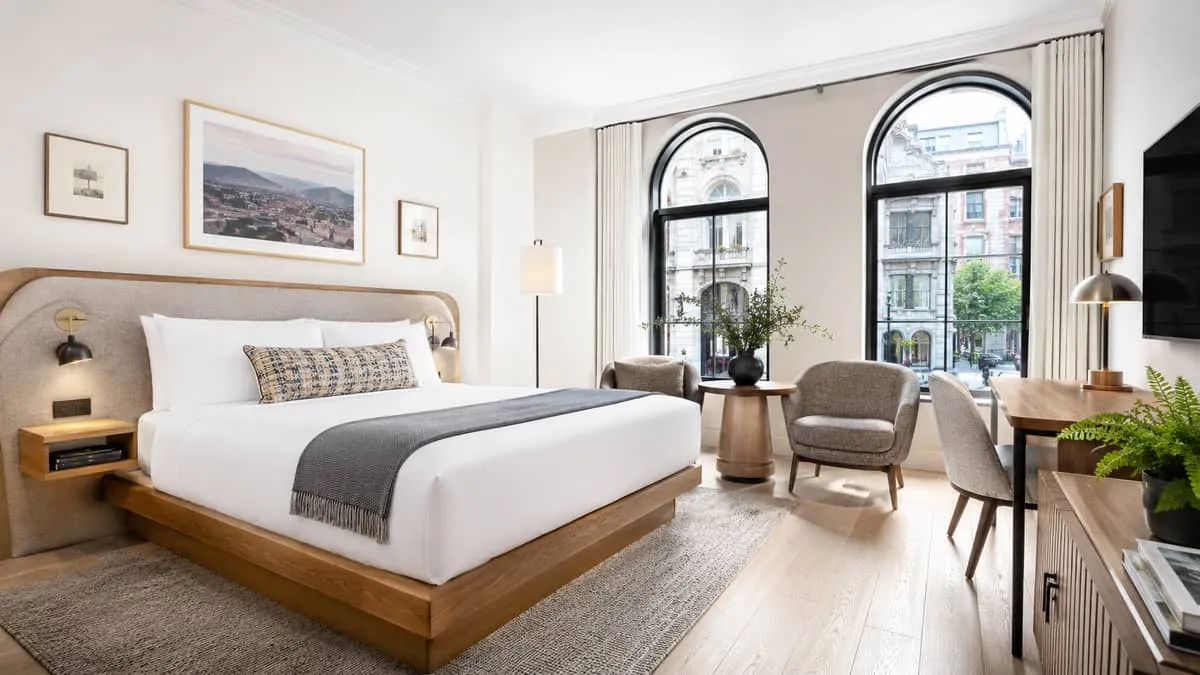
Montreal's boutique hotel guests are not comparing your property to other Montreal hotels. They are comparing it to the Marais apartment they stayed in last March, the canal-side hotel they booked in Amsterdam, and the Soho House membership they considered before choosing a boutique property instead. This is the most design-literate hospitality market in Canada, shaped by a city that has always looked east toward Europe rather than west toward Toronto for its cultural reference points. When a guest books Hotel Nelligan or Le Mount Stephen, they arrive with a visual vocabulary built from years of boutique travel. Sourcing boutique hotel furniture Montreal requires furnishing for that guest, not for a traveller who will accept anything with a firm mattress and fast wifi.
The Old Montreal Palette and Why It Works
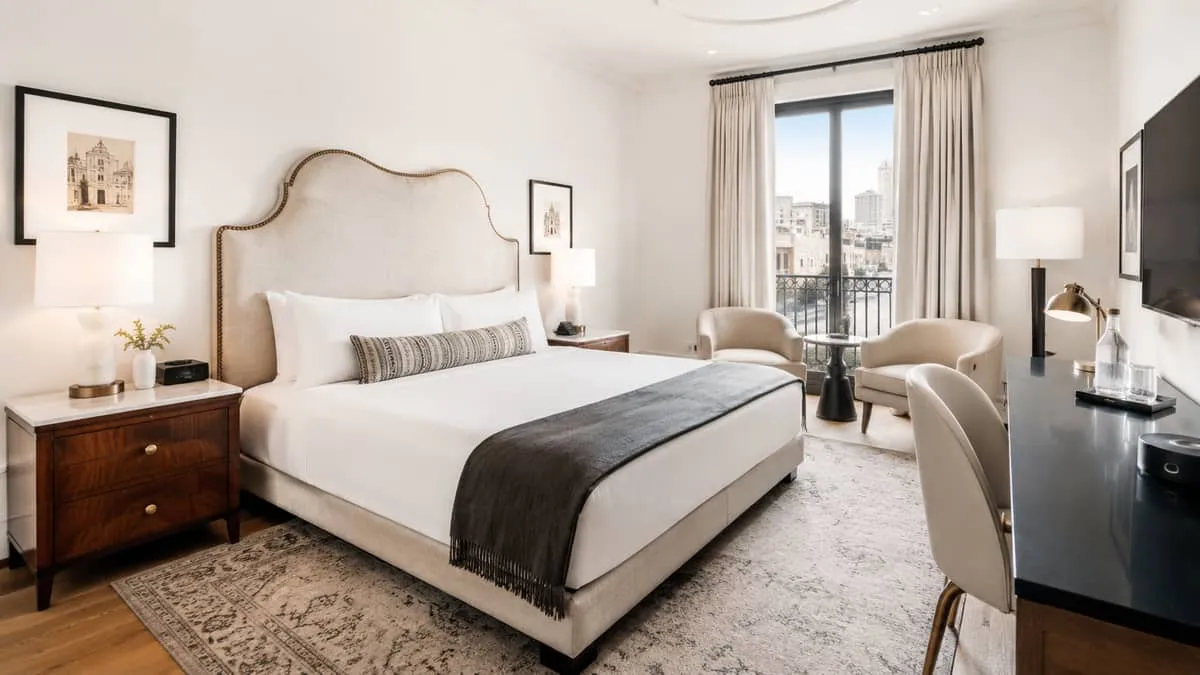
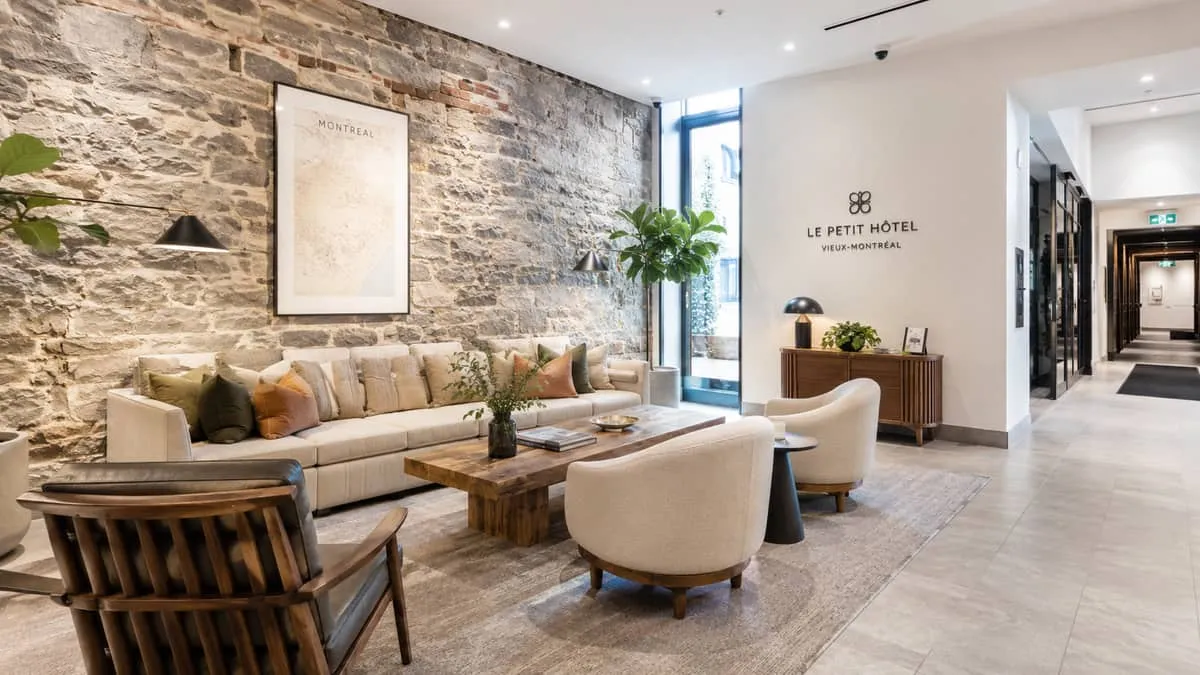
Old Montreal is the densest concentration of heritage hospitality real estate in Canada. The properties here sit inside nineteenth-century stone warehouses, former bank buildings, and converted merchant houses where the architecture is already doing significant design work. Hotel Nelligan occupies two adjacent grey stone buildings on Rue Saint-Paul that were built in the 1850s. Auberge du Vieux-Port wraps around exposed brick and heavy timber framing that dates to the same era. The furniture in these rooms cannot fight the architecture. It has to answer it.
The palette that successful Old Montreal properties have converged on is not accidental. Aged leather in cognac, tobacco, and deep oxblood reads warm against cold stone walls without competing with the materiality of the building. Dark walnut casegoods, whether in case pieces, bedside tables, or writing surfaces, carry enough visual weight to hold their own in rooms with high ceilings and thick masonry. Brushed brass in hardware and light fixtures bridges the gap between the industrial past of the district and a level of finish that justifies the room rate. Wool throws and stone-textured cushions bring tactile warmth into spaces that could otherwise feel museum-like.
This is not a decorating formula. It is a material logic that grows from the buildings themselves. When you source boutique hotel furniture Montreal for an Old Montreal property, the question to ask of every piece is whether it could plausibly have lived in this building before it became a hotel. Not literally, not as pastiche, but in the sense that its proportions, finish, and weight feel like they belong in a space with this kind of history. A narrow-profile chair with hairpin legs does not belong in a converted warehouse on Rue de la Commune. A substantial club chair in full-grain leather does.
For contract-grade execution in this context, the specifications matter precisely because you are working against an architectural backdrop that will expose any shortcut. Full-grain leather hides defects in the grain that corrected leather conceals artificially; after two years of use, the difference is visible. Dark walnut veneer on a furniture-grade substrate is appropriate if the substrate is dimensionally stable and the edge banding is machine-applied with heat, not pressure-sensitive tape that lifts in a heated room over winter. Brushed brass hardware should be solid brass with a physical brushing finish, not a plated finish that wears through within a season. These are not premium specifications for their own sake. They are the baseline for furniture that survives in a high-turnover heritage environment and still looks intentional when guests who have stayed at the Hôtel de Nell in Paris walk through the door.
Griffintown's Different Problem
The Griffintown neighbourhood presents the opposite challenge. Where Old Montreal operators are furnishing against nineteenth-century architecture, Griffintown operators are furnishing against twenty-first-century construction that has no inherent character at all. The condo towers and adaptive loft conversions going up along the Lachine Canal and Wellington Street are all concrete, glass, and steel, with layouts designed by developers whose priority was maximising sellable square footage, not creating rooms with a sense of place.
The boutique hotels emerging in this neighbourhood, positioned between the design studios of the Cité du Multimédia and the terrasse bars along the canal, are serving a different traveller than Old Montreal. The Griffintown guest is typically younger, often connected to Montreal's AI and tech sector centred around Mila and the Square Mile tech cluster, or in the city for film and TV production work. They live in cities where exposed concrete and industrial materials are the visual baseline of every coffee shop, coworking space, and restaurant. They are not impressed by exposed concrete. They require something warmer on top of it.
The Griffintown furniture palette that works threads a precise needle. Exposed concrete walls and polished concrete floors need wood to bring warmth, but raw reclaimed wood in this context reads as cliché, the same material language as every brewery taproom and startup office. The better specification is reclaimed or live-edge wood with a more refined finish: a matte oil that brings out grain without looking rustic, combined with furniture-grade joinery rather than the rough-cut aesthetic. Industrial metal frames and bases belong in these rooms, but the finish should be warmer than raw steel. A blackened steel with a slight warmth, or a dark bronze powder coat, shifts the feel from construction site to considered residential.
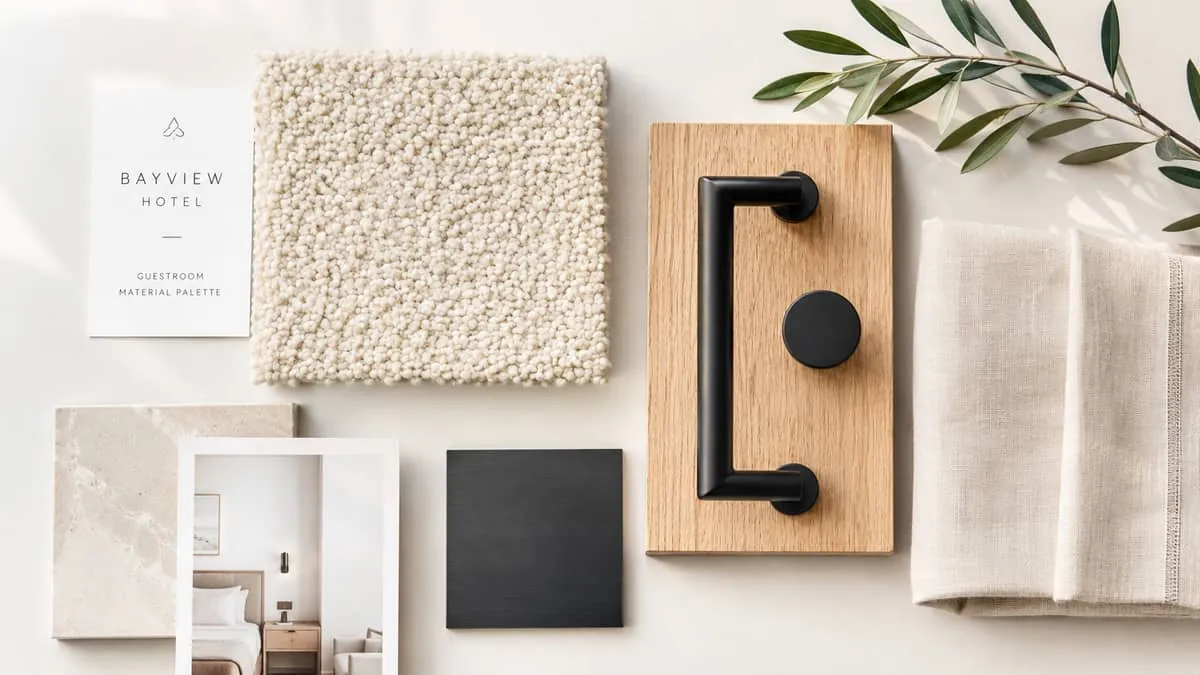
Upholstery in Griffintown rooms benefits from the same move toward residential warmth. Bouclé in warm white or oatmeal on lounge seating, linen-blend fabrics in muted earthy tones on headboards, and textured wool on accent pieces all signal that someone made deliberate choices about comfort, not just surface. Contract-grade specifications for these fabrics require a minimum 30,000 double rub rating and a backing fabric that prevents stretching across a frame over time. The feel of a piece that meets these specs is indistinguishable from residential furniture to a guest. The performance over a three-year replacement cycle is entirely different.
The Airbnb-Literate Guest and What They Know
Montreal has one of the most active short-term rental markets in Canada, concentrated in Plateau-Mont-Royal, Mile End, and the Rosemont neighbourhoods that sit adjacent to the city's independent restaurant and coffee shop culture. A significant portion of boutique hotel guests in this city have stayed in design-forward Airbnb and VRBO properties and know exactly what a well-furnished room looks like when the host has spent real money on it versus when they have furnished around a budget.
This matters for procurement because it raises the floor. A guest who spent a weekend in a Plateau apartment with a custom Tremblant wool throw on the bed and a Structube chair they recognised from their own wishlist will notice immediately when a hotel room has a headboard covered in vinyl that is textured to look like leather, or when a lounge chair has cushions that compress the moment you sit down. The design codes are legible to this traveller in a way they were not to hotel guests a decade ago.
The practical implication for sourcing boutique hotel furniture Montreal is that visible quality signals carry disproportionate weight. Guests do not sit down and assess foam density specifications. They sit down, feel the chair hold its shape, look at the stitching on the seam, and register whether the piece feels like it was chosen or whether it feels like it was procured. Those are different feelings and they produce different reviews.
High-return specifications in this context: visible joinery on wood pieces rather than concealed hardware, contrast stitching on upholstered pieces at a thread weight that reads clearly, solid wood legs rather than tapered wood sleeves over metal frames, and hardware that operates with weight and precision, whether drawer pulls, door handles, or bed frame connectors. None of these are the most expensive options on the market. All of them communicate that the furniture was chosen by someone who knows what they are looking at.
Furnishing for Grand Prix and Jazz Festival Demand
Montreal's peak hospitality seasons create specific durability requirements that should shape furniture specifications. The Grand Prix weekend in June and the Jazz Festival through late June and July bring the highest volume of design-aware international travellers the city sees. These are guests who have options in Paris, New York, and London and choose Montreal specifically. They are also guests who, during festival periods, are not particularly gentle with hotel rooms.
Contract-grade furniture in Canadian hospitality is typically specified to BIFMA standards for commercial use cycles. For a boutique property managing peak festival demand, the relevant standards are BIFMA X5.4 for lounge and public seating and BIFMA X5.1 for general seating. These test for structural integrity under concentrated loads and repeated use cycles that go well beyond what residential furniture is designed to handle. A lounge chair that passes BIFMA X5.4 testing will maintain its structure through ten years of hotel use. One that does not will show frame fatigue within three seasons.
For guestroom casegoods, the durability question centres on drawer slides, door hinges, and surface finish. Undermount full-extension drawer slides with a soft-close mechanism handle the daily use cycle without developing rattle or misalignment over time. European cup hinges with a six-way adjustment hold door alignment through repeated temperature changes between Montreal winters and heated hotel rooms. Surface finish on wood casegoods should be a conversion varnish or catalyzed lacquer rather than a waterborne finish; the chemical cure creates a harder surface that resists the moisture and abrasion of daily guestroom use.
Working with Montreal's Building Stock
Old Montreal's heritage buildings create procurement constraints that are not present in new construction. Room dimensions in converted nineteenth-century buildings are irregular. Ceiling heights vary between floors. Door openings in stone walls cannot be widened to accommodate oversized furniture without structural review. Any supplier you work with for boutique hotel furniture Montreal in a heritage conversion needs to understand this before they quote.
The suppliers who have done this work before will ask for floor plans and door swing dimensions before they begin specifying. They will flag pieces that will not clear a stairwell or fit through a heritage door frame. They will understand why a custom headboard width of 61 inches is sometimes the right answer when the bed sits between a heritage radiator and a window reveal. These are not complicated requests, but they sort quickly between suppliers who have actually furnished heritage hospitality buildings and those who have not.
Quebec has a genuine furniture manufacturing tradition concentrated in and around the Bois-Francs region south of Montreal, and several manufacturers in that tradition still do contract-scale work with custom sizing capability. Working with this regional manufacturing base shortens lead times, provides a reupholstery and warranty path that does not require coordinating with a manufacturer across a time zone boundary, and produces pieces that can be specified in both French and English without communication gaps on technical details. For a bilingual city where your maintenance and housekeeping teams may work primarily in French, having a supplier relationship that functions in both languages reduces friction across the entire service lifecycle.
The Material Shortlist That Holds Across Both Palettes
Whether you are furnishing a converted stone warehouse on Rue Saint-Paul or a canal-adjacent boutique tower in Griffintown, a coherent material shortlist is the structural foundation of a furniture program that reads as intentional rather than assembled.
For Old Montreal properties: aged full-grain leather in cognac or tobacco for primary upholstered seating, dark walnut or fumed oak for all wood surfaces, brushed brass for hardware and metal accents, and a stone or wool texture for any soft goods. These four material anchors can accommodate significant variation in silhouette, manufacturer, and price point while maintaining the visual coherence that the heritage context demands.
For Griffintown properties: bouclé or textured linen in warm neutrals for upholstered pieces, reclaimed or character-grade oak with a refined oil finish for wood surfaces, blackened steel or dark bronze for metal frames and hardware, and natural fibre textiles for soft goods. The same logic applies: four anchors, applied consistently, allow the flexibility to mix sourcing and scale without losing cohesion.
A Montreal boutique hotel guest who has stayed at the 9Hotel Opéra in Paris or The Hoxton in Amsterdam has internalized what a coherent material palette feels like in a room, even if they could not articulate it. They register its absence immediately. Getting the material shortlist right before sourcing begins is the decision that makes every subsequent procurement choice easier and the finished room feel like it was designed rather than furnished.
Pricing for boutique hotel furniture in Montreal depends on quantities, finishes, and your delivery window, so a project-specific quote beats any list figure. Request a quote to get yours.