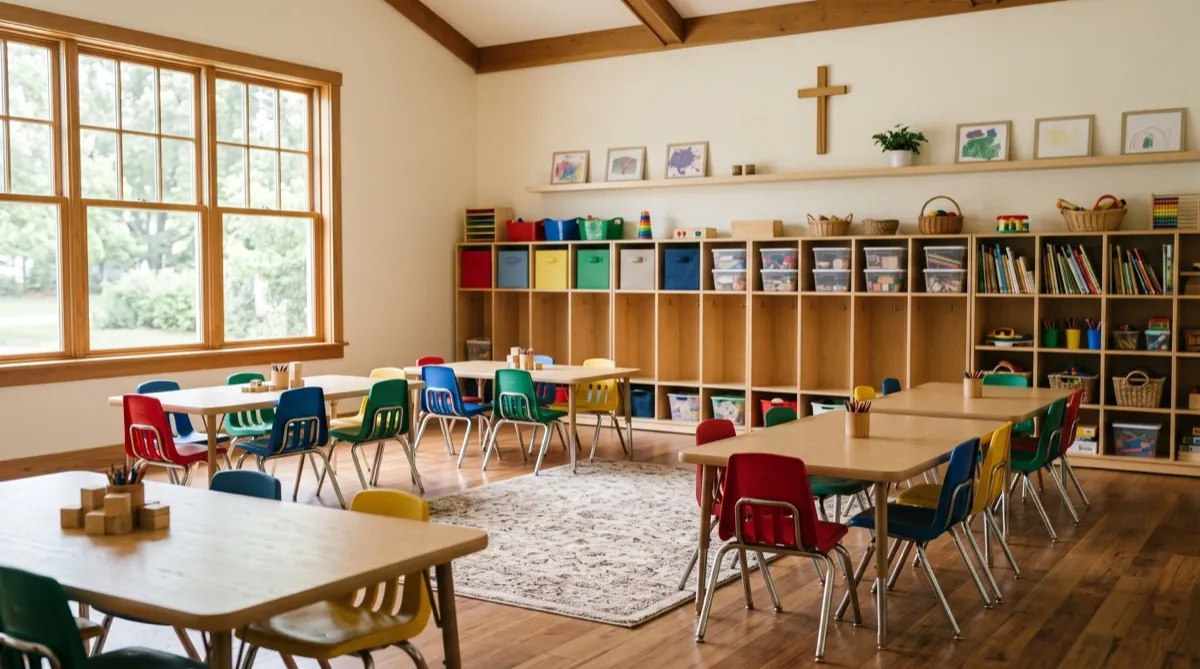
A church education wing is really several small furniture projects stacked under one roof. A nursery, a preschool room, an elementary classroom, and a youth room all need different table and chair sizing, different storage, and different durability expectations, and most of these rooms run double duty on weeknights for programs that have nothing to do with Sunday school.
Why age-group sizing matters
Use the maker's sizing guidance and an appropriate user-fit trial rather than age alone to select paired tables and chairs. Check supported feet, seat depth, work-surface relationship and the intended activity with the ministry team; this guide does not establish a posture or behavior outcome from an age-group label.
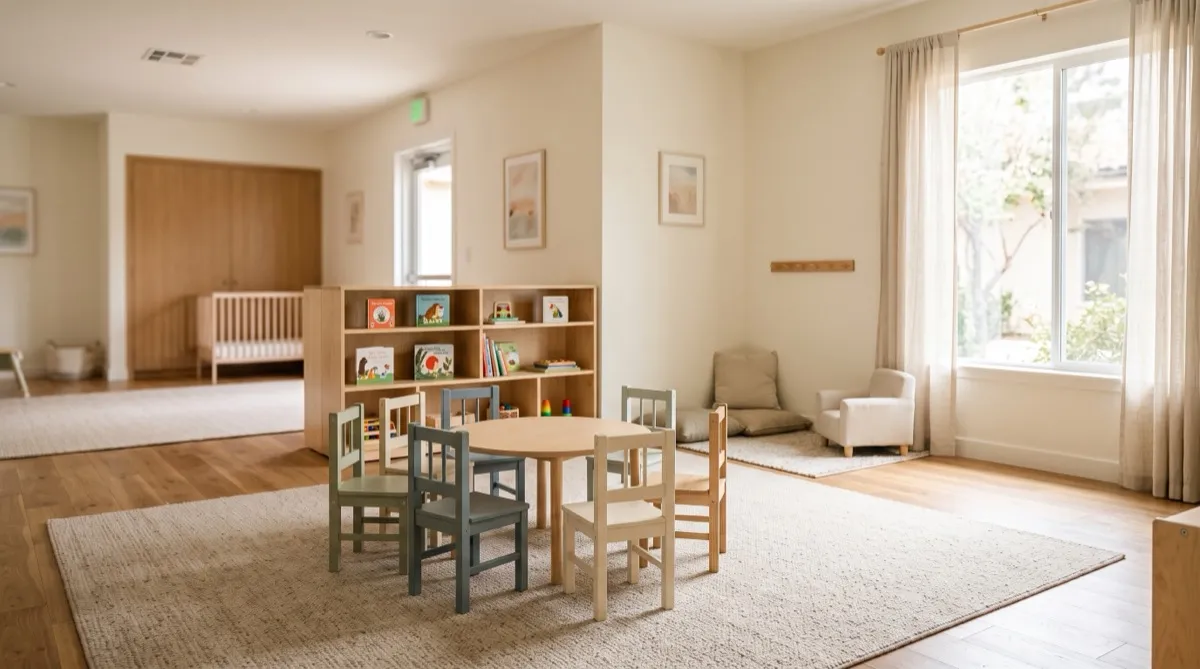
Nursery and toddler rooms need low, soft seating and low tables, if tables are used at all, since most activity in this age range happens on the floor. Furniture here prioritizes soft edges and easy cleaning over stacking or storage efficiency.
Preschool rooms can start a sample assortment with 10 to 12 inch seat heights as illustrative options, then use the chosen manufacturer's size chart and check each child's supported feet and fit at the paired table, typically round or kidney-shaped for small group activities. Stacking matters here since preschool rooms often reset for different activities within a single session.
Elementary classrooms can compare 14 to 16 inch seat-height samples as illustrative options, alongside any other sizes needed for the actual pupils. Check the maker's sizing guidance and paired table height; age alone does not establish fit. Rectangular or trapezoid tables can then be compared for the group-work layouts. Compare the exact models' documented intended use, cleaning, loads and sample fit; a school-use label alone does not establish greater durability through Sunday and midweek programs.
Youth rooms for middle and high school age often skip traditional classroom furniture entirely in favor of casual seating, since youth programming leans toward discussion-based formats over desk-based instruction. Stacking chairs and folding tables that can reconfigure for games, small groups, or a lecture format cover most youth room needs.
Tables and chairs as a system
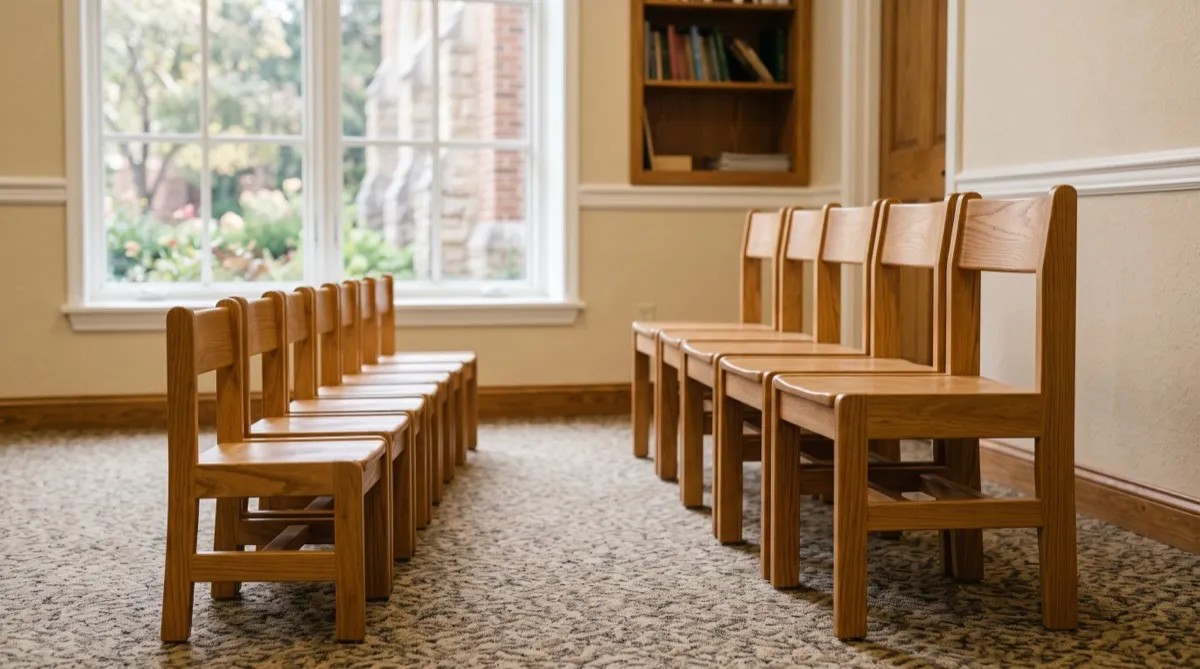
Compare the exact paired table and chair dimensions with the maker's size guidance and a user-fit trial, whether bought together or separately. A matched set does not establish posture outcomes or guaranteed reordering; obtain actual model continuity, parts and substitution terms.
Compare round, kidney, rectangular and trapezoid tables in the actual teacher and student layouts, including reach, occupied clearances and permitted joining or movement. Shape alone does not establish the best age-group fit or greatest flexibility; test the intended activity with exact samples.
Storage and multi-use reality
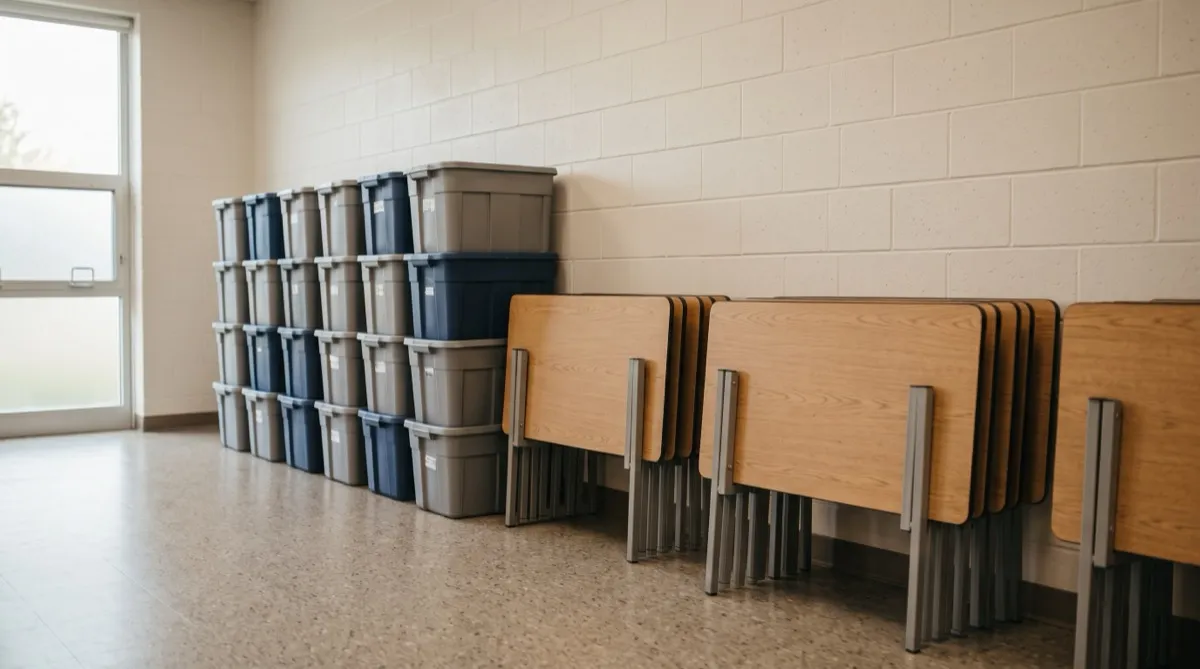
Most church education wings do not have the luxury of a room used only for Sunday school. The same classroom hosts a Wednesday night kids program, a Vacation Bible School week, and sometimes community group meetings that have nothing to do with children's ministry. Furniture that stacks and stores easily protects the room's ability to serve all of those uses without requiring a dedicated setup crew every time the room changes purpose.
Evaluate approved carts, racks and stacking methods with exact loads, anchoring, storage clearances and a timed reset trial. They do not automatically reduce labor or remove the need for trained staff. Include the actual storage and handling scope in the furniture budget.
Durability standard
Record each room's actual activities, impacts, spills, cleaning and supervision with the ministry team. Obtain exact load, intended-use, edge, hardware, assembly and care documentation and have the responsible team assess suitability; children's or commercial labels do not establish harder wear, a safety standard or disinfectant compatibility.
Budgeting an education wing separately
It's common for a church renovation or new building project to budget sanctuary furniture carefully and then treat the education wing as an afterthought, splitting a leftover portion of the budget across nursery, preschool, elementary, and youth rooms without pricing each separately. That approach tends to under-fund the rooms that see the hardest daily use. Compare observed condition, use hours, handling and care in each classroom and sanctuary before assigning a relative wear allowance; program names alone do not establish which accumulates more annual damage.
Price each room type on its own line: nursery, preschool, elementary, and youth, since the per-seat cost and quantities differ meaningfully by age group and the elementary and preschool rooms typically need the most units given class size and multi-room programming. Use our furniture cost calculator to model the total across rooms before finalizing a capital budget, so the education wing gets a realistic allocation rather than whatever remains after the sanctuary and lobby are priced.
Planning for growth
Plan reserve quantities from attendance records, expected programs, approved room capacity, storage and confirmed replenishment terms. A modest surplus can be tested as a budget scenario, but this guide has no data establishing that children's ministry grows fastest or that a later top-up is easier than another procurement approach.
Sourcing an education wing
Use the church furniture planning hub to organize the education-wing brief by nursery, preschool, elementary, and youth rooms. Record the actual user sizes, activities, table and chair pairings, cleaning criteria, and storage route; ask suppliers for the selected models' size and use documents and arrange a fit trial. Confirm room counts and class sizes with the ministry team before treating square footage as a purchasing quantity.
Related reading
Request a quote with the room list, age groups, actual fit requirements, paired table and chair quantities, care criteria, and dates. Ask responding suppliers for model-specific size charts, samples, documented intended use, and itemized current delivery terms for each room.