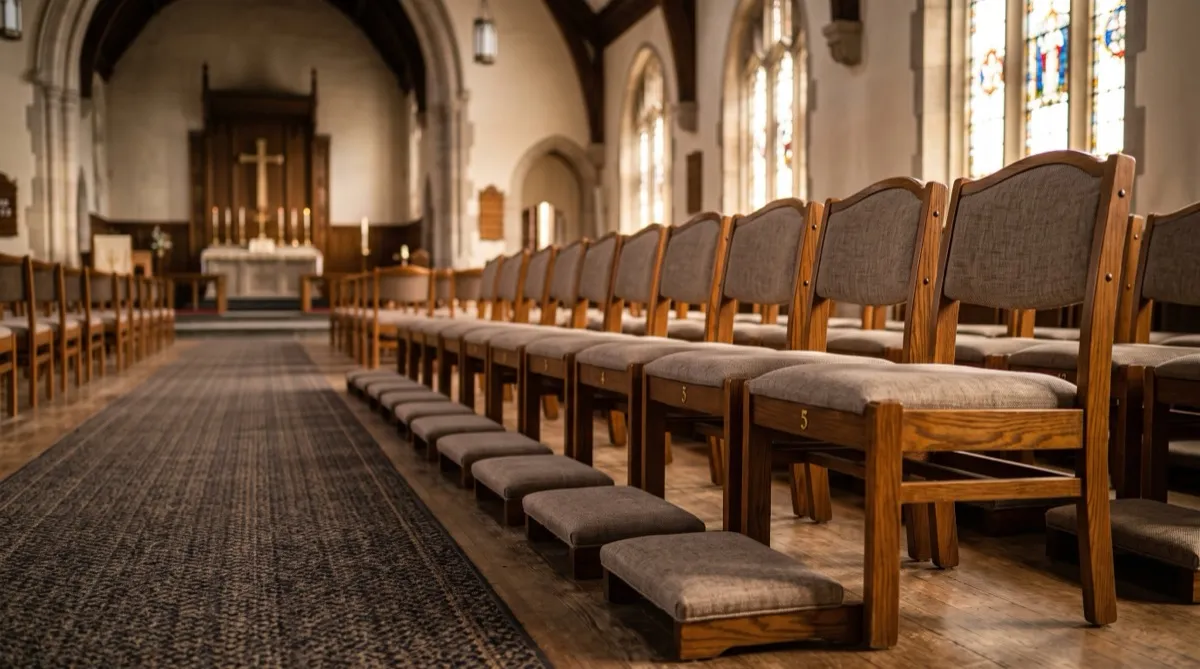
Decide on kneelers from the congregation's actual worship practice and the selected seating system. A denominational label alone does not make a chair-mounted kneeler mandatory. Confirm with clergy and users whether a chair feature, separate kneeling support or another arrangement is appropriate before comparing models.
Which traditions need them
For a congregation that kneels during prayers, confession or consecration, confirm the actual support arrangement with clergy and users. A chair-mounted kneeler is one option alongside separate support or an approved existing installation; a liturgical label alone does not make that chair feature mandatory. Include storage, deployment and user needs in the comparison.
Congregations in traditions without a regular kneeling practice generally skip this feature entirely, and there's no reason to add the cost and complexity if it won't be used. If you're unsure how often your specific congregation kneels during a typical service, that's worth confirming with clergy or worship leaders before finalizing a spec, since the answer sometimes differs from what a general denominational assumption would suggest.
Flip-up vs fixed kneelers
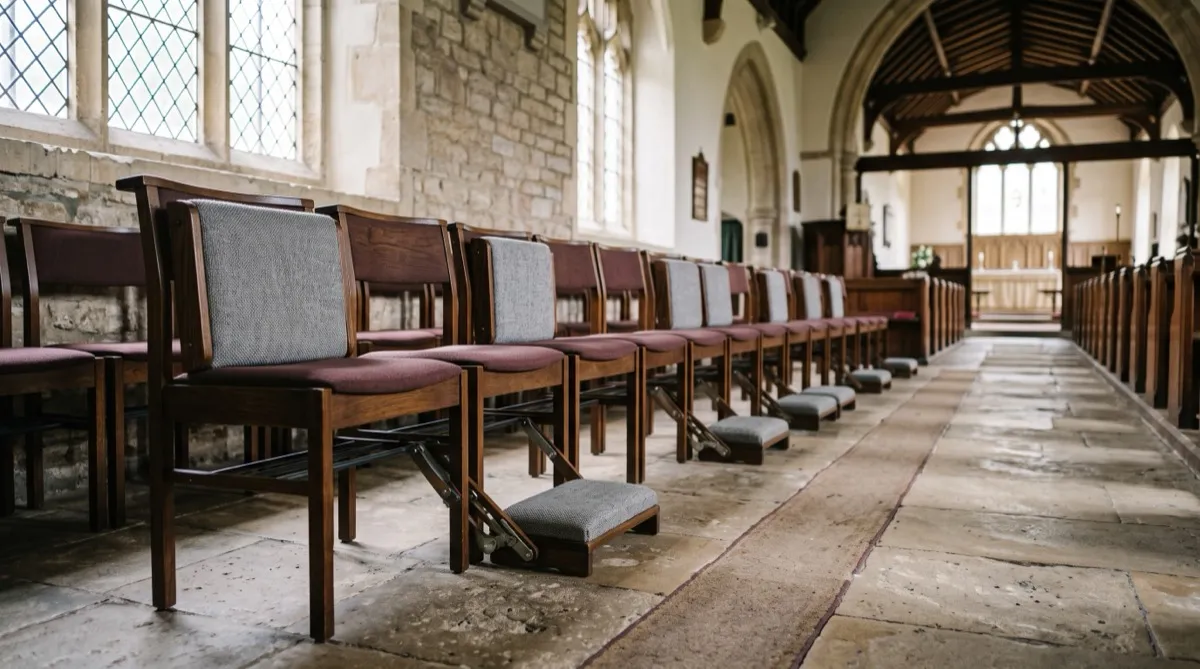
Flip-up kneelers stow against the underside of the chair in front (or against the chair itself, depending on design) when not in use, and fold down into position when needed. This is the more common design in chairs meant to also stack or interlock for flexible room use, since a fixed kneeler permanently extending from the chair complicates both stacking and aisle clearance when the kneeler isn't needed.
A fixed kneeler may suit a seating plan that does not need to stow or move the feature. Review the exact assembly's mounts, loads, maintenance and occupied row envelope. Absence of a hinge does not establish a longer service life than every flip-up option.
Compare fixed and flip-up configurations against the congregation's actual services, room changes, deployment and storage. Either option needs the maker's approved use and the occupied mock-up row. Choose from that review rather than assuming every flexible room needs flip-up or every single-purpose room needs fixed.
Durability and hinge specs
Review the exact hinge, bracket, locking or stowage mechanism and the maker's repeated-use documentation. A hinge is one possible inspection point alongside mounts, frame, pad and hardware; its construction alone does not establish a relative failure rate. Obtain the prescribed checks and replacement parts for the selected model.
Request the kneeler pad's foam density with units, firmness, cover and relevant performance documentation separately from the main seat. Thickness or density alone cannot establish how quickly either cushion will flatten. Test the sample for the intended kneeling duration and users, and confirm the maker's permitted loads and care instructions.
How kneelers affect row spacing
A kneeler in the down position extends into the space between rows, which means row spacing for a sanctuary with kneelers needs to account for a kneeling congregant's position, not just a seated one. Rows spaced correctly for seated comfort alone can feel cramped or make kneeling awkward if the kneeler doesn't have room to fully extend, or if the person kneeling ends up too close to the row behind them.
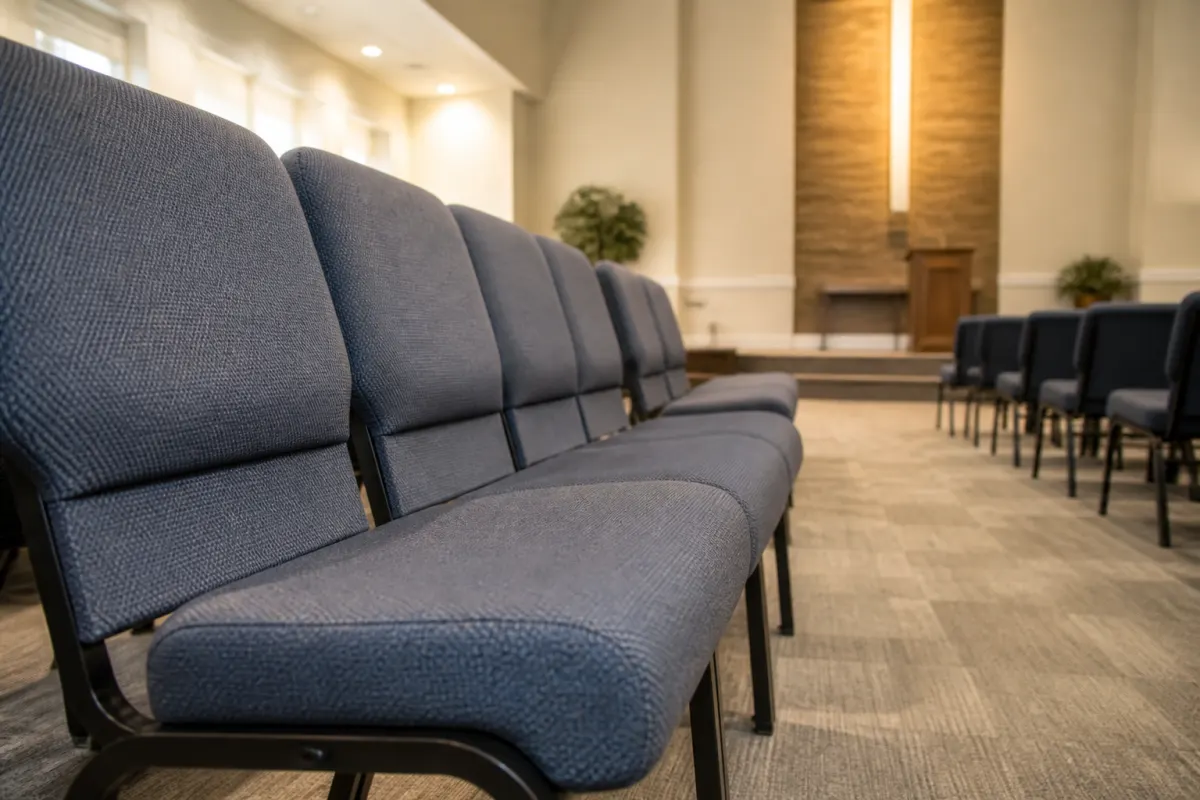
When planning row spacing for a kneeler-equipped sanctuary, measure the spacing with the kneeler in the down position and a person actually kneeling, not just the chair dimensions on a spec sheet. This is one of the details easiest to get wrong on paper and easiest to catch with a physical sample chair set up in a mock row before a full order is placed.
It's also worth timing how long the kneeling portion of a typical service actually runs. A brief kneeling prayer that lasts a minute or two puts a very different demand on row spacing and kneeler durability than an extended kneeling portion of a full liturgical service. Facilities committees sometimes assume the same spacing rule applies regardless of duration, but a congregation kneeling for several minutes at a stretch needs more forgiving spacing than one that kneels briefly and returns to a seated position.
Ordering considerations
If only part of your sanctuary needs kneelers (for example a main worship space with a liturgical service pattern, versus a fellowship hall or classroom that never needs the feature), specify kneelers only for the rows that need them rather than adding the cost across the full order. Keep frame and fabric consistent between kneeler and non-kneeler chairs in the same room so the mixed order still reads as one coherent design rather than two different chair lines placed side by side.
Use church furniture resources to prepare the kneeler brief. Submit a furniture request with actual worship practice, row envelope, quantities and care needs. Independent suppliers must confirm whether their exact models offer fixed or flip-up kneelers, the hinge/stowage instructions, load and stack limits, and quote dates.