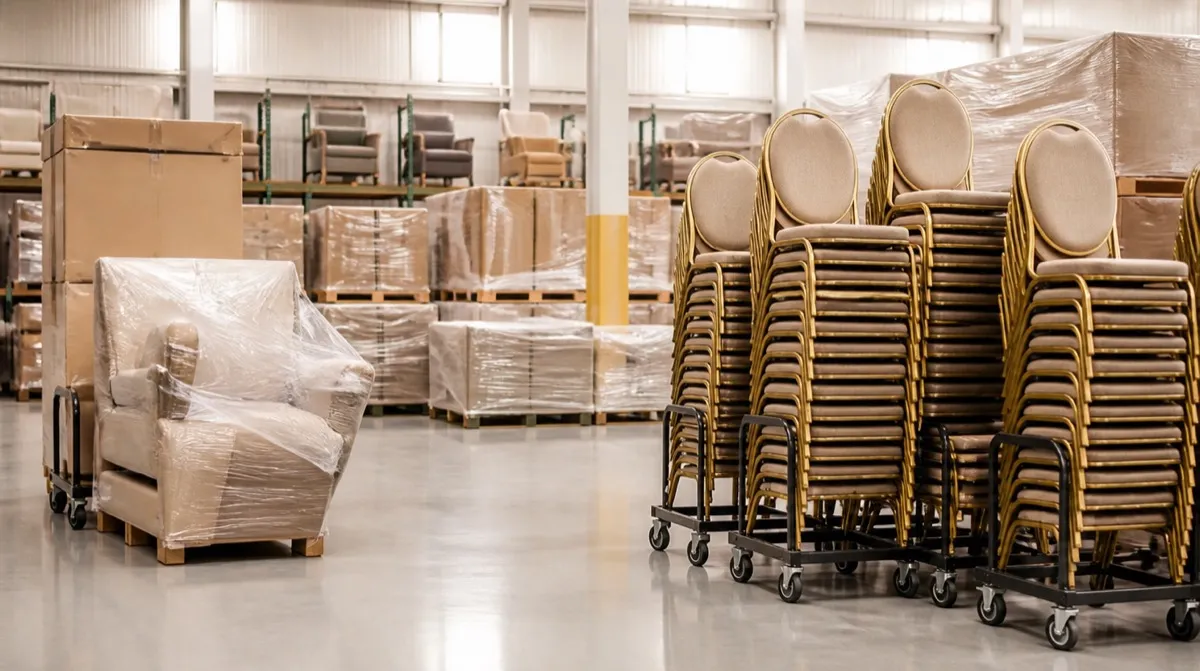
A bulk furniture order coordinates many products, specifications, and delivery requirements. For a 200-seat restaurant or a 120-room hotel, the quote needs to connect the item schedule with samples, production, freight, and receiving. This guide explains how to prepare that order and compare complete proposals.
What a bulk order needs to specify
Separate stocked products from made-to-order items. For custom work, record the finish, fabric, dimensions, and approved sample for each line. Confirm which decisions must be final before production can start.
How production and shipping affect an order
An order's cost depends on its specifications and fulfillment requirements. Review the production, packaging, and delivery details with the supplier before comparing unit prices.

- Minimum order quantity (MOQ): confirm any minimum by product, finish, or carton before finalizing the order.
- Production requirements: identify custom finishes, fabrics, and dimensions that need approval before manufacturing.
- Packaging and freight: confirm pallet or container requirements, receiving equipment, and the delivery service included.
Undiscounted per-unit planning ranges
Exact pricing depends on spec and quantity, but these retained article values are illustrative pre-quote assumptions rather than verified current supplier prices across the categories most commercial buyers order:
- Banquet and event seating: steel-frame stacking chairs run $45 to $90 per unit, aluminum stacking chairs $70 to $130, resin chiavari chairs $40 to $80, and wood or aluminum chiavari chairs $90 to $180.
- Bar and lounge seating: commercial barstools typically run $110 to $320 depending on frame, swivel, and upholstery grade.
- Tables: round 60 inch tables run $60 to $130, rectangular 6 to 8 foot tables $50 to $120, and cocktail or highboy tables $70 to $150.
Use the furniture cost calculator with these undiscounted planning ranges to build a rough budget across the categories you need.
What drives the price besides quantity
These requirements affect the quoted package:
- Materials and construction: compare itemized prices for exact frame, textile and cushion specifications; welded steel, hardwood or a lighter build does not establish the higher cost. Higher abrasion results alone do not prove added service life, as the ACT guidance explains.
- Customization: ask whether the selected model supports the requested frame finish, premium or COM (customer's own material) fabric, or nonstandard dimension. Confirm feasibility, setup charges, approval documents, and any separate minimum.
- Freight and delivery: factory-direct, dock delivery, inside delivery, and white-glove installation are different line items. Knowing which you need changes the quote.
- Lead time: confirm actual stock quantity, release and delivered dates; use 10-14 weeks only as an illustrative initial custom-order assumption until the exact schedule is confirmed.
Commercial grade is the baseline, not the upsell
When comparing bulk quotes, confirm everyone is quoting the same specification. A lower per-unit price is a reason to compare the actual specification and service scope, not evidence of a weaker frame, lower-grade foam or early failure. There is no single test count or warranty term that verifies every furniture category. Request the exact model's applicable structural test documentation, textile type and care, cushion properties, and written commercial-use warranty. The ACT guidance distinguishes woven or knit from coated abrasion criteria; a 50,000 count and a 2-5 year warranty are not a universal grade definition. A lower price needs a matched specification and lifecycle comparison; it does not establish replacement in a season or two. Always normalize the spec before you compare the numbers.

How to prepare for the best quote
You get a faster, sharper quote when you bring complete information. Before requesting a bulk furniture quote, pull together:
- Item list and quantities by style, with the specification or SKU for each line.
- Finish and fabric direction, including any brand colors or COM plans.
- Delivery details: ship-to address, dock or no dock, inside delivery, and any installation needs.
- Target delivery date, which sets the lead-time conversation and whether anything needs to be expedited or pulled from stock.
The more concrete the brief, the more precisely a supplier can confirm the products, delivery requirements, and project price.
What to check before you commit
Before committing, obtain the exact approved stack or nesting method, frame and joint tests, intended-use load and restrictions, component warranty terms and floor compatibility. Review a physical finish sample where matching matters. Those checks support comparison, but do not establish that an order lasts for years or predict early replacement.
If pricing spare units, request exact model and finish codes, approved batch controls, storage conditions and replenishment terms. For an illustrative 150-chair inventory and two-year horizon, test reserve assumptions against actual damage records; ordering extras does not guarantee future exact matches or a lower lifecycle cost.
From deposit to delivery day
When you compare quotes, compare total landed cost, meaning unit price plus freight, not just unit price. Orders at this scale move via LTL freight or full truckload, and the real freight cost depends on your delivery zip code, whether the site has a loading dock, and whether liftgate service is needed, so have delivery details ready for every site in the order.
Record the supplier's actual payment terms and production-release requirements in the order. A 50 percent deposit is an illustrative payment scenario here, not a universal term, and the quoted clock may also depend on drawings, samples, final measurements, or COM receipt. Agree the production confirmation, progress checks, and any pre-shipment photos or inspections against that release milestone rather than assuming payment alone starts the schedule.
Confirm the contracted delivery service, inspection procedure, damage notation, concealed-damage reporting window and responsible contact before dispatch. Arrange people, equipment, unpacking, staging and disposal to that scope. A clean signature's effect on a claim depends on the actual carriage and purchase terms; this guide does not establish a universal deadline or remedy. A full-day receiving allowance is an illustrative staffing input to test against the shipment, not a guaranteed duration.
Plan the timeline backward
Work backward from the project's actual approved milestones, using confirmed production and transit durations and separate contingency. A 10-14 week combined duration is only an illustrative scenario. Compare early-delivery storage, handling and access with later-delivery dependencies; this guide has no construction-delay or revenue-impact dataset and does not guarantee that ordering early protects an opening.
Request a quote with the item list, quantities, finish direction, and receiving details, and ask responding suppliers for itemized current terms. Browse the Commercial Furniture Depot catalog as furniture concepts for discussion; submitting an inquiry does not start a bulk purchase order.