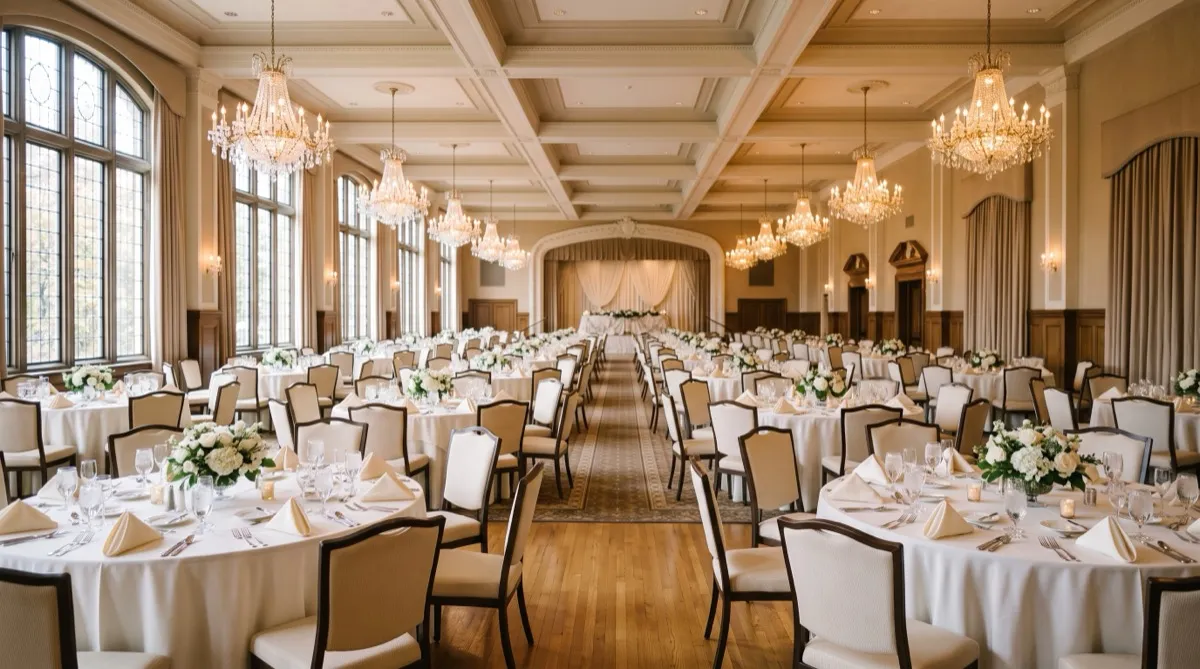
A banquet hall makes its money on the flip. The same room that seated a 220-guest wedding on Saturday night has to be cleared, reset, and dressed for a corporate lunch by Monday, and the crew doing that turnover is judged on minutes. That single operational fact should drive almost every furniture decision a venue owner makes, and it is the reason buying a banquet room is a volume problem rather than a shopping problem.
When you furnish one hall you are not buying a chair, you are buying two hundred of the same chair, plus the tables they wrap, plus the carts they stack onto. Get the specification right once and it repeats cleanly across the whole order. Get it wrong once and you multiply the mistake by the room.
Quantities start from the room, not the catalog
The honest starting point is capacity. A ballroom rated for 300 banquet guests on rounds does not need 300 chairs. It needs 300 plus an overage for damage, for a second seating layout, and for the inevitable stragglers a planner adds the week of the event. Most operators land somewhere around a ten to fifteen percent cushion over rated capacity, then round up to a clean stacking number so full carts are full carts.
Tables follow the seating count. A 72-inch round comfortably seats ten, a 60-inch round seats eight, and a serious venue carries a mix because the events do. Rectangular banquet tables handle head tables, buffets, gift and registration stations, and the classroom setups that corporate clients ask for. The banquet seating calculator turns a square-footage figure and a layout into a real chair and table count, which is a better place to begin than a round number pulled from memory.
Stacking and storage is a spec, not an afterthought
The difference between a chair that stacks eight high on a dolly and one that stacks four high is the difference between one storage closet and two. Over a few hundred chairs that gap decides whether your back-of-house works. Before you fall in love with a frame, put a tape measure on the stack height and confirm the chair ships with, or fits, a compatible dolly.
Stacking banquet chairs in steel or aluminum are the workhorses here because they take the abuse of constant restacking and roll efficiently. For a more formal look, resin or wood Chiavari chairs stack too, though not as tightly, and that trade-off between appearance and storage density is one every ballroom operator negotiates. Whatever you choose, buy the carts in the same order. A stack of chairs with nowhere to roll is a labor problem every single event.
Durability is what protects the margin
Banquet furniture fails in predictable places. Seat-to-frame joints loosen from being lifted by the seat instead of the frame. Glides pop off from dragging across a dance floor. Upholstered seats absorb spills at a bar-adjacent table. A contract-grade chair is engineered against exactly these failures with welded joints, reinforced stress points, and wipe-clean vinyl or performance fabric rated for commercial cycles.
The math that matters to an owner is service life against turnover. A properly spec'd banquet chair should stay in rotation for the better part of a decade under heavy use, while a lightweight import bought on appearance alone can start shedding units in a season. When a chair leaves rotation it is not just a replacement, it is a mismatched chair in a photographed room, which is a reason venues care about buying deep from one specification.
Why volume ordering changes the equation
Buying a whole room at once is where a venue gets real leverage, and not only on the quote. A single specification produced across the full quantity means every chair matches, every reorder starts from a spec that already exists, and the freight arrives as one coordinated delivery rather than a trickle of partial loads. That is the core of how volume ordering through CFD works, and a banquet hall is close to the ideal case for it because the order is deep, repeatable, and predictable.
It also lets you stage. A venue opening in phases, or renovating one hall while another keeps booking, can take delivery against that schedule instead of receiving everything at once and storing what it cannot yet use. And when the venue grows, adds a second ballroom, or refreshes after a few hard years, the held specification means the new chairs match the old ones instead of announcing themselves.
Coordinating delivery and install around a booked calendar
The hardest part of furnishing a working venue is that the calendar never fully clears. Furniture has to arrive during a gap between events, get received without blocking a loading dock a caterer needs, and be staged out of the way. Plan the delivery window the way you would plan an event: a firm date, a receiving contact, and a clear path from dock to storage. Order well ahead of a grand opening or a season, because a banquet package built to a custom finish sits in a production queue, and the one date that will not move is the wedding already on the books.
Building the order
Start with capacity, add your cushion, and settle the stacking spec before anything else, because storage constrains everything downstream. Choose one seating line and one table program you can reorder for years. Then price it as a package. Send an item list with quantities, finish and fabric direction, a delivery zip, and your target date, and request a quote so the figure reflects your actual room rather than a guess. The number comes out of the count, the freight route, the grade, and how long production runs, which is exactly why locking quantity first matters more than any other decision.
Browse the banquet chairs catalog to see the frames that hold up under real turnover, and use the tools to size the room before you commit.