
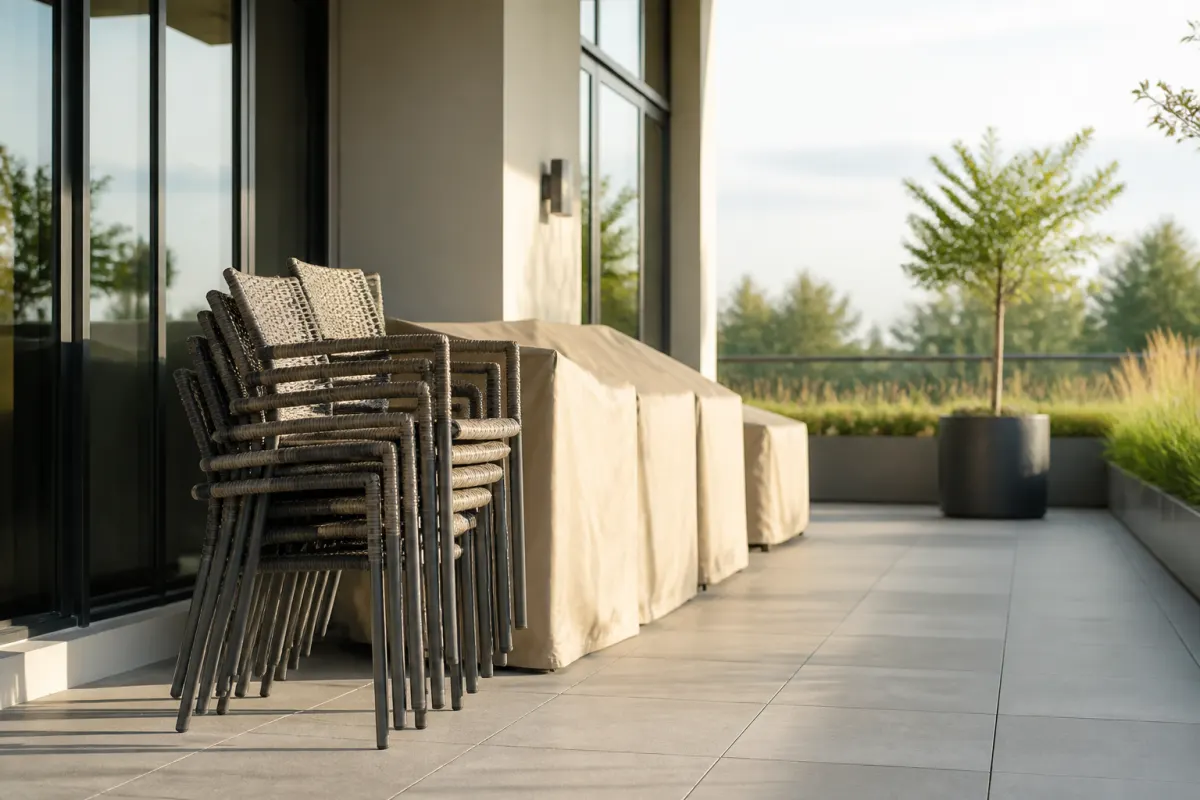
Plan where patio furniture will go at closing, during adverse weather, and for seasonal or event changes. Compare stackable and other products using the actual approved handling, storage, and exposure limits. Stackability offers a storage option but does not automatically establish a labor saving or outweigh the other product requirements.
Why stacking matters at volume
Compare an illustrative 20-table, 80-chair program with the actual closing and storage tasks. Time clearing, approved stacking, cart travel, and securing with the available crew; neither chair count nor non-stacking construction establishes a multi-hour job.
Calculate stack loads, loaded cart trips, and storage footprint using the selected system's approved limits. An 80-chair scenario does not establish a handful of stacks, one-or-two-person handling, or a particular time saving. Compare the resulting footprint and measured tasks with suitable on-site and any separately priced storage.
What makes a chair stack well
Not every chair marketed as stackable actually stacks cleanly at commercial volume. A few things separate a chair that stacks well from one that is technically stackable but impractical.
Frame geometry. Trial the maker-approved nesting and unstacking procedure, inspect contact points, and obtain separate storage and transport limits. A commercial stacking label alone does not establish that frames will never bind, catch, or be damaged.
Approved stack and transport limits. Obtain separate limits for stored stacks and the matched cart. Compare 8 to 10-chair and 4 to 5-chair scenarios only where the exact models permit them. Use loaded dimensions and the approved transport count for storage and trip calculations rather than judging safety by how many chairs can physically nest.
Weight per chair and loaded handling. Measure the actual chair and loaded cart weights, thresholds, turns, and travel distance. Trial the maker-approved handling method with the staff who will do it. Aluminum or resin does not automatically make a partial stack safe for one person to carry.
Cart compatibility. Obtain the maker-approved cart model, payload, transport count, loaded dimensions, securing, and handling instructions. Trial the actual route. A compatible cart does not automatically turn the full order into a single trip or establish most of the labor saving.
Materials for commercial outdoor stacking chairs
Aluminum. Compare the exact chair's mass, loads, finish, hardware, salt/pool exposure, and care instructions. Aluminum does not develop iron rust, but corrosion and coating deterioration remain product- and exposure-specific. No market-prevalence or category-wide durability ranking is established here.
Resin and polypropylene. Compare the exact formulation, exposure limits, tests, approved stack/cart system, care, and warranty. A commercial or consumer label does not establish a cracking or fading rate, price tier, or stacking efficiency.
Wrought iron and steel. Use actual product mass, stacking limits, loads, finish, and crew trials. These materials are options to compare; no universal weight or handling ranking follows from the name alone.

Arm vs armless
Compare arm and armless versions using actual seated comfort, transfers, table clearance, stack dimensions, and approved counts. Arms do not automatically establish accessibility or a premium tier, and armless construction does not guarantee a smaller stored footprint.
Trial the seat mix with the guests and meal lengths the patio serves. Select it alongside handling and storage requirements rather than prescribing armless seating for turnover or arms for longer meals.
Storage math worth doing before you order
Before finalizing a chair order, walk through the actual storage space available at season close or ahead of severe weather. Measure the storage area, calculate stack height and footprint per stack based on the specific chair's stacking dimensions, and confirm the total inventory fits with room for staff to maneuver carts. Operators who skip this step sometimes discover after delivery that their chairs stack fine on paper but the available storage room cannot fit the number of stacks their full inventory requires.
Ordering at volume
Confirm availability and the production schedule for the exact chair, finish, fabric, cart, and quantity. A 10 to 14-week custom-order window is an early planning scenario; obtain dated approval, dispatch, transit, and receiving milestones before relying on it for the patio opening.
Related reading
- Outdoor furniture maintenance for commercial patios
- Teak vs aluminum outdoor furniture
- Winterizing commercial patio furniture
Request a quote with chair counts, approved layout, measured storage, routes, and crew trials for relevant independent suppliers to review. Suppliers confirm actual chair/cart documentation, limits, availability, pricing, and delivery terms; the site does not certify a stacking system.
Our take
Inspect the selected system's stacking contact points, bumpers or glides, coating condition, and water drainage according to its instructions. Contact and retained water are concerns to assess, but no universal coating-wear timetable or corrosion sequence is established here. Confirm approved repairs and outdoor storage; do not tip a loaded stack as a general drainage method.
The bottom line: Use the exact chair/cart limits and handling trials for the storage calculation. Follow approved contact-protection, drainage, cover, inspection, and repair instructions rather than predicting wear from stackability alone.