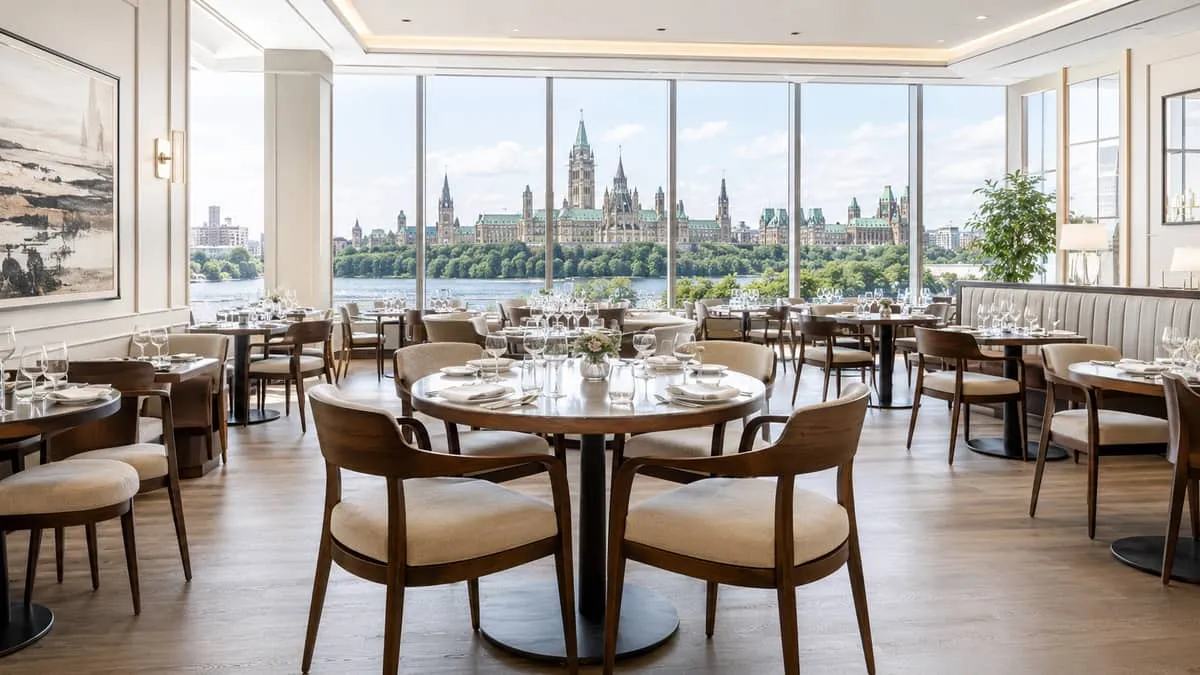
Ottawa's restaurant market is shaped by forces most Canadian cities don't share. The federal government pulls tens of thousands of workers into Centretown and the Hill district every weekday. The diplomatic corps on Sussex Drive maintains a calendar of receptions, working lunches, and formal dinners that runs year-round. July and August bring the Parliament Hill visitor season, when ByWard Market corridors fill with international tourists and the city's busiest restaurant terraces run at capacity from noon until last call. Then there's the conference economy: the Shaw Centre consistently ranks among Canada's top convention facilities outside Toronto, and association events tied to the national capital draw delegates who expect hospitality at a level that matches the setting.
If you're operating anywhere in this market, from a ByWard Market terrace to a Hintonburg neighbourhood spot to a private dining room serving Fairmont Chateau Laurier overflow, the furniture you specify needs to carry the room. A wobbling table during a working lunch off Sparks Street or a cracked seat pad in a room where a diplomatic delegation is meeting sends a message you cannot walk back. Contract-grade furniture is not a luxury specification for Ottawa operators. It is the baseline.
ByWard Market: High-Volume Summer Service and the Tourist Trade
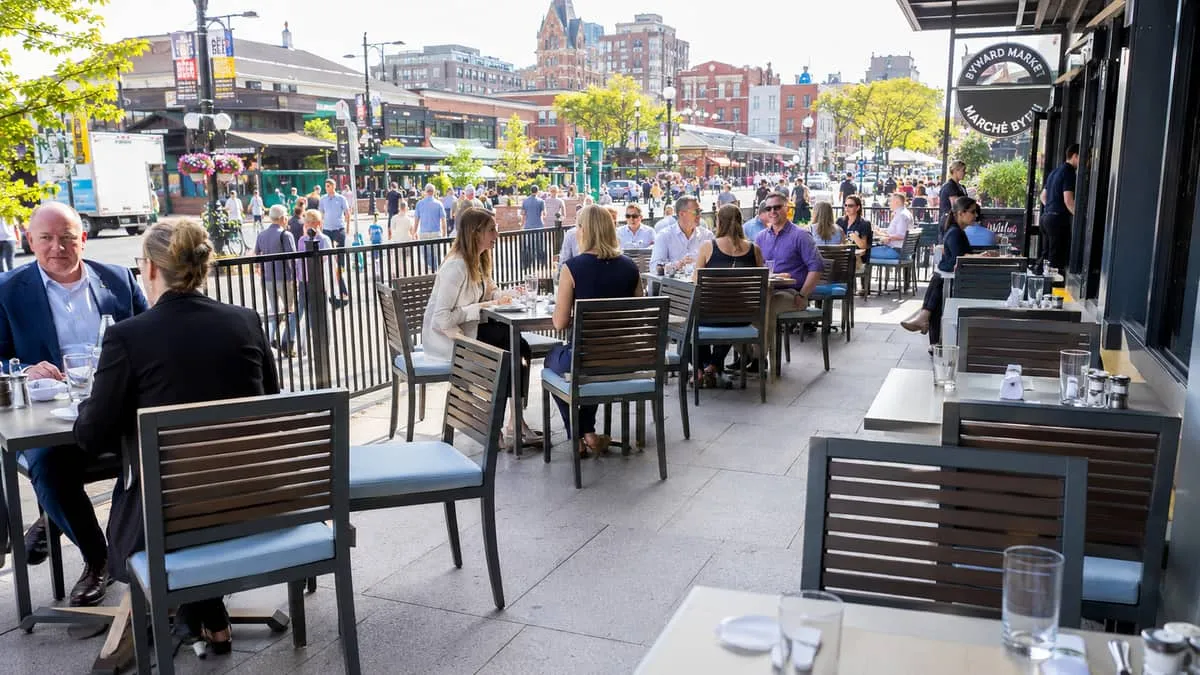
ByWard Market is one of Canada's oldest and most concentrated restaurant districts. The blocks around George Street and William Street pack an extraordinary density of concepts into a compact footprint, and during the Parliament Hill visitor season the entire area operates at a pace that would stress furniture specified at anything below contract grade.
Foot traffic in July and August comes from everywhere. European tourists, American visitors crossing for a Parliament tour, school groups, and Ottawa residents all converge on the same terraces and dining rooms. Table turns run fast. Chairs get dragged across stone patios and heritage brick floors. Cushions get sat on hundreds of times a week.
For ByWard Market terraces specifically, the frame material decision is critical. Powder-coated aluminum is the practical default for exposed outdoor seating: it won't rust in Ottawa's wet springs, handles the UV exposure of a full summer season without fading, and is light enough that staff can reconfigure a terrace quickly when a group walks in. Wrought iron reads beautifully on a heritage streetscape but adds weight that staff notice at the end of a long shift when they're stacking and storing. If your concept leans into the historic character of the market district, wrought iron with nylon floor glides and stackable geometry is the right compromise.
For the dining room itself, ByWard Market operators competing for the tourist dollar need furniture that photographs well and holds up in equal measure. Solid wood seats with a catalyzed lacquer finish in a mid-tone stain read as warm and authentic without the maintenance burden of raw or oiled wood. Upholstered seats in a commercial vinyl or a Crypton woven fabric give tourists the comfort they expect after a long day of walking Parliament Hill and the National Gallery, while wiping down quickly between the seatings that define a summer service.
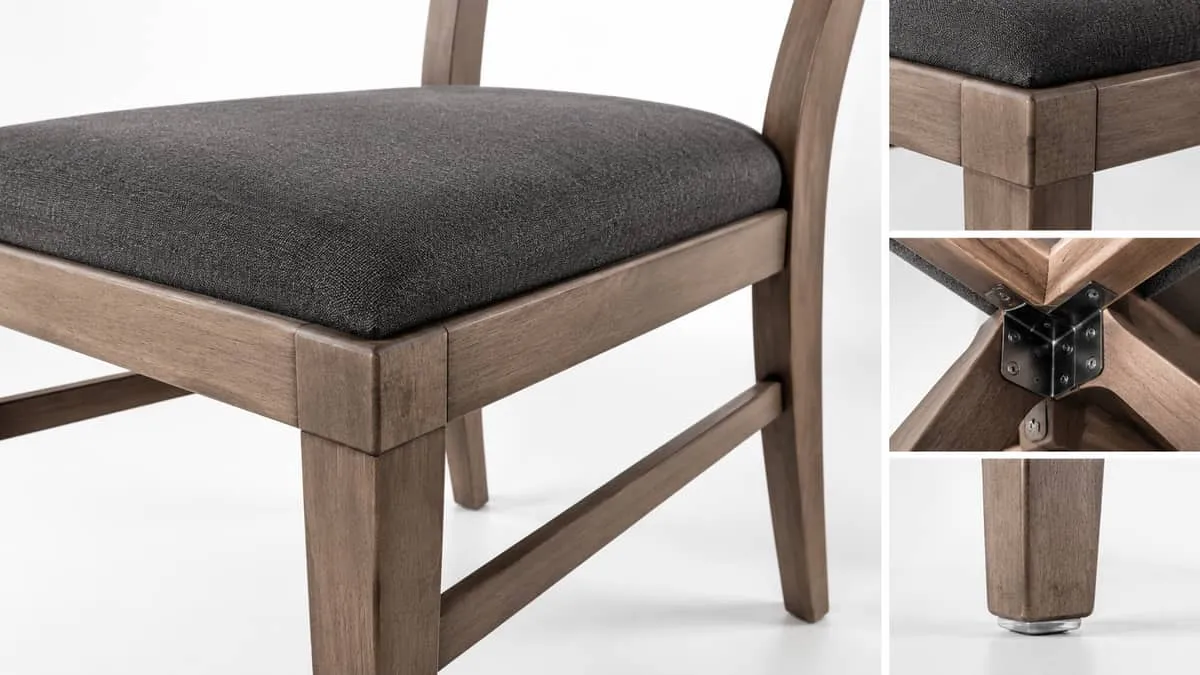
Frame construction needs to hold at 300 pounds and through 100,000 drop cycles at minimum, which is the BIFMA commercial standard. Mortise-and-tenon joinery or corner block reinforcement at the leg-to-seat connection matters more than the finish on top. A chair that looks great at opening and starts rocking six months into service is a cost that hits the P&L twice: once for the replacement, and once for every guest who noticed before you did.
The Government Lunch Market: Sparks Street and the Formal Dining Standard
Sparks Street and the blocks between the Hill and the Shaw Centre represent a distinct furniture specification category. The clientele here is committee members finishing hearings, senior public servants hosting working lunches, lobbyists managing relationship dinners, and the association conference circuit that fills the Shaw Centre calendar through spring and fall.
This market expects permanence. A four-leg base on a solid wood frame with upholstered seating in a Grade A or B commercial fabric signals that you're running a serious operation. The pedestal base is useful for event flexibility, but in a dining room serving government lunches, the four-leg communicates stability in both the literal and symbolic sense. Choose bases in solid steel or cast iron over hollow alternatives. The added weight means tables don't shift when a briefcase drops on a corner.
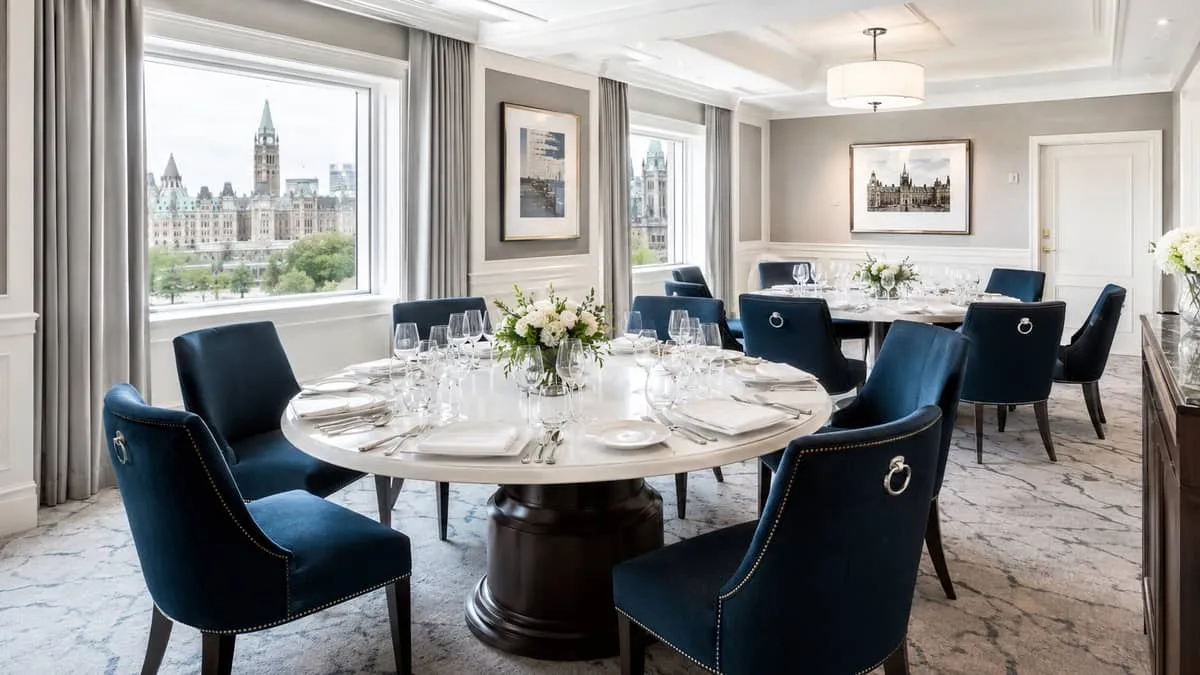
Private dining rooms serving this segment need furniture that transitions between configurations. A round table at 60 inches seats eight comfortably for a formal working dinner. The same room with rectangular tables pushed together becomes a breakout room for a conference delegation. Specify chairs with a consistent stack height and a design that looks intentional in both a formal dinner layout and a more casual working session arrangement. Armchairs work well at the head of a table; armless versions give you more flexibility in tighter configurations.
Upholstery in this segment should be COM-ready or specifiable in a commercial woven. Embassy functions and Parliamentary receptions that spill over into adjacent restaurant spaces often have specific aesthetic requirements. A supplier who can work with a customer's own material or offer a broad Grade B fabric program gives you the flexibility to meet those briefs without custom lead times.
Table surfaces in this category should be solid wood with a conversion varnish finish or high-pressure laminate on a minimum 19mm core. The conversion varnish finish holds up to the chemical exposure that comes with a serious lunch service: coffee, wine, hand sanitizer, cleaning solutions. Laminate in a wood-look finish is appropriate for conference hotel dining rooms where the volume is high and the aesthetic brief is more neutral.
Hintonburg and the Independent Dining Scene
Hintonburg sits west of Centretown and has built a genuine independent dining culture over the past decade. The operators there are serving Ottawa's growing tech and creative workforce, the Shopify crowd and the design studios and the media companies that have settled in the neighbourhoods west of the Queensway.
The furniture brief in Hintonburg is different from ByWard Market or the Hill district. The aesthetic leans toward honest materials and deliberate design: blackened steel, white oak, raw concrete, textured plaster. The clientele notices when furniture looks like it came from a generic hospitality catalogue, and they also notice when it holds up over years of serious use because the operator made smart choices upfront.
Solid wood seats in a white oak or ash, finished in a matte hardwax oil or a conversion varnish with a low sheen, work well in this context. They age honestly. A chair that develops a patina over three years of service reads as character in Hintonburg in a way that a worn veneer on a cheap frame does not. Steel tube frames in a matte black powder coat or a raw steel finish with a clear coat are appropriate here, both aesthetically and functionally.
Banquette seating is common in the Hintonburg neighbourhood scale, where operators are often working with long, narrow dining rooms in converted commercial buildings. A banquette with a tight foam density of 1.8 pounds per cubic foot or higher and a commercial fabric in a dark solid or a subtle texture will hold its shape through five or more years of regular service. Under-specify the foam and you're looking at a reskin within two years.
Table bases in the Hintonburg context often work better as adjustable pedestal bases in powder-coated steel, because the buildings are older and the floors are not always level. Adjustable leveling glides on every base are a non-negotiable in any Ottawa restaurant in a building older than thirty years, and Hintonburg has a lot of those.
Convention Hotel Spec: Shaw Centre and the Rideau Street Corridor
The Shaw Centre and the Rideau Street hotel cluster, which includes properties ranging from the Fairmont Chateau Laurier to the cluster of business hotels between the Convention Centre and the Rideau Centre, represent a high-volume specification category with its own logic.
Convention hotel dining rooms need furniture that works across multiple configurations: breakfast buffet service, working lunch, formal dinner, and private event. That flexibility requirement points toward stackable chairs with upholstered seats in a commercial fabric, folding or nesting tables for reconfiguration, and a palette that reads neutrally enough to work with different event decor schemes.
Stack height and stack weight matter in this environment. A chair that stacks six high and weighs under fifteen pounds is the practical specification for a banquet team storing and retrieving two hundred seats multiple times a week. Dolly compatibility matters equally: specify chairs with a dolly system that your supplier can provide so the banquet team isn't hand-carrying stacks across a ballroom floor.
The dining room that serves daily restaurant service in a convention property needs a different specification from the event furniture. Comfort matters more for a seventy-seat restaurant serving dinner service than for a banquet chair that will be used for ninety minutes and stacked. For the hotel restaurant proper, a fully upholstered seat and back in a commercial fabric, on a solid wood or metal frame, with a four-leg base that is not stackable, sends the right signal to guests who are choosing between eating at the hotel and going out into ByWard Market or the Glebe.
Climate, Patio Season, and the Rideau Canal Context
Ottawa's patio season runs May through September. The ByWard Market terraces, the Rideau Canal-adjacent restaurant patios in the Glebe and Old Ottawa South, and the newer LeBreton Flats development all operate outdoor seating for a genuine summer season with real UV exposure, temperature swings from evening cold to midday heat, and the moisture that comes with a canal city.
Outdoor furniture for Ottawa needs to handle frost heave cycles if any storage is marginal, direct sun without fading through a full season, and the condensation and humidity that is part of any waterfront or waterway-adjacent setting. Powder-coated aluminum is the right default for frame material. Teak is appropriate for high-end terraces serving the Chateau Laurier or similar calibre properties: it weathers well, ages gracefully, and reads as premium. Resin wicker over an aluminum frame is appropriate for casual terraces that want a softer aesthetic without the maintenance commitment of natural materials.
Cushions for Ottawa patios need a marine-grade foam or a Dryfast open-cell foam that drains and dries quickly. Standard upholstery foam holds moisture and mildews through an Ottawa summer. Fabric should be solution-dyed acrylic, Sunbrella being the most widely specified commercial option, with UV resistance rated for five or more years of direct exposure.
Storage is a real operational consideration. ByWard Market terraces often have limited back-of-house access for furniture storage during winter months. Stackable frames with a small footprint stack count, chairs that stack six to eight high on a dolly, and tables that fold or nest are worth specifying even at a modest cost premium if your storage situation is tight.
Sourcing and Lead Times for Ottawa Operators
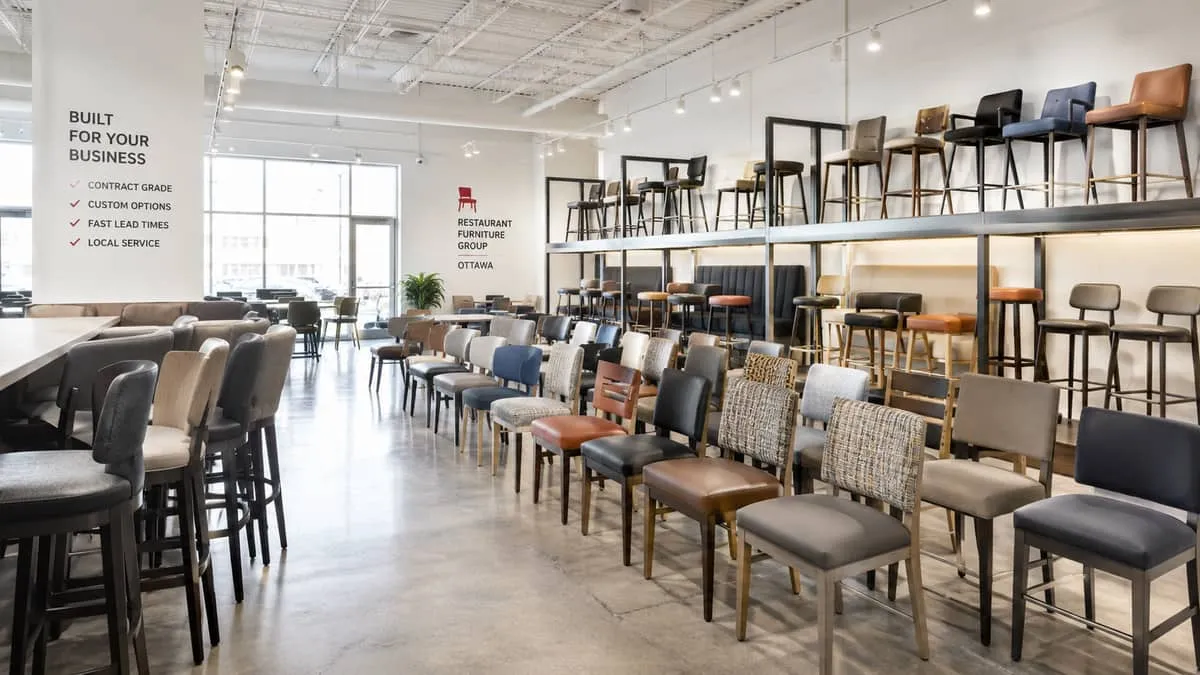
Most contract furniture suppliers serving Ottawa operate distribution out of Toronto or Montreal. Lead times on stocked commercial programs run four to twelve weeks. Custom upholstery specifications run sixteen to twenty-four weeks from order to delivery. If you're opening to a lease commencement date or refreshing a hotel dining room ahead of a major convention season, those timelines need to be in the project schedule from the first week of planning, not added at the end.
Ask suppliers directly about Ottawa project references. A rep who has delivered restaurant furniture into ByWard Market heritage buildings understands the freight access limitations, the elevator dimensions that come with older commercial properties, and the installation windows you can negotiate with a heritage building manager. Those logistical details are not trivial when you're moving two hundred chairs and forty tables into a third-floor dining room above a functioning restaurant.
Minimum order quantities vary by supplier. Custom upholstery programs typically require twenty to thirty seats minimum. If you're fitting out a smaller Hintonburg concept with forty seats or fewer, it's worth identifying suppliers who maintain a stocked commercial program so you can specify from their inventory rather than committing to a custom production run.
For Ottawa operators working across multiple concepts or managing a hotel's full furniture program, consolidated sourcing with a single supplier or a short-list of two reduces the coordination overhead significantly. One supplier who can cover dining chairs, bar stools, banquette frames, outdoor seating, and table bases means one freight schedule, one installation crew, and one warranty conversation if something needs attention in year two.
The Ottawa market rewards furniture specifications that carry the weight of the city's particular clientele mix. Get the contract-grade standard right from the start and you're not replacing chairs eighteen months in.
Tell us about your Ottawa restaurant furniture needs and we will turn your quantities, finishes, and timeline into a firm quote. Request a quote whenever you are ready to compare.