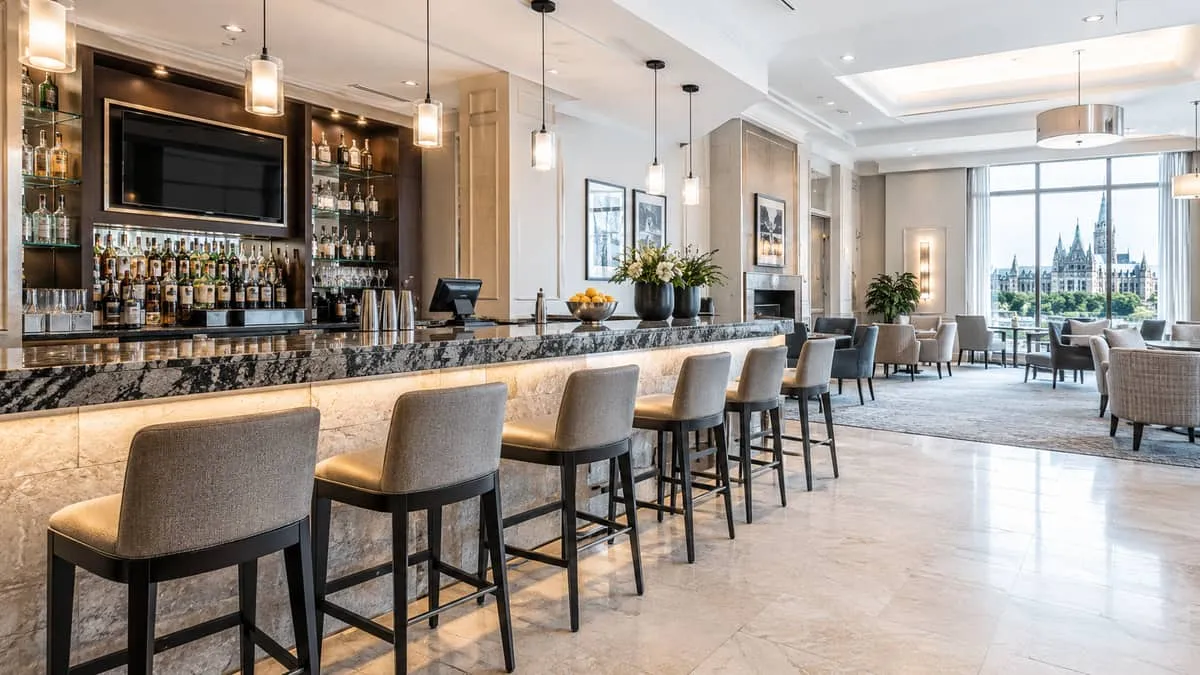
Ottawa's bar market is not one market. It is three distinct operating environments stacked inside a single city, each with its own clientele, its own pacing, and its own tolerance for what furniture failure looks like. A lounge within walking distance of Parliament Hill answers to expense accounts and ministerial staffers who benchmark against similar establishments in Washington and Brussels. The ByWard Market patio corridor runs maximum capacity from May through September, absorbing tourism traffic, convention overflow from the Shaw Centre, and the largest concentrated weekend crowds in the city. And the Hintonburg and Wellington West strip hosts a cocktail bar scene where the regulars have been to Proof in Toronto and Le Lab in Montreal, and they will notice if your seating tells a different story than your menu does.
Getting bar lounge furniture Ottawa right means understanding which of those three markets you are serving, because the specifications diverge significantly across all three.
Expense-Account Bars Near Parliament: Seating That Earns Discretion
The corridor running from Sparks Street through the Fairmont Chateau Laurier and along the Rideau Centre to the hotel cluster on Rideau Street is where Ottawa's political economy does its informal work. The people in these rooms are lobbyists, senior civil servants, association executives, foreign officials, and elected members. They are not looking for a nightlife experience. They are looking for a room that allows a conversation to stay private.
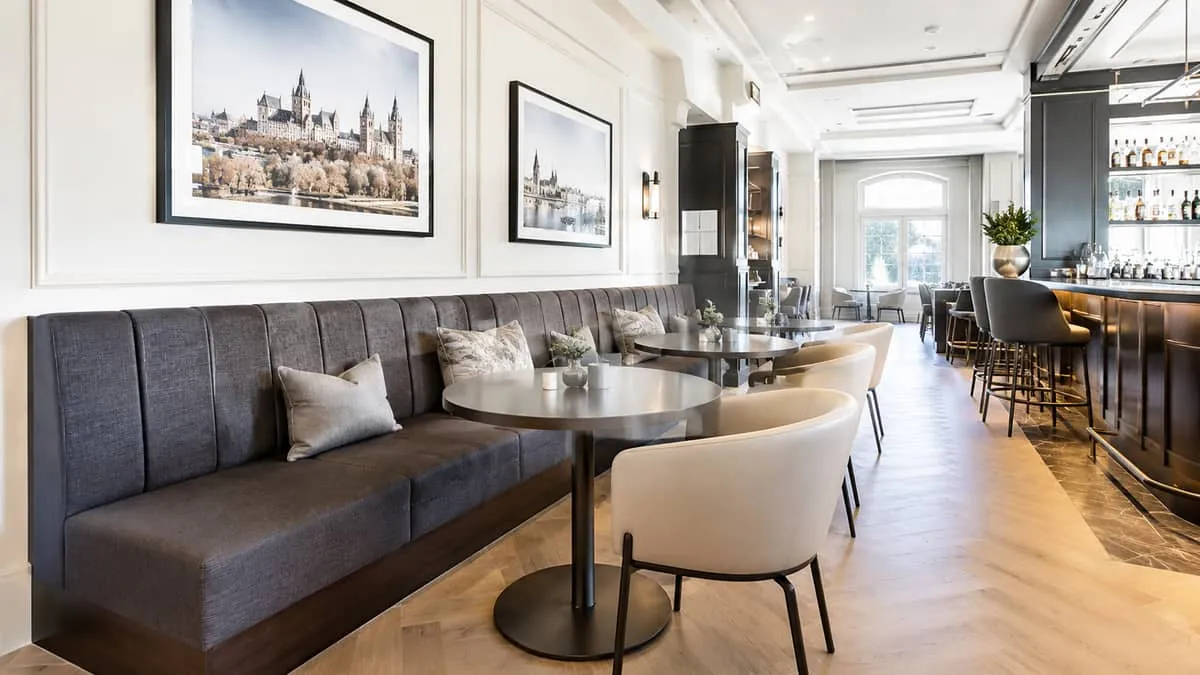
That requirement drives specific furniture decisions. Booth configurations are the priority. High-backed banquette seating, ideally with wings on the returns, gives seated parties acoustic separation without requiring physical barriers. The back height matters: anything below 48 inches from floor to top of back loses the sense of enclosure that makes a political conversation feel contained. Upholstered backs with dense foam and tight fabric construction absorb sound instead of reflecting it. For bar lounge furniture Ottawa serving this corridor, the material finish also carries professional weight. Brushed brass hardware reads as considered. Dark wood staining on frames, particularly walnut or a dark-stained oak, signals permanence. Chrome and white laminate read as casual in a room where the clientele is not feeling casual.
Club seating in pairs or fours, arranged with low lounge tables between them, serves the semi-formal function when booth capacity is exhausted. These groupings need enough visual separation from neighboring tables that two parties seated close together still feel distinct. Area rugs under each grouping accomplish this without adding millwork. The rug also contributes to the acoustic suppression that makes the room feel appropriate for the use case.
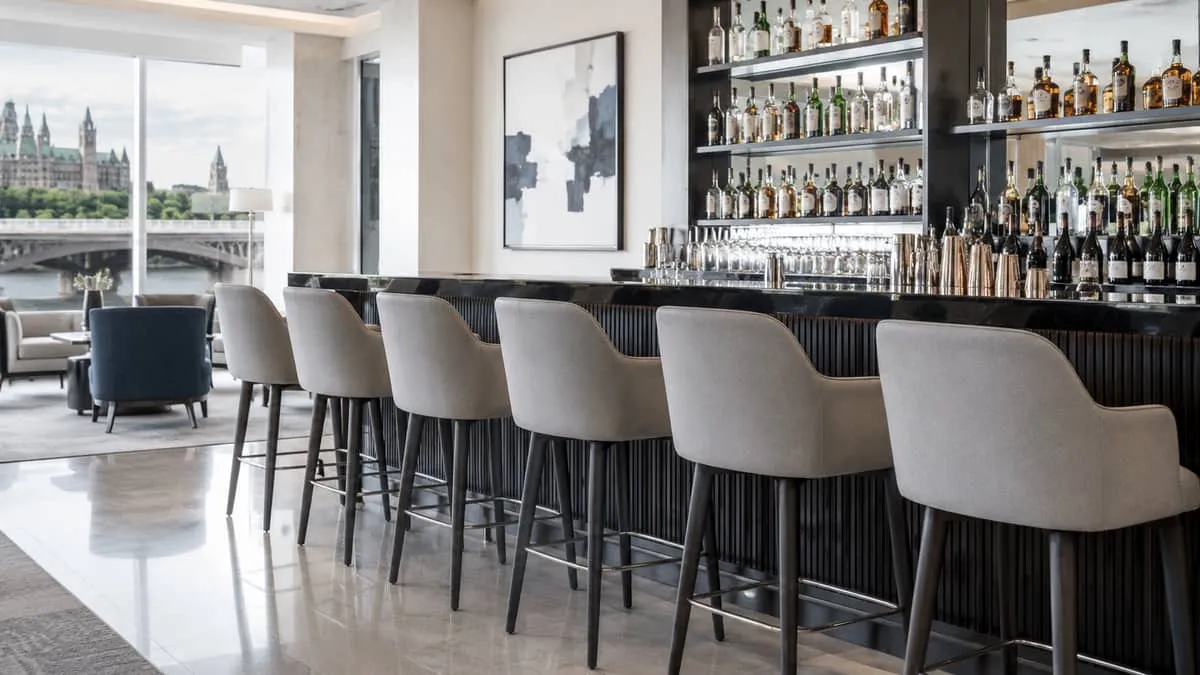
For operators near the Chateau Laurier or along Sparks Street, swivel barstools at the bar itself need to match the room's register. Cast aluminum bases with upholstered seats and backs in a performance textile handle the volume while looking the part. Avoid barstool designs with exposed footrests in a bright metal finish in rooms with a dark and intimate palette. The visual contrast draws the eye in the wrong direction.
ByWard Market Patio Season: Contract Grade for Five Months of Maximum Load
The ByWard Market patio corridor is the busiest outdoor hospitality stretch in Ottawa, and one of the most demanding operating environments for outdoor furniture in the country. From May through September, terraces on George Street, William Street, and York Street absorb foot traffic from Parliament Hill tourists, the Rideau Centre shopping corridor, the national museum visitors moving between the Canadian Museum of History across the river and the War Museum on the other side of the city, and the convention overflow from the Shaw Centre on Colonel By Drive.
That volume, compressed into five months, is why contract-grade specification is not optional for ByWard Market patio operations. Furniture that looks presentable in week one needs to still look presentable in week twenty-one after daily setups, takedowns, rain events, and the kind of late-night foot traffic that ends every ByWard weekend.
For outdoor bar lounge furniture Ottawa in this environment, the frame specification starts with marine-grade aluminum or powder-coated steel with a minimum 65-micron coating thickness. Both resist the freeze-thaw cycling that Ottawa winters impose, because even outdoor furniture stored improperly or brought out too early in shoulder season encounters temperature swings that crack inferior coatings and open rust pathways. Stackable seating is worth specifying for terraces where evening close requires staff to clear the floor quickly. Stacking chairs and barstools that nest cleanly reduce the labor burden at close and minimize the damage that comes from hurried staff moving pieces that were not designed for quick handling.
Tabletops on ByWard Market patios need edge protection. Solid surface and HPL laminate tops with a polished or beveled edge resist the chips and cracks that come from chair contact during a busy service. Avoid veneer and tile-inset tops in outdoor settings. Veneer delaminate at the edges when exposed to the moisture cycle. Tile insets crack when a server sets a heavy tray down during a rush.
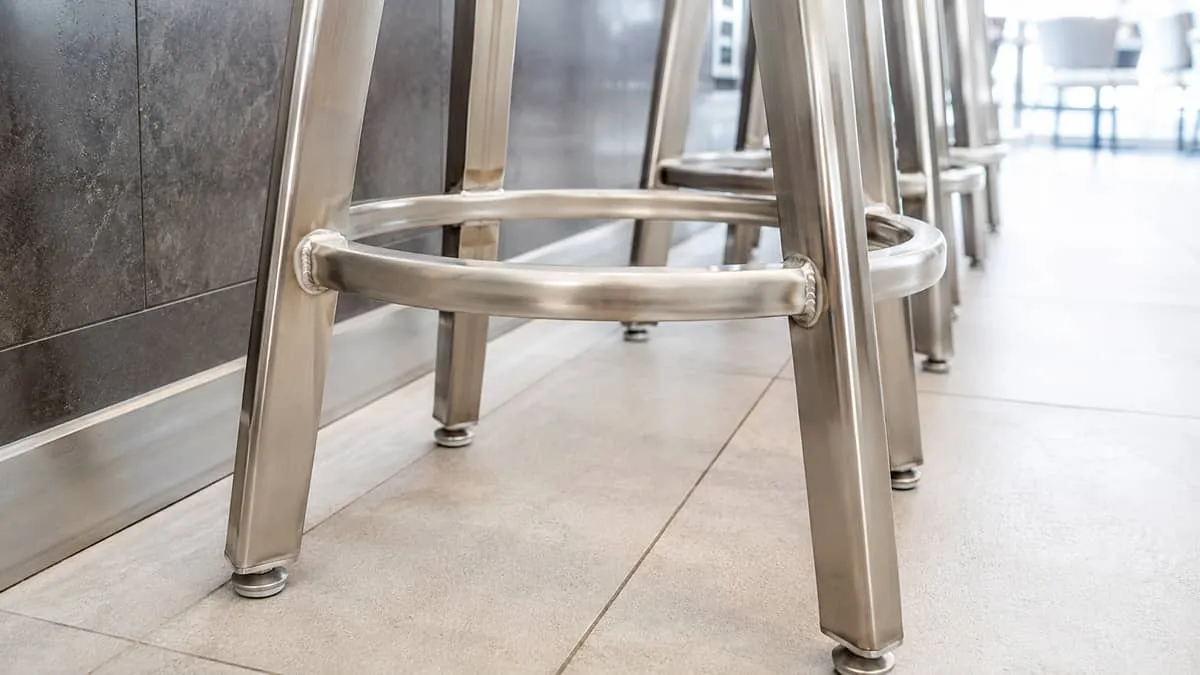
Barstools for patio bar counters in this market need footrests that are welded, not bolted. Bolted footrests loosen through a season of daily use and become a wobble complaint by July. Seat foam density for outdoor cushions should be rated for UV stability, not just load: foam that degrades under direct sun loses its loft by mid-summer and creates a seat experience that reads as cheap regardless of the frame underneath it.
Shaw Centre and Convention Overflow: Flexible Lounge Configurations
The Shaw Centre is Canada's largest convention facility outside Toronto, and its programming generates consistent lounge demand in the adjacent hotel bars and in the restaurants within walking distance along Colonel By Drive and the Rideau Canal corridor. Convention delegates leaving sessions need seating that can flex between two people having a working conversation and a standing group of eight debriefing over drinks.
That flexibility requirement pushes against the fixed banquette model that works well in the political corridor. For lounge areas absorbing Shaw Centre overflow, modular club seating in moveable groupings gives floor staff the ability to reconfigure without requiring heavy lifting. Pieces that are light enough for one person to move but heavy enough to feel substantial when seated are the practical target. Ottoman cubes that double as additional seating or low table surfaces are useful in this context. Low lounge tables on casters allow quick reconfiguration without disruption.
Fabric choice in hotel lounge seating near the Shaw Centre should default to Crypton or a equivalent performance textile. These fabrics handle the coffee, wine, and food contact that comes with delegate groups grazing through a buffet-adjacent space without requiring immediate staff intervention at every incident. The visible-stain rate in a high-traffic hotel lounge correlates directly with how quickly a room starts to look worn, and it is the single most controllable variable in a fabric specification.
Hintonburg and Wellington West: Furniture That Can Hold Its Own in the Room
The cocktail bars and independent restaurants along Wellington West and into Hintonburg are operating in a different economy than the convention corridor or the political district. The clientele here is Ottawa's tech community, working in the March Road corridor and in the Kanata offices of companies whose employees commute downtown on weekends. It is the creative and cultural sector. It is the demographic that makes regular trips to Toronto and Montreal, has opinions about the bar programs at places like Bar Raval or Vin Papillon, and pays attention to whether a room was designed or merely furnished.
For bar lounge furniture Ottawa in this market, design credibility is a real specification criterion. That does not mean expensive for its own sake. It means coherent. A room where the barstools are a different material language than the tables, or where the lounge chairs look like a hospitality supply catalog rather than a considered choice, reads as unconsidered to a clientele that has a reference set for what a good room looks like.
Solid wood elements, whether in barstool seats, chair frames, or table bases, carry more credibility in this market than chrome and vinyl combinations. White oak and walnut remain the commercial standard for this aesthetic because both take a variety of finishes, hold up under commercial use better than softer species, and age in ways that read as character rather than wear. Woven seagrass or rattan elements work in this context for the warmth they add to a room, though they require more careful specification for commercial durability than solid wood.
Booth seating in Hintonburg cocktail bars should be low-back rather than the high-back booth appropriate for the political corridor. Low-back banquettes keep the room visually open and allow the space to feel social rather than separated. Upholstery in leather or a textured performance fabric with visible stitching detail reads better in this market than smooth, undifferentiated vinyl.
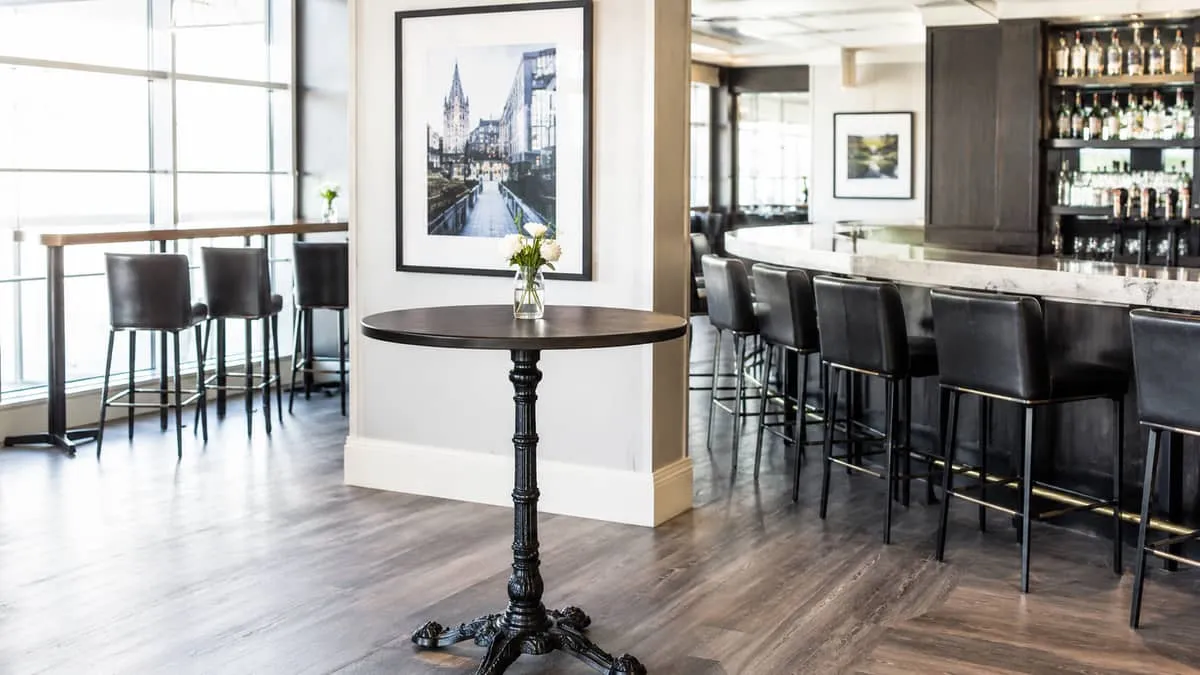
High-top tables in this environment should have bases with design intention. Turned wood pedestals, blackened steel frames, or cast iron bases with visible detail all work better than generic chrome pedestals. The top material can be solid surface, reclaimed wood with a penetrating oil finish, or a stone-look porcelain slab. Avoid high-gloss laminate in rooms targeting a design-aware clientele. It reads as commercial in a negative sense, as if the decision was made on price rather than fit.
What Contract Grade Means in Ottawa's Climate Context
Ottawa winters are cold enough to matter for indoor furniture specification as well as outdoor. Heating systems running at full capacity from November through March create a low-humidity environment that causes wood to move, veneers to lift at edges, and upholstery fabric to develop static and cracking over time if the material specification was not designed for climate variation.
Solid wood frames with a catalyzed lacquer or conversion varnish finish handle humidity cycling better than veneer-over-MDF construction, which is the default for much of the residential and lower-tier commercial furniture market. For an Ottawa lounge running central heat all winter and air conditioning through summer, the frame material and finish specification has real longevity implications.
For indoor bar lounge furniture Ottawa, this means asking suppliers directly about the finish system on wood components, not just the species. A furniture piece described as "solid oak" can still carry a finish that will check and crack after two heating seasons if it was designed for a climate-controlled showroom rather than a working bar.
Contract-grade foam specification also matters in cold climates. High-resilience foam rated for commercial use maintains its loft through the compression cycle of daily use regardless of temperature variation. Cheaper foam formulations lose loft faster in cold environments and show permanent compression within a year in high-use seating.
Specifying for the Long Term
Ottawa's bar operators are often managing spaces in heritage buildings with fixed architectural constraints, or in new builds where the fit-out budget was established before construction cost escalation. Either way, furniture decisions made at opening set the performance baseline for five to eight years of commercial operation, because a full replacement cycle is a significant capital event.
The right specification process starts with use case before product. A ByWard Market patio seat will be set up, broken down, rained on, and dragged across concrete 150 times between May and September. A booth in a Sparks Street lounge might receive 1,500 covers over the same period from guests in suits who will notice if the cushion has lost its loft. Those are different briefs, and a furniture supplier who approaches both with the same catalog is not serving either well.
Contract suppliers who work in Ottawa's hospitality market understand the client range the city produces. They have specified for National Capital Commission properties, for Fairmont Chateau Laurier adjacent restaurants, for the ByWard Market corridor, and for the independent operators in Hintonburg who know exactly what they want and why. The specification conversation for bar lounge furniture Ottawa should reflect that range, because the city's hospitality market rewards operators who get it right and is unforgiving of those who treat a capital city as a standard commercial market.
For Ottawa properties comparing bar and lounge furniture options, project-specific pricing tells you more than any published range. Request a quote and we will scope it to your space and volume.