Hotel renovation projects in San Diego operate in a compressed and unforgiving timeline environment. The city's event calendar anchored by Comic-Con International in July, a continuous convention schedule at the San Diego Convention Center, and Padres home game traffic that peaks from April through October creates hard windows when renovation work at downtown and Gaslamp Quarter properties simply cannot proceed. Coastal resort properties on Coronado Island and in La Jolla face their own seasonal constraints tied to peak leisure travel periods. Navigating these windows while meeting the design expectations of today's California hospitality market is the central challenge of hotel renovation furniture procurement in San Diego.
The San Diego Renovation Landscape
Full-service hotel renovations in San Diego's Gaslamp Quarter and Convention Center corridor typically target the January-March window, which represents the clearest calendar opening before the spring convention season ramps up and Comic-Con preparations begin absorbing hotel attention in June and July. Properties that miss this window are often forced to choose between a July renovation that conflicts with Comic-Con risking significant revenue disruption or pushing to the following year. Planning furniture procurement with this calendar reality means engaging suppliers in October or November for a January delivery target: that requires purchase orders in Q4, which means design decisions need to be finalized by September or October at the latest.
Coronado Island resort properties operate on a different cycle. Peak leisure season on Coronado runs May through September, and renovation windows open from October through February. Furniture delivery to Coronado Island carries the additional logistical constraint of routing across the Coronado Bridge there is no other freight access route which limits vehicle size and requires detailed coordination with the property's freight receiving team. Suppliers unfamiliar with this constraint create expensive delays.
La Jolla oceanfront properties face similar leisure seasonality constraints but with an additional complication: the concentration of biotech and defense corporate travelers who drive weekday occupancy year-round means there is rarely a clean weekday renovation window even in winter. Phased renovation approaches one wing at a time, using demand management to minimize occupied rooms adjacent to construction are the practical model for full-service La Jolla properties.
Boutique hotels in North Park, Little Italy, and the beach corridors are typically smaller footprints that can accomplish full renovations in shorter windows. But smaller doesn't mean simpler boutique operators often have more design-specific requirements, higher proportions of custom or semi-custom pieces, and less tolerance for furniture that doesn't precisely match their vision. The spec process for a 45-room boutique renovation can be more time-intensive than a 200-room flag conversion renovation, even though the order volume is smaller.
Furniture Specifications for San Diego Renovation Projects
The shift in San Diego hotel design from the dark-wood-and-jewel-tone palette of the 2010s to today's California coastal contemporary aesthetic is the driving force behind most current renovation programs. Properties that renovated 8-10 years ago are now re-renovating to align with what the market and review platforms have established as the contemporary standard.
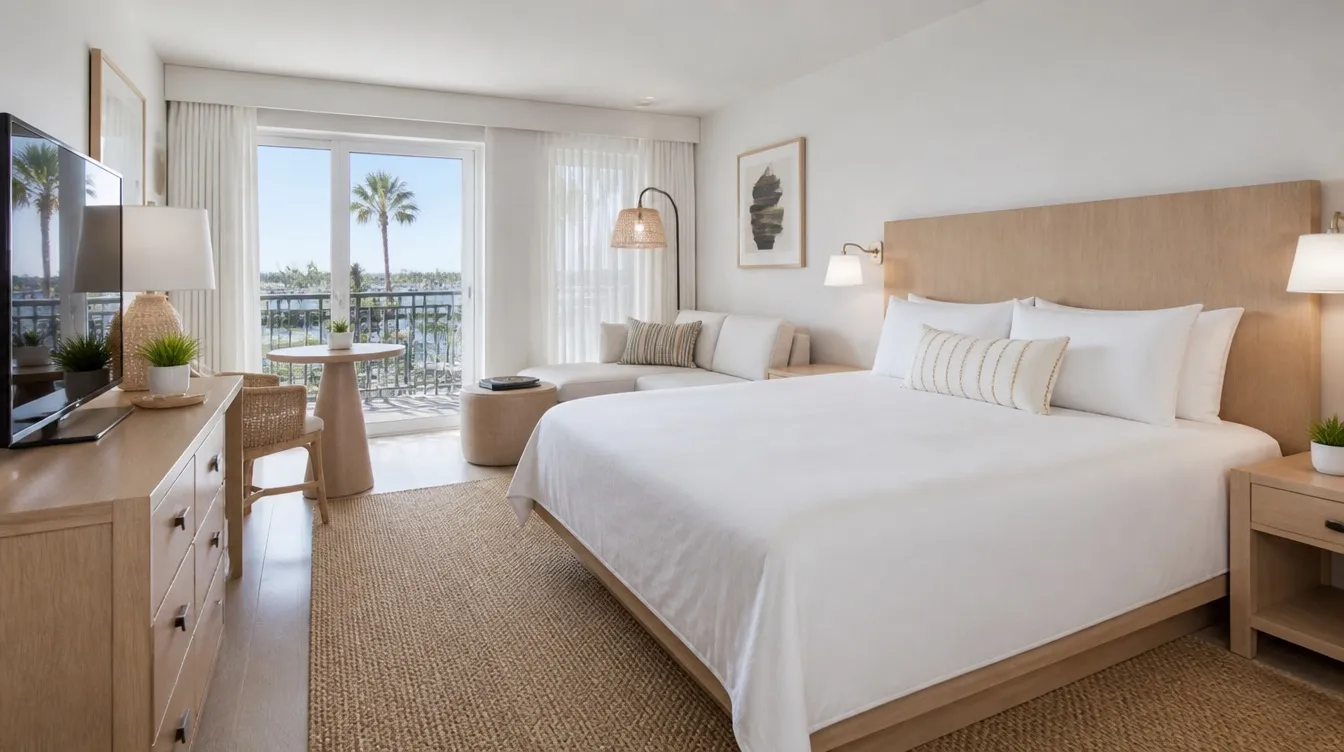
The California coastal contemporary renovation palette centers on headboards in linen, bouclé, or cane panel upholstery over light-toned frames, case goods in cerused or whitewash wood finishes, and seating groups that include an upholstered lounge chair with a contemporary profile that photographs well for OTA listings. The photography value of renovation choices has become an explicit spec criterion operators know that a guestroom that presents well in photos on Booking.com and Expedia directly affects conversion rates.
For guestroom renovation programs, headboards are the highest-visibility single piece. A statement headboard oversized, upholstered in a texture or pattern that reflects the coastal aesthetic, extending wall-to-wall or to the ceiling transforms a guestroom photography image. Properties that replace the headboard alone while keeping other case goods often achieve a significant visual improvement at a fraction of the full guestroom renovation cost. It's frequently the right partial-renovation strategy for properties with capital constraints.
Lobby and common area renovations in San Diego need to address coastal material degradation issues that have accumulated since the previous renovation. UV-faded upholstery, oxidized metal finishes, and compressed foam in high-traffic sofas and ottomans are predictable end-of-cycle conditions. Specifying replacements in UV-stable fabrics and marine-appropriate finishes from the start of the new renovation cycle extends the time before the next refresh is needed.
Managing Renovation Delivery and Installation
For any San Diego hotel renovation project, the furniture delivery and installation schedule should be part of the general contractor's master schedule not an afterthought appended to the construction schedule. Furniture arriving before floor finishes are complete creates damage risk. Furniture arriving after the soft opening date creates revenue loss.
Work with your supplier to establish a confirmed delivery window, a storage plan if the installation window is delayed by construction, and a clear escalation path if production timelines slip. San Diego's event calendar means there is usually a hard deadline that cannot flex, and suppliers who treat deadline certainty as a premium service not a default commitment are not the right partners for this market.
Tell us about your San Diego hotel renovation furniture needs and we will turn your quantities, finishes, and timeline into a firm quote. Request a quote whenever you are ready to compare.