No major U.S. city extracts more commercial value from outdoor seating than San Diego. With an average of 266 sunny days per year, mild temperatures that stay in the 60s and 70s even in winter, and a hospitality culture built around outdoor living, San Diego's restaurants, hotels, and resorts operate patio programs as primary revenue drivers not seasonal supplements. That year-round intensity means commercial patio furniture in San Diego needs to be specified to a standard that most other markets simply don't require.
The Scale of San Diego's Outdoor Dining and Hospitality Market
The scope of outdoor seating demand in San Diego spans every hospitality category. Restaurant patios along Little Italy's India Street and Kettner Boulevard stay full through December and January when comparable outdoor programs in other cities have been shuttered for months. Mission Bay's waterfront resort hotels run pool deck and marina terrace programs at full commercial capacity year-round, with furniture taking sun and salt air exposure every single day. Coronado Island's resort properties have outdoor dining terraces, pool bars, and beachfront lounge areas that collectively represent hundreds of thousands of dollars in patio furniture investment all of it exposed to coastal conditions that are genuinely corrosive to improperly specified materials.
The craft brewery taproom corridors of North Park and South Park have transformed parking lots and loading docks into beer garden programs that are among the busiest outdoor hospitality venues in the city. These environments are typically more casual in aesthetic but no less demanding in commercial terms dining chairs and communal tables in brewery beer gardens see the same cover volumes as restaurant patios but with less attentive maintenance protocols.
Hotel rooftop programs have expanded dramatically throughout the Gaslamp Quarter and the Downtown corridor. Properties with rooftop bars and lounges serving the Convention Center crowd need outdoor lounge chairs, barstools, and sofas that maintain their appearance through peak periods like Comic-Con, when occupancy and rooftop traffic are simultaneous at maximum levels.
La Jolla's restaurant row and coastal resort properties represent the premium tier of patio furniture demand. Properties here are buying pieces that need to look immaculate while positioned on cliffside terraces and ocean-facing patios where salt mist and UV exposure are at their most intense. Operators in La Jolla who have made the mistake of purchasing non-marine-grade furniture have faced rusted frames, delaminating finishes, and faded upholstery within a single season.
Material Specifications for San Diego's Coastal Environment
The coastal salt air environment in San Diego creates a specific and non-negotiable material specification hierarchy for outdoor commercial furniture. This isn't a preference issue it's a cost-of-ownership issue with clear data behind it.
Frame materials: Marine-grade aluminum (6061 alloy or equivalent) is the baseline for any property within a mile of the ocean, which includes essentially all of Mission Bay, Coronado, La Jolla, Pacific Beach, Ocean Beach, and the downtown waterfront. Stainless steel is acceptable for accent hardware and fasteners. Powder-coat finishes need to be applied over a phosphate conversion coating or similar corrosion-inhibiting primer; bare powder coat over untreated aluminum starts failing at coastal exposures within 18 to 24 months. Wrought iron and untreated mild steel are not appropriate for any outdoor application in San Diego's coastal zone.
Upholstery fabrics: Solution-dyed acrylic (Sunbrella and similar) is the commercial standard for San Diego outdoor seating. Solution-dyed means the color runs through the fiber, not printed on the surface so UV exposure bleaches the face more slowly and the color degradation is uniform rather than mottled. Quick-dry foam cores underneath outdoor cushions prevent moisture retention that leads to mold growth in high-humidity coastal conditions.
Tabletops: Teak remains a premium option for marine environments because its natural oil content provides genuine corrosion resistance, but it requires annual cleaning and oiling to maintain appearance. High-pressure laminate (HPL) on aluminum subframes is a lower-maintenance commercial alternative. Tempered glass tops work well in sheltered locations but are inappropriate for any rooftop or exposed patio where wind is a factor insurance liability alone should drive operators away from glass in those settings.
Procurement and Maintenance Planning
Commercial patio furniture in San Diego's coastal environments should be planned on a 5 to 7 year primary lifecycle with budget for upholstery replacement at years 3 to 4. Even correctly specified frames will outlast their original cushion programs in direct coastal exposure.
For hotel and resort properties planning large outdoor programs, phased delivery tied to construction completion on outdoor spaces is standard. Coordinate with your general contractor on the stage completion schedule for each outdoor area and schedule furniture delivery for each phase independently it prevents the common problem of expensive outdoor furniture sitting in staging areas exposed to construction dust and salt air for months before install.
Commercial Pool Furniture in San Diego
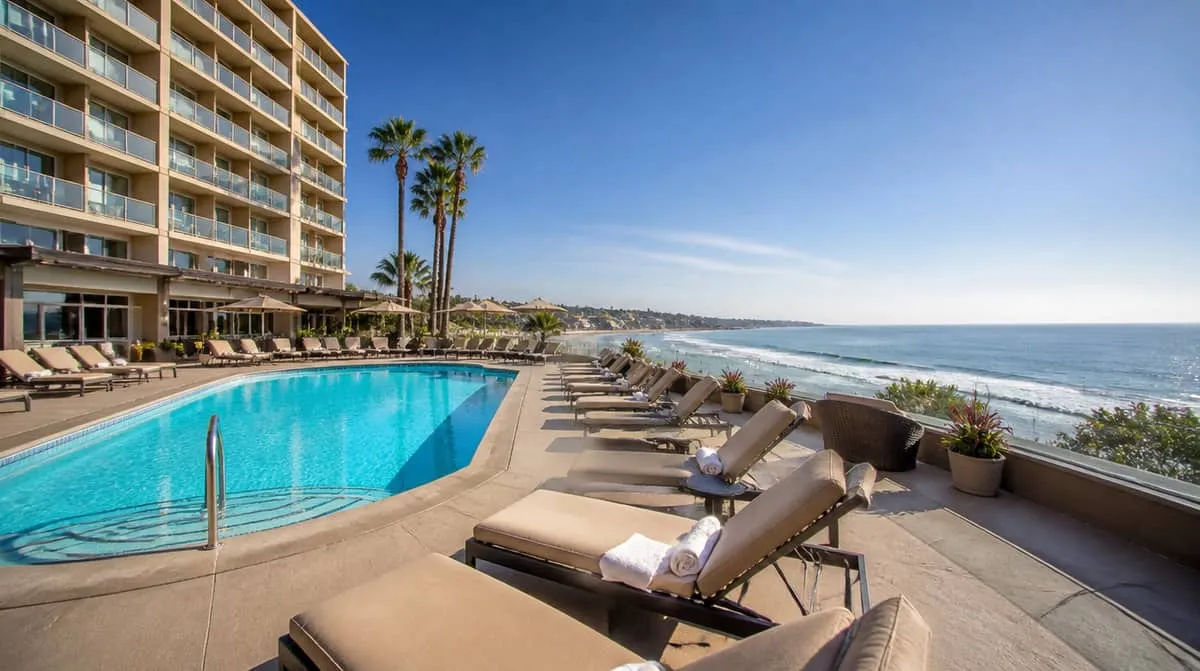
Mission Bay and Coronado resort pool decks combine two demanding conditions at once: coastal salt air and near-daily sun exposure, plus routine contact with pool chlorine. Chaise lounges for these decks need the same marine-grade aluminum frame called for elsewhere in this guide, welded rather than bolted, with a powder coat applied over a corrosion-inhibiting primer. Sling and cushion materials should be solution-dyed and quick-drying; a cushion that holds chlorinated or salt-laced moisture against the frame accelerates the exact corrosion this climate already pushes toward.
Pool deck seating around cabana and shallow-end areas sees the heaviest turnover on the property, so quick-clean surfaces matter as much as UV resistance. Sling or strap seating wipes down faster between guest changes than upholstered cushions, and it eliminates the mold risk that comes with retained moisture in a marine environment.
Browse outdoor lounge chairs built for pool deck and cabana programs, and see our commercial patio furniture guide for the full frame and fabric spec breakdown.
Tell us about your San Diego commercial patio furniture needs and we will turn your quantities, finishes, and timeline into a firm quote. Request a quote whenever you are ready to compare.
Related reading
- Commercial pool furniture in Orlando
- What is contract furniture
- Hotel furniture supplier guide
- Hospitality furniture supplier guide
- Outdoor lounge chairs
- Commercial dining chairs for patios
- Outdoor barstools
- Commercial furniture in California
Our take
Properties running more than one outdoor zone, a pool deck plus a restaurant patio plus a rooftop bar, are effectively managing three different wear environments even though the guide treats coastal exposure as a single condition. Chlorine contact from pool-adjacent seating adds a variable that a rooftop bar or a streetside restaurant patio never sees, and that difference shows up first in the frame finish and second in how quickly cushion covers need replacing.
A property with multiple outdoor zones can stagger its replacement purchasing by zone instead of treating the whole outdoor furniture program as one lifecycle. Pool deck sling and cushion seating, already flagged as the fastest-turnover category because of combined chlorine and salt exposure, can reasonably be budgeted on a shorter cycle than a covered rooftop lounge area that sees UV but not the same moisture load, even on the same property.
The bottom line: Multi-zone coastal properties get more useful lifecycle planning by tracking pool deck, patio, and rooftop programs as separate replacement schedules rather than a single lifecycle clock for the entire outdoor furniture investment.