A claims executive flies into Bradley International, takes the forty-minute ride down I-91, and checks into a downtown Hartford hotel two blocks from the home office of the insurer she is there to meet. She has spent her morning in an airport terminal and her afternoon will be spent in a conference room. The lobby she walks through in between is the only part of her day that is not scheduled, and for those ninety seconds, the furniture she sits in while waiting for a colleague is doing the job of telling her what kind of property this is.
That moment carries real weight in Hartford's hotel market. This is a city built on the insurance industry, with a downtown corporate travel base that moves through lobbies year-round regardless of season, layered on top of a convention and event calendar centered on the Connecticut Convention Center and the XL Center that brings a different kind of volume through the same rooms. Your lobby furniture is working across both patterns at once, and how it holds up under each is a direct business variable, not a design afterthought.
Hartford's Market Segments Demand Different Things From the Same Room
Hartford's hospitality market splits along lines that matter directly for furniture specification. The downtown properties serving the insurance corridor around Asylum Hill and the financial district face a different daily-use pattern than the boutique hotels and inns near West Hartford Center and the Elizabeth Park neighborhood. Both segments require contract-grade construction, but the use case and the design expectation are different enough to change what you should specify.
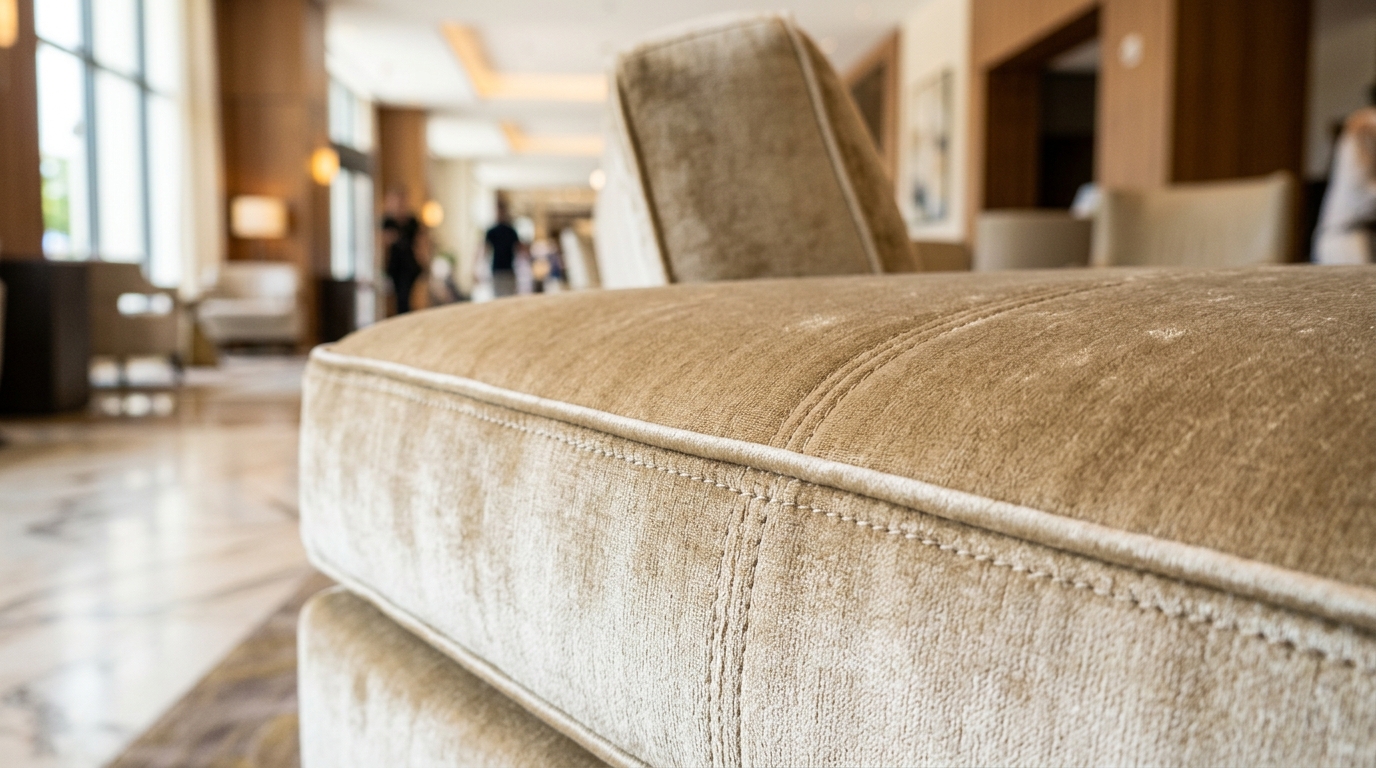
Downtown business hotels serving the corporate travelers who move through Hartford for meetings at the insurance and financial services headquarters, along with the properties absorbing Connecticut Convention Center and XL Center event traffic, are managing a lobby that rarely goes quiet. Weekday mornings bring a wave of business check-outs before eight, and event weeks at the convention center or a concert night at the XL Center can double the lobby's normal traffic inside a few hours. At that kind of steady, year-round volume, upholstery fabric, frame joinery, and glide hardware are all being tested constantly rather than seasonally. Furniture that looked sharp at opening will show fabric wear, loose joints, and worn glides within eighteen months if it was not specified for this level of daily use. Contract-grade kiln-dried hardwood or steel frames, high-resilience foam rated for commercial use, and performance textiles rated well above 100,000 double rubs are the baseline here, not an upgrade.
The boutique inns and design-forward small hotels near West Hartford Center and along the Farmington Avenue corridor are managing a different expectation entirely. Guests booking these properties are often visiting nearby colleges, attending a wedding, or choosing Hartford's leafier west side deliberately over a downtown business tower. They have already looked at the photos, and the lobby furniture is part of a specific, curated impression rather than a functional waypoint. Pieces that read as generic catalog selections undermine that impression quickly. Durability still matters just as much in this segment, but the design judgment behind the specification carries equal weight with the construction quality.
What Hartford's Climate Actually Does to Lobby Furniture
Connecticut's climate is a real durability variable that operators sometimes underweight when specifying lobby furniture. Hartford runs a full four-season cycle, with winters that bring snow, road salt, and sustained cold from December through March, and summers that get genuinely humid from June through August. That combination means lobby furniture in Hartford is absorbing two very different seasonal loads within the same calendar year, not one steady condition.
Winter is the harder test. Guests walk in tracking snowmelt, salt residue, and moisture on their boots and coats, and that moisture ends up on chair arms, ottoman tops, and the base of upholstered seating near the entry. Upholstery that is not rated for moisture and stain resistance will show discoloration and foam breakdown at the contact points first, usually within a season or two if the fabric was under-specified. Frame hardware matters just as much. Metal components that are not properly finished or sealed can show corrosion faster in a climate where salt is tracked indoors for months at a stretch, which is a detail that gets missed when furniture is sourced for looks rather than for New England's actual weather pattern.
Summer humidity creates the second challenge, and it is the same issue Atlanta and other humid-summer markets deal with, just compressed into a shorter window. Solid hardwood or steel frames with reinforced corner blocking handle Hartford's expansion-and-contraction cycle between a dry winter interior and a humid summer one far better than particleboard components, which absorb moisture and swell over repeated seasonal shifts. In a lobby that gets reconfigured for a corporate event, an insurance conference reception, or holiday programming tied to the downtown calendar, frame integrity under that kind of repeated movement is a practical requirement, not a nice-to-have.
Designing for the Arrival Experience in Hartford's Signature Districts
The lobby arrival sequence plays out the same way whether an operator plans it or not: guests register the primary seating cluster first, then the front desk, then the path toward the elevators. Every piece in that sequence is communicating something before a single staff member says hello.
In the downtown core near Bushnell Park, the Wadsworth Atheneum, and the corporate towers along Asylum Hill, the guest profile leans heavily toward business travelers and conventioneers who have seen a great many hotel lobbies and register quality quickly. Furniture that reads as right here has clean lines, upholstery that holds its shape through daily use, and a scale that fits rooms which often carry the proportions of older, architecturally significant buildings converted for hospitality use. A lounge chair in a textured neutral fabric, properly scaled to the room's ceiling height, communicates the same quiet competence as an efficient check-in process.
West Hartford Center properties are competing on a different register. This is one of the region's more affluent and design-conscious neighborhoods, and guests booking a boutique property here are used to a certain level of finish in their daily lives. Lower-profile lounge seating with tailored backs, leather or leather-alternative accents, and side tables in materials that reference wood or stone rather than laminate read as appropriate to that context. Furniture that looks like a standard national-brand package signals a mismatch against both the rate and the neighborhood.
For properties near the Connecticut Convention Center and the XL Center, the priority shifts toward efficient movement. Guests arriving after a long event day or an early morning flight into Bradley want to orient quickly and get to their room. Lobby furniture in that setting needs seating clusters that do not create bottlenecks between door, desk, and elevator, chairs that are easy to exit without difficulty when someone is managing luggage or convention materials, and configurations that can be cleared or rearranged when the property hosts a reception or meeting during a busy convention week.
Procurement Timing and Hartford's Renovation Cycle
Hartford's hotel stock skews toward established downtown properties undergoing renovation cycles rather than a wave of ground-up new builds, alongside steady refresh activity at the boutique and independent inns further out toward West Hartford and the suburbs. That mix creates its own planning pressure around furniture procurement, since renovation work at an operating property has to be sequenced around occupancy rather than a clean pre-opening schedule.
Contract-grade furniture is built to order. Standard commercial pieces typically run eight to twelve weeks lead time from confirmed specification, and custom or semi-custom work, COM fabric programs, frame modifications, non-catalog finishes, adds coordination time on top of that. Renovation projects that leave furniture procurement until late in the schedule tend to run into the same problem twice over: the property loses usable rooms or lobby space longer than planned, and the furniture that does arrive on time is rarely the furniture that should have been ordered.
If a property's renovation is timed around a slow season, a convention center event block, or an insurance industry conference calendar that drives predictable occupancy swings, those lead times need to be built into the project timeline from the start. The cost of running with placeholder furniture through a soft opening, measured in guest review scores, staff time spent managing complaints, and the capital expense of a second purchase cycle inside a year or two, is consistently higher than the cost of getting the specification right the first time.
Working with a supplier who gives clear, honest lead time commitments, who understands hospitality projects at a property's specific volume and rate category, and who can run COM programs for operators with a defined material story, is worth more than a marginally lower unit price from a vendor treating a hotel lobby order like a retail transaction. Hartford's market rewards that kind of discipline, since the difference between lobby furniture that confirms a guest's decision to book and furniture that quietly introduces doubt is a revenue question, not just an aesthetic one.