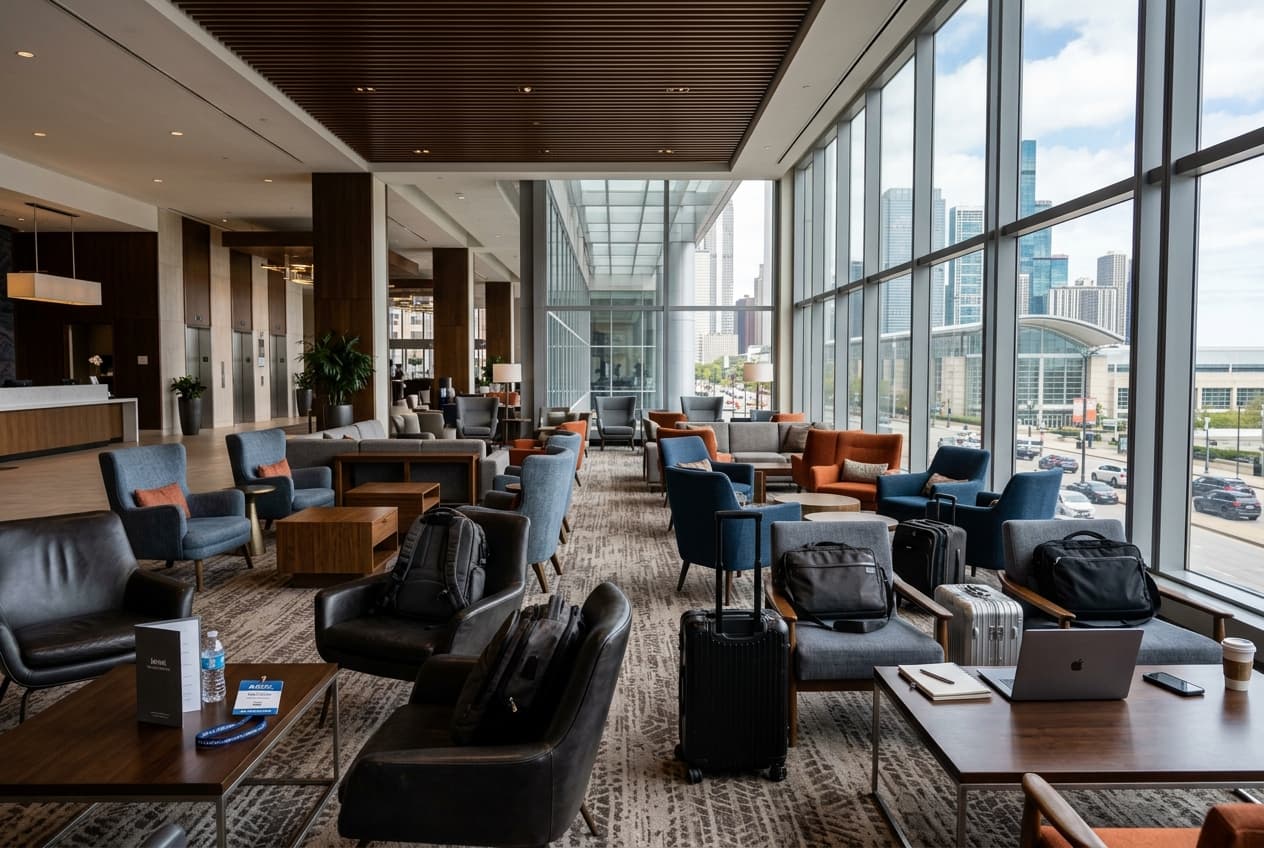
A Principal Financial vendor checks out of a downtown Des Moines hotel on a Thursday morning, rolling a bag past the front desk while three conventioneers from an Iowa Events Center trade show argue over rideshare pickup points in the same twelve feet of lobby. An hour later, a family driving through on the way to the Iowa State Fair drops a diaper bag on the arm of a lounge chair while they figure out parking. That is a normal Thursday for a Des Moines hotel lobby, and the furniture in that room is absorbing all three of those moments without a break in between.
Des Moines runs a corporate travel calendar that is unusually steady for a metro this size. The insurance and financial services cluster headquartered downtown, Principal, Nationwide, Wellmark keeps business travelers moving through the market year-round, and the Iowa Events Center and downtown convention hotels handle a rotating schedule of trade shows, agricultural conferences, and state association meetings. Layer in the seasonal surge around the Iowa State Fair in August and the steady flow of Drake University and state government visitors, and you have a lobby that needs to perform at commercial volume every week of the year, not just during a defined peak season.
Des Moines's Market Segments Demand Different Things From the Same Room
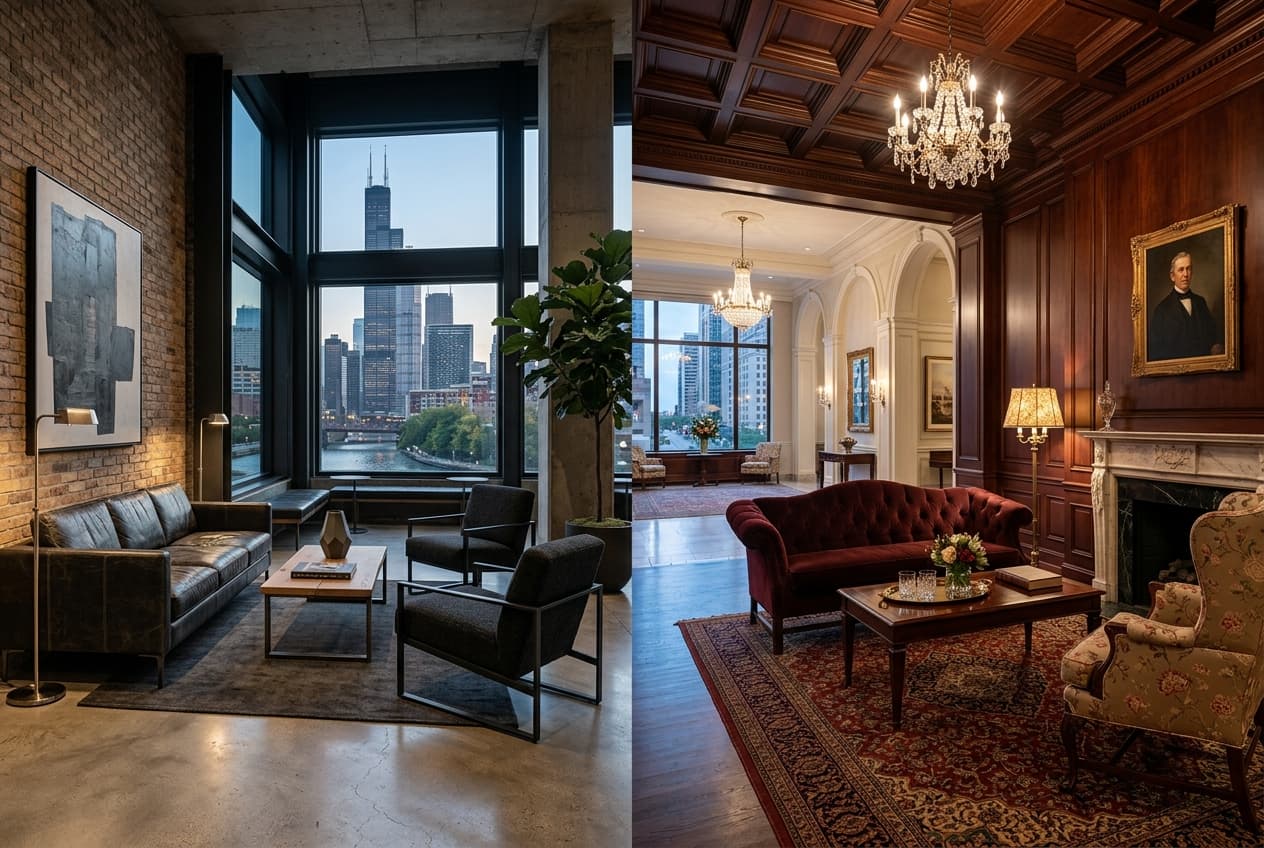
Des Moines's hospitality market splits along lines that matter for how you specify furniture. The convention and corporate hotels clustered downtown near the Iowa Events Center and the Western Gateway are managing a different durability problem than the boutique properties opening in the East Village and around Court Avenue. Both segments need contract-grade construction underneath, but the design brief on top of that foundation is not the same, and treating them identically produces furniture that underperforms in one direction or the other.
Downtown convention hotels serving the Iowa Events Center, the corporate travel base tied to the insurance and financial services sector, and the state association meeting circuit are managing lobby traffic that runs heavy and steady rather than in isolated peaks. A 300-room downtown property can turn its lobby over several times during a single trade show move-in, and the furniture has to survive that churn week after week without visible wear. Kiln-dried hardwood frames, high-resilience foam built for commercial cycling, and performance upholstery rated above 100,000 double rubs are the baseline here, not an upgrade tier. Furniture specified below that standard shows fabric pilling, loose joinery, and worn arm surfaces well before the replacement cycle a property budgeted for.
Boutique properties in the East Village and around Court Avenue are competing on a different story. Guests booking these properties have already looked at the photos and chosen the hotel for what the design communicates, not just for proximity to a meeting. Furniture that reads as generically commercial, the kind that could belong in any airport hotel, undermines the argument the property is making about itself. Durability still matters just as much here, but the visual judgment behind the specification, scale, silhouette, upholstery texture, carries equal weight with the construction underneath it.
What Iowa's Winters Actually Do to Lobby Furniture
Iowa's continental climate is a real durability variable that gets underweighted when hotels specify lobby furniture. Des Moines winters bring sustained cold, road salt, and snow that guests track in on boots and bag bottoms from November through March, followed by a humid summer that runs the other direction. Lobby furniture near entrances is absorbing salt residue, melted snow moisture, and temperature swings between a cold vestibule and a heated lobby, all in the same piece of upholstery.
Performance textile specification is the direct answer to that exposure. Upholstery that is not rated for moisture and stain contact shows salt staining and fabric degradation first at the base of chair legs and on seat cushions closest to the entrance, exactly where winter traffic concentrates. Stain-resistant, cleanable fabric treatment is a baseline call for Des Moines hotel lobbies, not an optional upgrade, and it matters most on the pieces positioned within the first twenty feet of the door.
Frame construction carries the same logic. Solid hardwood or steel frames with reinforced corner blocking hold up to the humidity swing between a Des Moines summer and the dry heated air of a Des Moines winter interior, a cycle that stresses joinery more than a stable climate does. Particleboard components absorb that moisture variation and swell, loosening joints faster than the finish shows it. In a lobby that gets rearranged for a trade show reception or a state association banquet setup, frame integrity under repeated repositioning is a practical requirement, not a nice-to-have.
Designing for the Arrival Experience in Des Moines's Signature Corridors
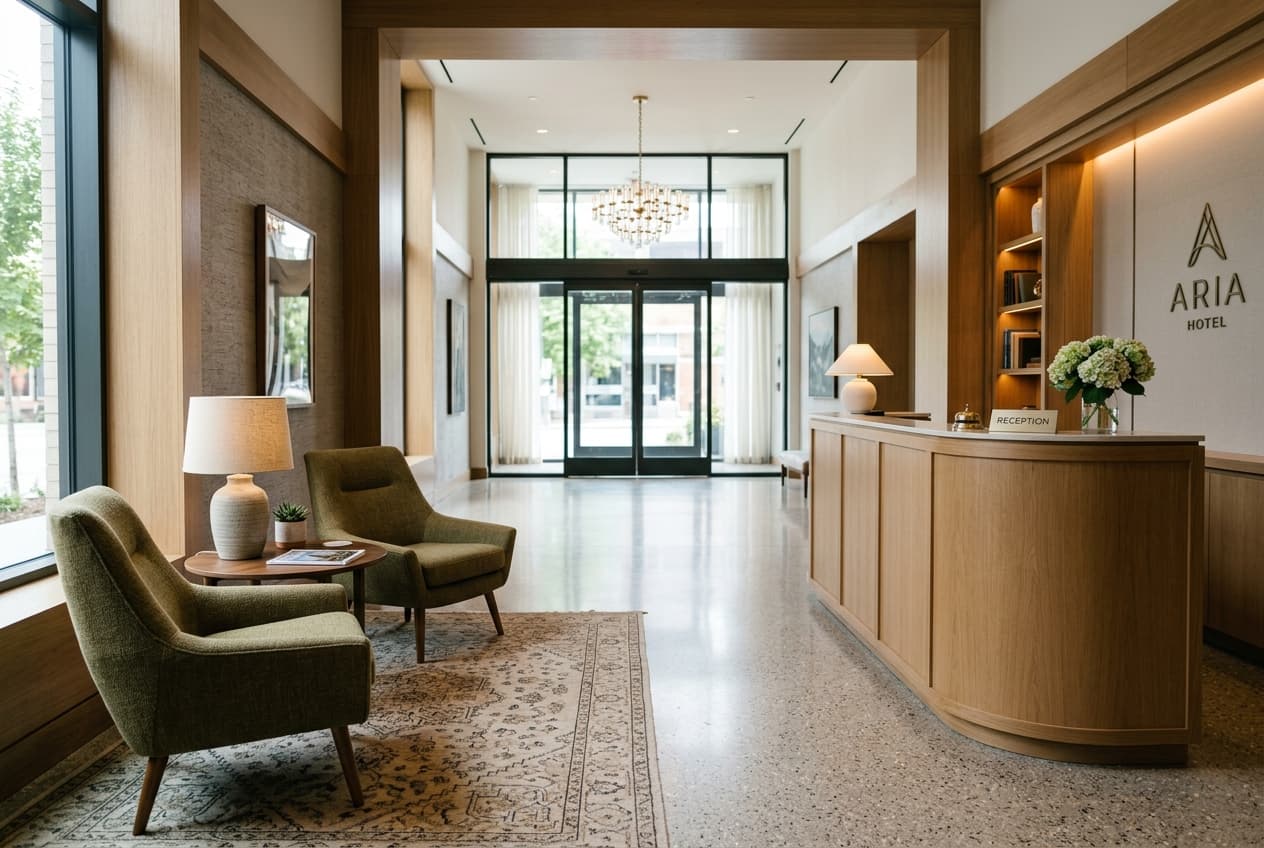
Guests process a lobby in a fixed sequence whether a property plans for it or not: the seating cluster first, then the front desk, then the path toward the elevators. Every piece in that sequence is communicating something before a staff member says a word.
In downtown properties along the Western Gateway and near the Iowa Events Center, the guest base skews corporate and convention-heavy, insurance industry travelers, trade show attendees, state government visitors who have checked into a lot of lobbies before. Furniture that reads as right here has clean lines, upholstery that holds its shape through daily use, and a scale proportioned to the room rather than furniture that looks bought to fill square footage. A well-scaled lounge chair in a durable neutral fabric signals the same thing a smooth check-in process does: this property is run with intention.
East Village and Court Avenue boutiques are working a different register. These neighborhoods have become the design-forward core of the metro, drawing guests who have chosen the property specifically for its character rather than its proximity to a highway exit. Lower-profile lounge seating, wood tones and materials that reference the corridor's converted-warehouse architecture, and side tables that avoid a laminate, big-box look all read as intentional in that context. A standard national-chain furniture package looks like a mismatch against both the neighborhood and the rate.
Procurement Timing for Des Moines's Renovation and Opening Calendar
Des Moines has seen steady downtown hotel development and renovation activity, driven by both new construction near the convention core and adaptive reuse projects converting older downtown buildings into boutique hospitality. That activity puts real pressure on furniture procurement timelines.
Contract-grade furniture is built to order, and standard commercial lead times run eight to twelve weeks from confirmed specification. Custom or semi-custom pieces, COM fabric programs, frame modifications, non-catalog finishes, add coordination time on top of that baseline. Properties that leave furniture decisions until late in a construction or renovation schedule consistently end up with the wrong pieces arriving on time, or the right pieces arriving late.
If a property's opening or renovation is tied to a specific Iowa Events Center booking calendar, a State Fair season surge, or an insurance industry conference commitment, those lead times need to be built into the project schedule from day one. The cost of opening with placeholder furniture and replacing it within the first year, in review scores, in staff time, in a second capital expense, is higher than the cost of getting the specification right the first time. Working with a supplier who commits to real lead times, understands hospitality volume at your property's rate category, and offers COM programs for teams with a specific material direction is worth more than a marginally lower unit price from a vendor treating a hotel order like a retail transaction.