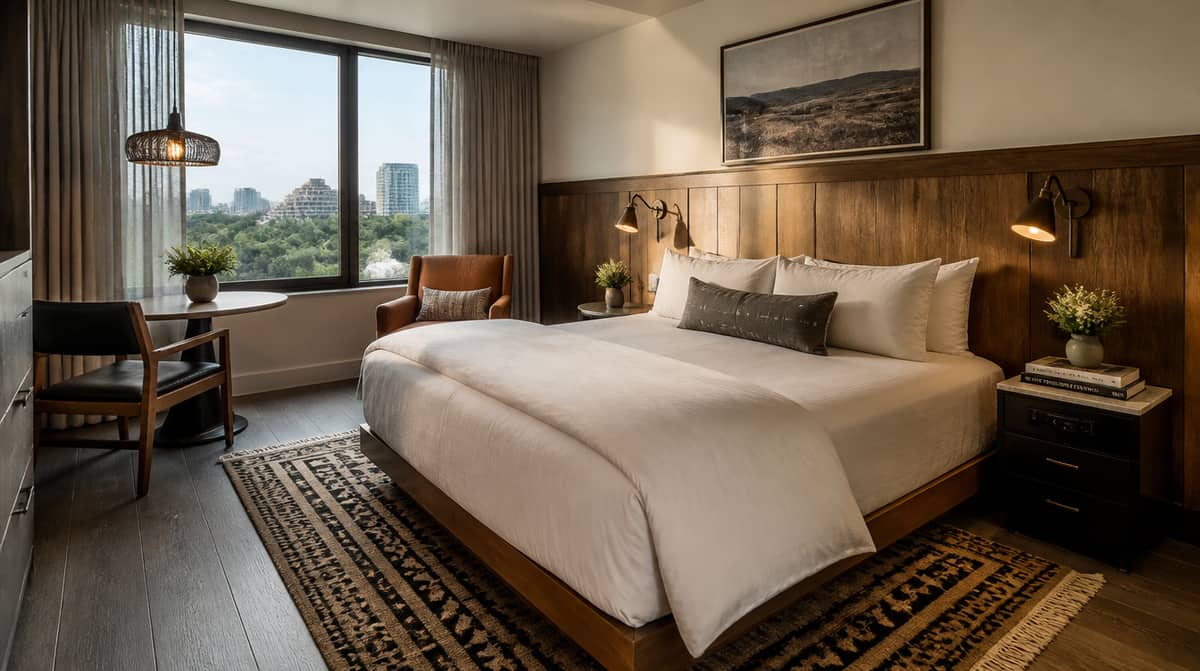
Cheyenne's hospitality market is smaller than a major metro but far more concentrated in its demand cycles than most people expect. You have the interstate corridor properties along I-25 and I-80 built for a constant stream of long-haul freight drivers, road-trippers, and business travelers passing through the crossroads of the region. You have the historic downtown district near Depot Plaza and the Cheyenne Depot Museum drawing visitors who want a walkable, character-driven stay. You have steady government and military demand tied to F.E. Warren Air Force Base just west of town. And you have Cheyenne Frontier Days every summer, ten days that push every property in the city to full occupancy and stress-test every piece of furniture in the building. If you are sourcing furniture for a hotel project anywhere in the Cheyenne area, here is what that market actually requires from your supply chain.
What Makes Cheyenne Different for Hotel Furniture Sourcing
Cheyenne is a crossroads city, and that shapes everything about how its hotel furniture gets used. Cheyenne Regional Airport and the I-25/I-80 interchange feed the market with a mix of long-haul commercial travelers, government and military personnel, and leisure guests whose volume shifts dramatically depending on the season. A limited-service property off the interstate near the truck stops operates with different durability assumptions than a boutique stay near the historic Depot or a select-service hotel closer to the base. Your furniture supplier needs to understand those distinctions, not just quote you from a catalog.
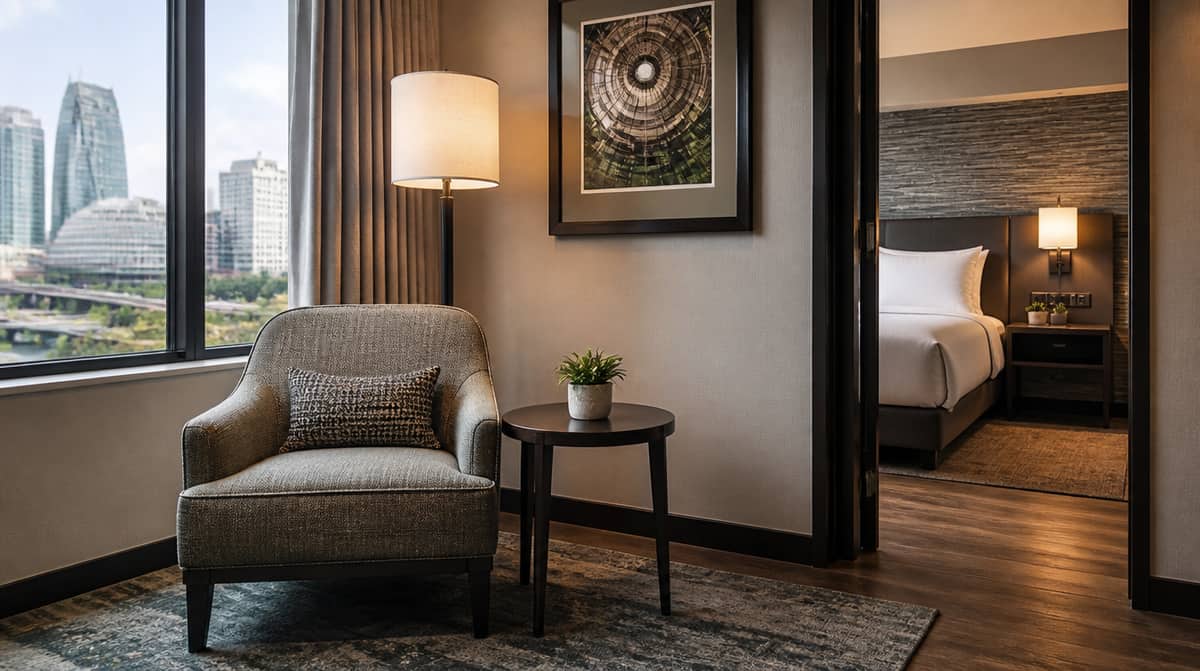
Cheyenne Frontier Days is the single biggest driver of wear cycles in this market. For ten days every July, the city's population effectively doubles with rodeo fans, concertgoers, and vendors, and every hotel room within twenty miles fills to capacity. Furniture in those rooms and lobbies gets used harder in that stretch than in the rest of the year combined. Soft goods take a beating from dust, boots, and constant turnover. Casegoods absorb more impact damage during Frontier Days week than most residential furniture sees in years. If you are sourcing for a property that leans on that event, durability ratings are not optional. Ask your supplier for the actual specification data, foam ILD ratings, fabric Martindale rub counts, frame material and joinery documentation. If they cannot provide that, keep looking.
Properties tied to F.E. Warren Air Force Base and the state government presence downtown sit at a different point in the spec conversation. Government per diem travel and long-term contractor stays call for furniture that holds up to consistent, unglamorous daily use over years rather than short bursts of heavy traffic. A hotel furniture supplier in Cheyenne who only understands one tier of this market, either the event-driven interstate volume or the steady government and business travel base, is going to leave gaps, whether you are spec'ing a property near the rail yards or a boutique hotel downtown.
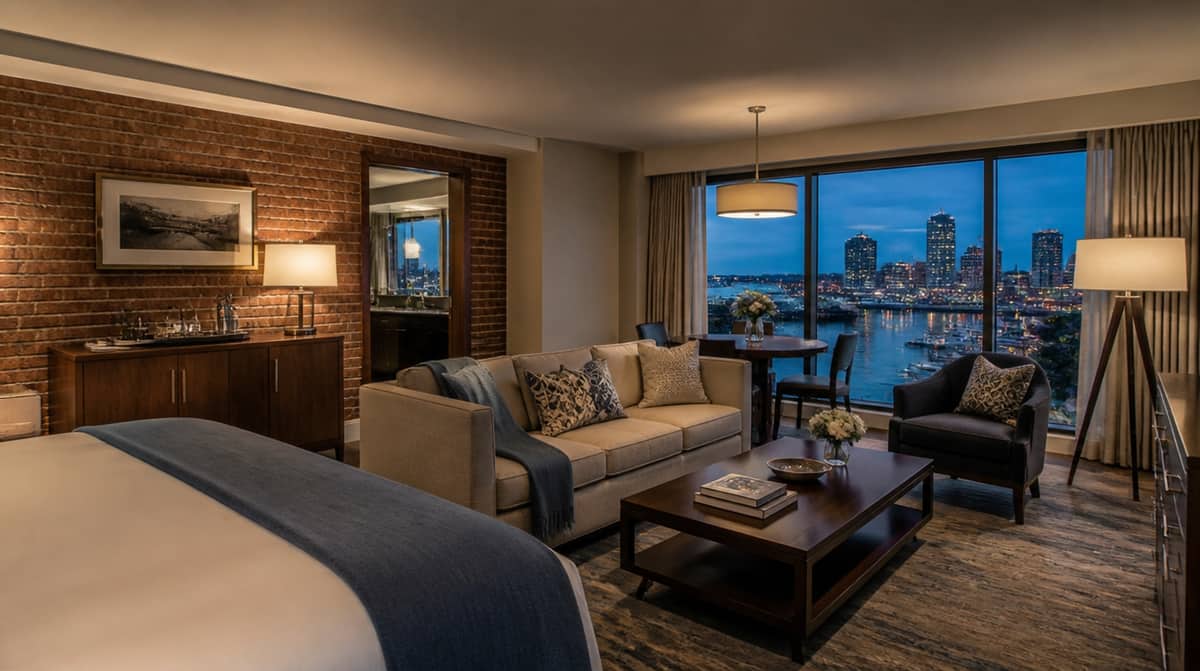
Why Contract Grade Matters in This Market
This is the conversation that saves you money over time even when it costs more upfront. Retail furniture is engineered for residential use, light daily use, careful handling, the assumption of periodic replacement as a style decision. Hotel furniture lives in a fundamentally different environment.
A lobby chair at an interstate-corridor Cheyenne property might be occupied by a different long-haul traveler every few hours, week after week. A guest room bed frame gets shifted by housekeeping staff multiple times daily. Drawer hardware in a downtown property near the Depot gets opened and closed under far more use cycles in a month than residential hardware sees in a year. When retail furniture fails in those environments, and it does fail, faster than you expect, the consequences are not just a replacement order. They are liability exposure, maintenance budget overruns, and the kind of guest experience failure that ends up in a review before the guest has left the building.
Contract-grade furniture from a qualified hotel furniture supplier meets BIFMA standards or equivalent hospitality certification benchmarks that retail products are never subjected to. The frame construction is reinforced for commercial load cycles. The finishes are tested for durability under institutional cleaning protocols. The foam and fabric specifications are chosen specifically for longevity under heavy use. The price difference between contract and retail product pays for itself before the end of the first replacement cycle in almost every hospitality application. Ask your supplier for documentation. If they hesitate, that tells you everything you need to know.
Lead Times, Logistics, and Getting the Timeline Right
Cheyenne hotel projects run on calendar pressure that is more predictable than in a larger metro, but no less strict. A property near the interstate racing to finish a renovation before Frontier Days week has a hard, unmovable deadline. A downtown boutique property near the Depot is often working within a historic building shell where construction access is limited and phasing has to work around the structure itself. A base-adjacent property cycling through a room refresh is coordinating around occupied floors where guest disruption is not acceptable.
In every one of those scenarios, lead time is the variable that determines whether you hit your target date. Standard lead times from contract furniture suppliers run 10 to 16 weeks for domestic production. Import orders stretch to 20 weeks or longer once you factor in shipping, customs, and any port delays. That math is not flexible when you are trying to finish before the busiest week of the Cheyenne calendar or hit a financing draw tied to substantial completion.
Lock your furniture specs at the same time you finalize interior design drawings. This is not a suggestion that sounds good in theory, it is the specific decision that separates hotel openings that go smoothly from ones that do not. A supplier worth working with in Cheyenne will turn around physical samples fast enough to keep your design and ownership review process moving, offer phased delivery sequencing for larger projects, and raise lead time risks early enough that you can act on them. They should be coordinating directly with your general contractor, not waiting for you to bridge that communication.
Minimum order quantities matter on Cheyenne projects, particularly for the independent and limited-service properties that make up most of the local inventory, often furnishing 50 to 100 rooms rather than several hundred. Most contract suppliers set MOQs at the piece level by category, 20 to 50 units per SKU is common for upholstered pieces, with more flexibility on casegoods. Custom fabrics and custom finishes almost always trigger higher minimums. Understand the MOQ structure before you get deep into the spec process. That conversation is far easier before you have spent weeks selecting samples.
How to Evaluate a Hotel Furniture Supplier in Cheyenne
Start with their actual project history across the Wyoming and greater Rocky Mountain region. A supplier with completed installations in Cheyenne across multiple property categories, interstate corridor, downtown historic, base-adjacent, understands the aesthetic range and the operational demands this market places on furniture. Ask for references from projects comparable to yours in scale and budget, then call those references.
Logistics capability is as important as product quality. Cheyenne is a smaller market, but hotel deliveries here still involve coordinating around high-wind weather windows, working within general contractor timelines, and in some cases getting freight in and out of a historic downtown footprint with limited loading access. A supplier with in-house white-glove delivery and installation experience in commercial environments handles those constraints before the truck leaves the warehouse. A supplier who ships freight and outsources the final mile to a third party may not, and you feel that gap on installation day when something goes wrong.
Ask how they work within the broader project team. Most Cheyenne hotel renovations run through an interior design firm or a dedicated FF+E project manager, even on smaller-scale projects. A supplier who has established working relationships with the regional design and PM community is better positioned to keep your project on spec and on schedule. Communication breakdowns between the supplier, the design team, and the GC are how projects lose weeks. A supplier embedded in that ecosystem prevents them.
The right hotel furniture supplier in Cheyenne is not a vendor you transact with once and move on from. In a market this concentrated, where Frontier Days demand, interstate travel volume, and the steady government and military presence are all shaping the same limited inventory of rooms, they are a project partner. Evaluate them that way before you sign a purchase order.
Related reading
- Commercial hotel furniture: a sourcing guide for every space
- Boutique hotel furniture: specifying a distinctive, durable look
- What is contract furniture
- Commercial furniture vs retail
- Hospitality furniture supplier guide
- Hotel lounge chairs
- Hotel headboards
- Browse full catalog
- Commercial furniture in Wyoming