
A dining room running two or three full table turns a day repeatedly moves chairs and cleans surfaces between parties. Record those conditions in the furniture brief. Turn count is useful context, but it cannot predict a failure date or establish that one restaurant segment wears furniture faster than every other segment.
What actually breaks first under high turn volume
Inspect joints, fasteners, glides, upholstery and finishes as separate wear points. Chairs may be pulled, pushed and bumped repeatedly during service. Ask the manufacturer how the complete chair is tested for the intended use and which inspection or tightening procedures apply. Welded frames, mortise-and-tenon joints and screwed assemblies vary in design; none establishes a guaranteed number of years by itself.
Frame construction for high-cycle use
For metal frames, request the material and joint specification and applicable whole-chair test evidence. For wood frames, review the joinery, reinforcement and maintenance instructions. Compare the actual construction and test documentation rather than making a thin-gauge, continuous-weld or corner-block feature a universal pass/fail rule.
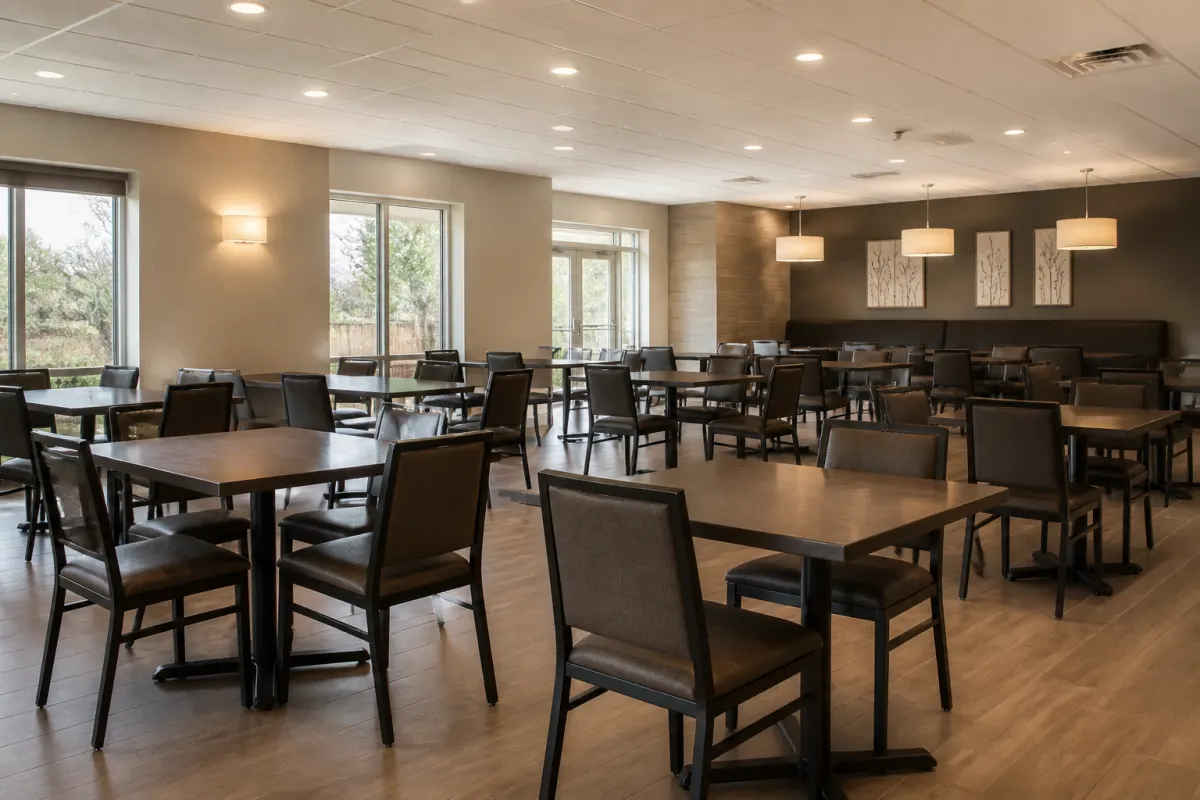
Finishes that hide wear
High-turn service brings repeated contact with trays, cleaning cloths and food spills. Review finish samples under your dining-room lighting and test the supplier-approved cleaning procedure on a sample. Texture, color and sheen may change how marks show; darker or matte finishes do not invariably hide wear better than every light or gloss finish.
Cleaning speed as a spec requirement
Trial the cleaning process on the proposed seat and table finish between services. Ask for compatibility with the actual products, dwell times and wiping procedure. Simple profiles can reduce places where crumbs collect, but a performance-fabric label does not make a surface non-porous or prove quick cleaning. Compare cleanability and staff handling using the actual sample rather than prescribing one material for every concept.

Replacement part strategy
Plan compatible replacement seats, glides and tops before ordering. A five to ten percent spare allowance can be a planning scenario, not a universal requirement; choose quantities from storage capacity, observed damage and confirmed reorder times. Track wear by location and investigate traffic, cleaning and installation as well as possible product defects.
Choosing between reupholstering and replacing
Compare a reupholstery quote with a complete replacement quote after the frame is inspected. Include foam, labor, transport, downtime and warranty implications. Repair may be useful when the frame and replacement components remain suitable, but it is not always cheaper and no fixed upholstery cycle follows from turn count alone.
Ordering with high-turn volume in mind
Give prospective suppliers the actual turn rate, covers, cleaning routine and handling conditions along with seat count. Ask them to explain how their proposed configuration addresses those requirements and what evidence supports the recommendation.
Chair and table weight as a proxy for durability
Furniture weight is useful for staff handling and storage planning. It is not a reliable standalone durability test: geometry, material, joints and the complete design all matter. Compare manufacturer specifications and applicable testing; picking up two similar chairs can help assess handling but cannot establish which will last longer.
Booth and banquette considerations at high turn volume
Booths and banquettes have different contact patterns because guests slide across a fixed seat. Ask for the exact upholstery specification, seam construction and compatibility with your cleaning products. Marine-grade vinyl, double stitching or welting alone does not establish longer life. ACT's guidance explains why abrasion results also need application, maintenance and other performance context.
For durability specs across the broader restaurant furniture category, see our bar and restaurant furniture guide.
Get a durability-matched quote
Include covers per day, turn rate, cleaning products and repair priorities when you request a quote. Relevant independent suppliers can use that brief to propose options and explain their documentation.