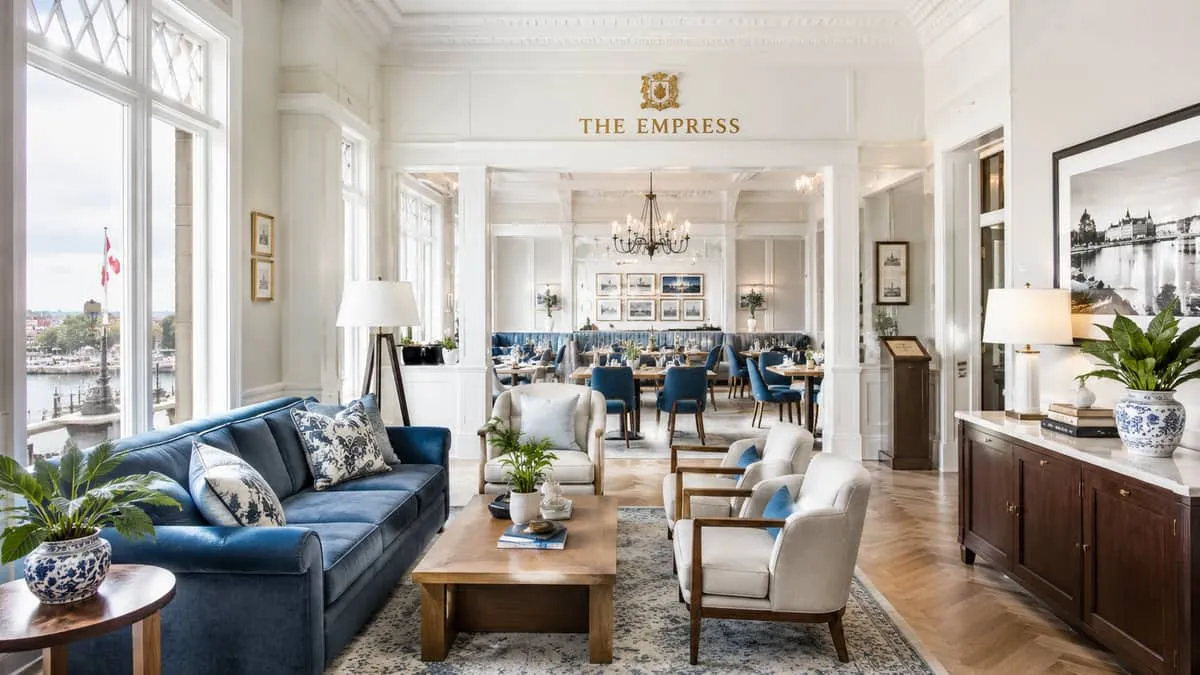
Victoria's boutique hotel market is being built inside old bones. Former bank buildings on Douglas Street, Edwardian rooming houses near the Inner Harbour, century-old merchant blocks in Chinatown , these structures are being converted into the kind of intimate, atmosphere-heavy properties that Victoria's tourism economy rewards. Visitors are not coming to this city for a generic hotel experience. They are coming for the Fairmont Empress afternoon tea, the Legislature lit up at night, a whale-watching departure from Fisherman's Wharf. The hospitality properties that succeed here understand that the building itself is part of the product.
That creates a procurement challenge that most mainland furniture suppliers are not equipped to solve. FF&E for a heritage conversion in Victoria is not the same exercise as furnishing a purpose-built hotel tower in Vancouver's Coal Harbour. The rooms are shaped differently, the heritage boards have opinions, the finishes need to read as period-appropriate without looking theatrical, and everything still has to cross a body of water to get here. This guide covers how experienced procurement teams actually work through those constraints.
Heritage Buildings Reward Sourcing Discipline
The wave of boutique hotel conversions happening in Victoria's Old Town, James Bay, and the blocks surrounding the Inner Harbour all share a common thread: the buildings were designed for a different purpose, and no two rooms are quite the same. A converted Edwardian office building might have guestrooms that vary by twelve inches in width from floor to floor because the original construction accommodated structural columns differently on each level. A heritage home converted to a small inn in Rockland might have doorframe openings that are two inches narrower than any standard case goods manufacturer assumes.
This is where FF&E procurement for a Victoria heritage project diverges sharply from a standard hospitality fit-out. You cannot pull a specification sheet from a previous project, issue purchase orders, and assume the furniture arrives and installs cleanly. Every room type needs to be field-measured, not just once but with the actual furniture dimensions verified against the actual opening sizes before anything goes on order.
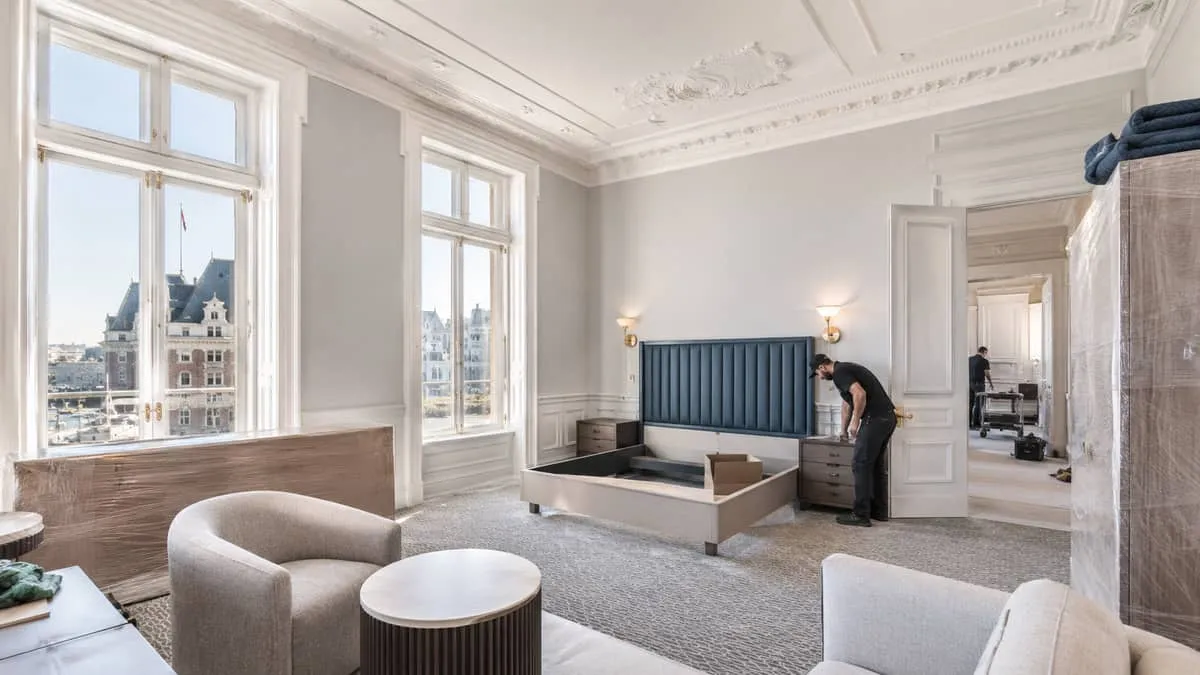
The practical implication is that your procurement timeline needs to front-load the measurement and specification phase. Heritage buildings surprise you. Once you have confirmed room-by-room dimensions, you can identify where standard product works, where you need modified sizing, and where custom fabrication is unavoidable. Getting that picture clear at week sixteen rather than week four saves the schedule.
What Heritage Boards Actually Care About (and How It Affects Your FF&E Spec)
Victoria has more registered heritage properties than any other city in BC. Properties undergoing conversion that fall under heritage designation , whether through the City of Victoria's Heritage Register or BC's provincial designation system , typically require Heritage Alteration Permits for significant interior changes. The scope of board review varies by designation level, but for higher-tier designated properties, the interior FF&E choices can come into the conversation.
In practice, heritage board review for interior FF&E usually focuses on a few specific areas. Window treatments that alter the perceived character of windows visible from the street can draw scrutiny. Built-in millwork or furniture that attaches to or modifies heritage fabric , original wainscoting, plaster cornices, period tile , will be reviewed. And in some cases, the board will want assurance that furniture choices are contextually appropriate for the building's designated period.
This does not mean your guestrooms need to look like museum displays. Modern operators and heritage boards in Victoria have reached a working understanding that boutique hotels need to function as contemporary hospitality businesses. What the board is protecting is authenticity of character, not literal reproduction of original contents. The practical effect for your FF&E specification is that you want to be able to articulate the design rationale for your furniture choices, particularly for any built-in or semi-permanent elements. A procurement team that has navigated Victoria heritage projects before will have that language ready.
For portable furniture , guestroom seating, case goods, dining chairs , the board typically has no jurisdiction. Your choices there are driven by design intent, durability requirements, and budget, not heritage compliance. But the design intent for a building on Humboldt Street or a property in the Harris Green neighbourhood will naturally push toward finishes and silhouettes that feel compatible with the building's era. That is not a constraint. It is the brief.
The Sourcing Challenge No One Talks About: Period-Compatible Contract Grade
The intersection of heritage-appropriate aesthetics and genuine contract-grade durability is where Victoria procurement projects either succeed or compromise. The wrong approach is to source decorative furniture from a retail or hospitality décor supplier and assume it will survive the occupancy levels of a functioning boutique hotel. Victoria's tourism season is long , the mildest climate in Canada means the shoulder seasons here are other cities' peak seasons , and a heritage hotel in the Old Town district will see consistent occupancy from March through November.
Contract-grade furniture in a hospitality context means seating that has been tested to a minimum of 250,000 double rubs on upholstered surfaces, frames constructed from kiln-dried hardwood or welded steel with proper corner blocking and mortise-and-tenon or dowelled joinery, and tabletops with commercial-grade finishes that resist moisture and cleaning chemicals. Those specifications exist regardless of aesthetic. The challenge in a Victoria heritage context is finding product that meets those standards while also working visually in a 1908 building with original fir floors and plaster ceiling medallions.
The suppliers who can solve this are not always the ones with the loudest presence at trade shows. They tend to be mid-scale contract manufacturers who run custom finish programs , the ability to specify a particular stain color, a specific nail head pattern, or a non-standard leg profile. For a boutique hotel aiming to position itself between the Fairmont Empress and a standard chain property, that customization capability is what allows the furniture program to feel intentional rather than assembled from whatever was available.
Working With Victoria-Based Designers on FF&E
The designers who understand Victoria's heritage hotel market are not always the same firms doing high-volume hotel work in Vancouver or Toronto. Victoria has its own design community, and the practitioners who have spent years working on Inner Harbour properties, Old Town restorations, and Rockland residential conversions carry knowledge that is genuinely hard to replicate from the mainland.
A Victoria-based designer who has worked through the heritage permit process, who has relationships with local tradespeople who understand period-appropriate installation, and who knows how rooms in a converted Edwardian building actually live , that designer is worth more to your project than a larger firm that will staff your project with a junior team and manage it from Vancouver.
The specification work that a good FF&E designer produces for a heritage project is also more detailed than what a standard hospitality project requires. Because rooms vary in dimension, because finishes need to be cross-referenced against heritage context, and because the supply chain for custom or modified product requires earlier commitment, the spec package needs to be more thorough. Procurement agents working with Victoria designers on heritage projects often find that the spec documentation is the clearest they encounter anywhere in BC.
For operators who are earlier in the process , still in feasibility or early design , the practical advice is to bring the designer into the conversation before you sign your heritage alteration permit applications. The designer's knowledge of what is and is not likely to clear heritage review, and their ability to present FF&E choices in the context of the building's history, can smooth the approval process considerably.
Accessing Contract-Grade Supply Chain as a Boutique Operator
One of the structural disadvantages facing boutique hotel operators in a smaller market like Victoria is purchasing power. A large hotel group doing multiple properties per year has leverage with manufacturers that a four-property independent operator does not. The tiered pricing structures that contract furniture manufacturers use mean that a boutique operator buying forty guestroom packages pays meaningfully more per unit than a brand buying four hundred.
There are practical ways to close that gap. The most effective is working through a procurement agent or dealer who aggregates volume across multiple clients. A procurement firm that handles hotel and restaurant projects across Vancouver Island , Victoria, Nanaimo, Tofino, Campbell River , is placing enough combined volume with manufacturers to access pricing tiers that no individual Victoria operator could reach independently. The fee structure for that service is usually a percentage of the total FF&E budget, and for most boutique projects the pricing improvement more than offsets the cost.
The second lever is specification flexibility. Boutique operators who insist on a specific product from a specific manufacturer have less room to negotiate than operators who give their procurement team a brief , performance requirements, aesthetic direction, budget target , and allow substitution within that brief. A procurement team that knows the contract furniture market can usually find two or three products that meet a given spec at meaningfully different price points. For a twenty-key heritage hotel in James Bay, that flexibility across the full FF&E package can represent a significant budget difference.
The third lever is timing. Manufacturers run closeout programs on discontinued finish options, discontinued frame configurations, and end-of-production-run inventory. A procurement team with active manufacturer relationships knows when those programs are running. For a Victoria boutique hotel project that is not on a hard timeline, buying a guestroom chair program from closeout inventory can yield the same contract-grade product at a fraction of the standard lead-time price. The tradeoff is reduced finish selection and less control over delivery timing, which may or may not fit a given project's constraints.
Island Logistics: What Changes When Your Project Is in Victoria
The Vancouver Island freight chain adds time and complexity to every procurement project in Victoria, and heritage hotel conversions feel this more acutely than purpose-built new construction. The reason is that heritage conversions typically have unpredictable installation windows. A heritage alteration permit can come back with conditions that require additional structural work. An original floor that looked sound turns out to need subfloor repair before furniture can be placed. Those delays are more common in heritage conversions than in new builds, and they interact badly with a supply chain that already has less scheduling flexibility than mainland deliveries.
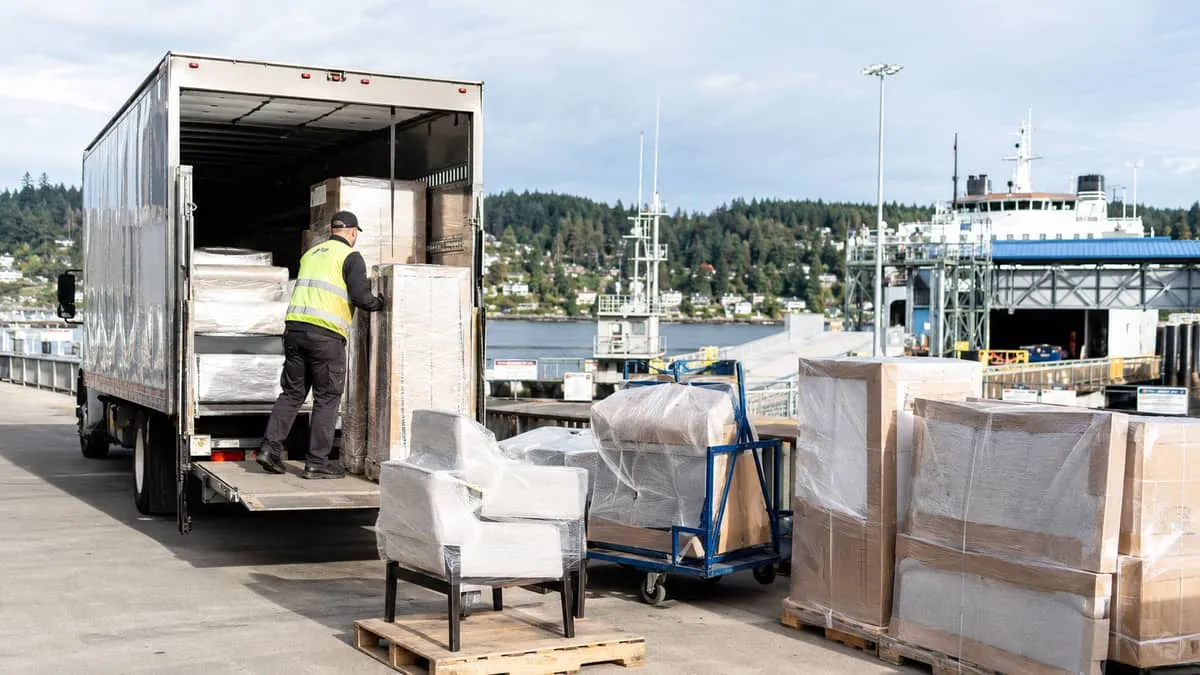
The standard approach for Victoria projects is staging. Product is manufactured and shipped to a receiving warehouse in the Metro Vancouver area , typically Burnaby or Delta , where it is inspected, counted against purchase orders, and staged for island transport. This inspection step is critical because damage and shortage claims are far easier to resolve before product crosses to the island than after. A damaged chair in a Delta warehouse can be replaced and on the next ferry. A damaged chair discovered after installation on a construction site in the Harris Green neighbourhood becomes a project management problem.
From the Vancouver staging point, consolidated loads move to Vancouver Island via BC Ferries freight service or barge, depending on volume and scheduling. A local receiving and installation company in Victoria coordinates the final delivery and handles white-glove installation if the project requires it. For heritage hotel projects where the general contractor has concurrent trades active on the site, coordinating the furniture installation window with the GC is where a local receiving company's knowledge of Victoria site conditions pays for itself.
The total lead time from purchase order to Victoria installation, for a heritage project with standard complexity, runs twelve to eighteen weeks depending on manufacturing lead times and how clean the staging inspection goes. Projects that skip the Vancouver staging step and ship direct to Victoria without pre-inspection consistently report higher damage rates and more installation-day problems. The staging cost is real but the risk mitigation is worth it.
What the Victoria Market Rewards
Victoria's hospitality visitors are a specific type of traveler. Destination wedding couples who chose the Inner Harbour for the backdrop. Retirees and affluent couples doing the British Columbia touring circuit who deliberately chose Victoria over Vancouver. Government visitors and university guests who extend their stays because the city is walkable and the waterfront is genuinely beautiful. Whale-watching tourists who booked the city because it sits at the confluence of the Salish Sea and the Strait of Juan de Fuca.
These are travelers with a taste for authenticity and a sensitivity to the difference between a property that has thought carefully about its environment and one that has not. The furniture in a heritage boutique hotel in Old Town either reinforces the property's story or it works against it. A guestroom chair that reads as generic hospitality beige in a room with original fir floors and heritage trim is a missed opportunity. A chair that was specified with the building's period and the property's positioning in mind is a detail that contributes to the guest experience even if the guest cannot articulate why.
For operators positioning themselves above the mid-market in Victoria , and the returns in this market justify that positioning for well-located heritage properties , the FF&E investment deserves the same attention as the building restoration itself. The city's hospitality infrastructure is not competing on price. It is competing on character. The procurement decisions you make for your guestrooms and your dining spaces either support that character or they dilute it.
Getting the sourcing process right in a market like Victoria means working with people who understand the specific constraints: the heritage building dimensions, the board approval dynamics, the island freight chain, and the design sensibility that Victoria's travelers actually respond to. If you're planning a heritage conversion or a boutique hotel renovation in the Victoria area, the sourcing conversation is worth having early.
Every Victoria venue has its own volume, layout, and turnaround demands, and FF&E pricing follows from those specifics. Request a quote and we will scope it to your project.