Hotel FF&E procurement in San Diego is a disciplined process with meaningful local variables that distinguish it from procurement in inland or non-coastal markets. The city's coastal salt-air environment creates material specification requirements that are non-negotiable for properties in the coastal zone. The event calendar anchored by Comic-Con International, the San Diego Convention Center's conference schedule, and Padres home games creates hard blackout windows that shape delivery and installation scheduling. And the California coastal contemporary aesthetic that defines the market's design expectations requires a level of finish and material coordination that rewards early supplier engagement.
San Diego's FF&E Market Context
San Diego's hotel market spans a wide range of property types, each with distinct FF&E profiles. The resort corridor Coronado Island's landmark properties, Mission Bay's marina hotels, La Jolla's oceanfront resorts represents the highest per-key FF&E investment in the market, with guestroom programs often running $8,000-$15,000 per key for a full renovation. These properties compete on design quality and have brand expectations that require custom or semi-custom furniture programs rather than off-the-shelf procurement.
The Convention Center-adjacent properties in the Gaslamp Quarter and East Village are predominantly full-service hotels with large meeting room inventories, which means FF&E programs include significant quantities of stacking banquet chairs, folding tables, and meeting room side seating in addition to the guestroom program. These properties renovate meeting room inventory on different cycles than guestrooms typically every 5-7 years for meeting rooms versus 7-10 for guestrooms and procurement needs to account for both programs separately.
The boutique hotel segment, concentrated in Little Italy, North Park, the Gaslamp Quarter, and the beach corridors, represents a growing share of San Diego's FF&E procurement volume. Boutique operators generally buy smaller quantities but with higher design specificity more custom pieces, more unique finish combinations, more attention to how each piece reads individually rather than as a uniform fleet. Procurement for boutique projects requires a supplier relationship built on design collaboration, not just order fulfillment.
Corporate-oriented properties in Sorrento Valley, UTC, and Kearny Mesa serving the Qualcomm campus, the biotech corridor, and the Naval Station contractor hotels run more utilitarian FF&E programs with a higher proportion of stocked catalog items and a stronger emphasis on durability metrics over design distinctiveness. Lounge chairs and sofas in these properties need to perform through extended-stay use patterns where guests are in rooms more hours per day than typical leisure travelers.
Specification and Design Coordination
The California coastal contemporary design language requires careful material coordination across the FF&E program. Bleached and cerused wood finishes, whitewash case goods, rattan and wicker accents, and linen upholstery all need to read as a cohesive palette when installed together which means finish samples and material boards need sign-off before production begins, not after goods arrive.
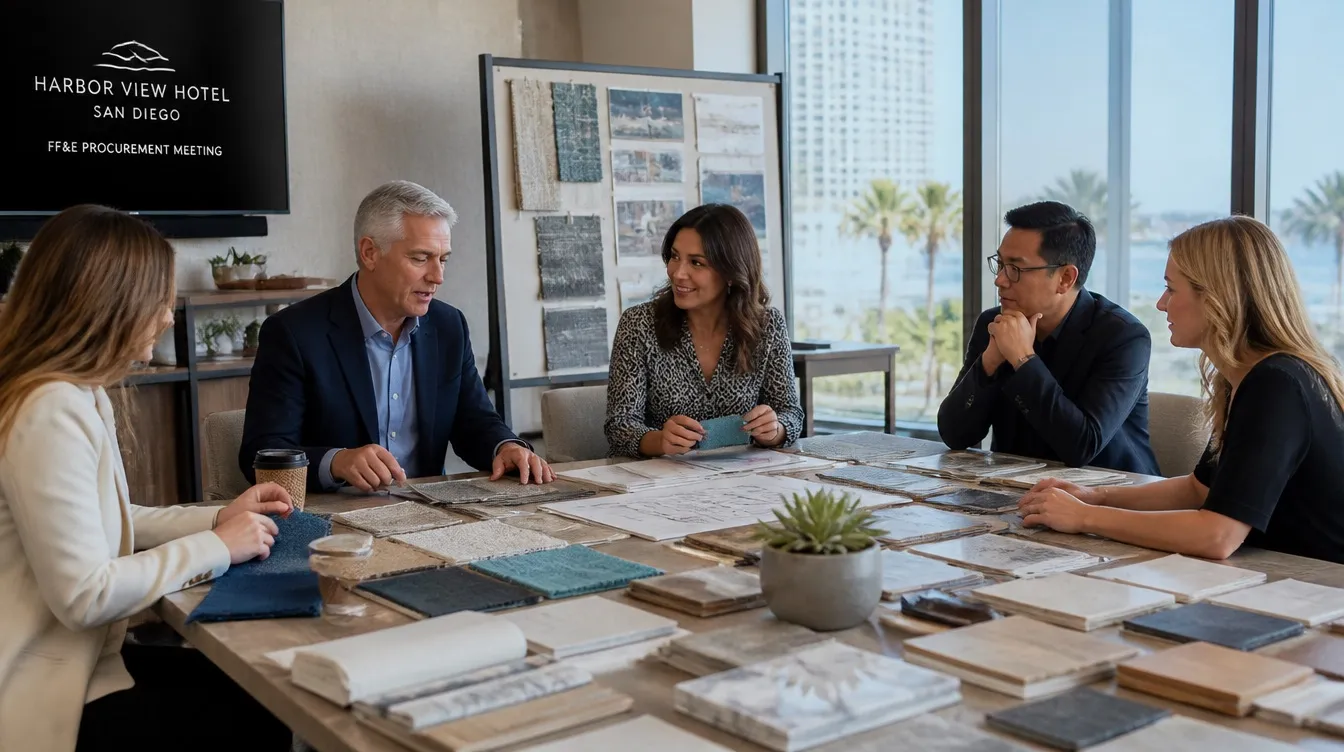
For guestroom programs, the core furniture pieces bed platform or headboards, seating group, case goods should be specified from a coordinated collection or with explicit finish matching across manufacturers. Mismatched wood tones between a headboard from one supplier and case goods from another is one of the most common and visible FF&E mistakes in hotel renovations.
For public areas and lobbies, the specification challenge is coordinating upholstered seating lounge chairs, sofas, ottomans with architectural finishes that are being selected in parallel by the interior designer. Furniture suppliers who can provide finish samples early in the design development phase, rather than only once construction documents are complete, enable better outcomes. Get fabric and frame samples into the design team's hands during schematic design if possible.
Procurement Timeline and Event Calendar Planning
San Diego hotel FF&E procurement timelines for custom or semi-custom production run 10-16 weeks from purchase order to delivery. Standard catalog items in volume are typically 4-8 weeks. Both of these timelines need to be plotted against the city's event calendar, which creates hard constraints on delivery and installation windows.
Comic-Con International, held in mid-July, fills essentially every hotel in the greater downtown San Diego area and creates the most acute scheduling constraint in the market. Any renovation project at a Downtown, Gaslamp Quarter, or Convention Center-adjacent property must either complete installation before Comic-Con week or schedule the next delivery window for after. The same logic applies to major conventions at the Convention Center and Padres playoff runs in October.
For coastal properties on Coronado Island, delivery logistics require additional planning freight routing across the Coronado Bridge or via ferry limits the size and timing of furniture shipments. Work with your supplier and the property's engineering team to map freight access routes, elevator specifications, and service corridor widths before finalizing delivery phasing.
If you are sourcing FF&E for your San Diego property, the fastest way to real numbers is to tell us what you need. Request a quote with your quantities and timeline.
Related reading
- Commercial pool furniture in San Diego
- FF&E procurement: a practical guide for hotels and venues
- What is contract furniture
- Hotel furniture supplier guide
- Hospitality furniture supplier guide
- Hotel headboards and guestroom furniture
- Lounge chairs and lobby seating
- Banquet chairs for meeting rooms
- Commercial furniture in California